Chapters
The history of ancient Rome is the most famous part of the ancient world today. Most often we associate them with a great empire, numerous conquests, a republic and an empire. When we think of the eternal city, we usually see armed legionaries, Nero or Colosseum.
Military, political and religious-cultural aspects have been elaborated on and are the subject of numerous scientific disputes and conferences. There are also issues that still await their place in history. One such topic, which is now coming out of the shadows of the past, is the situation of women. Wives and mothers of rulers, high officials and priestesses are already quite popular in historiography. However, alongside them, ordinary women also lived in Roman society. Their role was very simple – it boiled down to being a wife and mother. Married life, the question of contraception, pregnancy and childbirth, and the abandonment of babies – what was this everyday life like?
Engagement and wedding
The question of getting married in ancient Rome was a rather simple matter. Matrimonum legitimum, that is, a full-fledged marriage was concluded by a man and a woman with mutual consent. Just like today, it was preceded by an engagement. A candidate for a husband for a daughter was chosen by her father in consultation with the father of the possible son-in-law. However, unlike Greek women, Roman women had more independence when it came to getting married. The consent of the woman was especially important during the republic, but there was one condition – her will had to be unanimous with that of her father1. The wedding ceremony was not a big and grand event. Average, less wealthy citizens limited themselves only to organizing a banquet, while the richer ones could afford a larger ceremony. It was filled with songs, processions and customs, such as carrying a young bride over the threshold, wearing toga pura (traditional white dress) and croceum (saffron veil))2.
The marriage could be concluded in two ways. The first one – cum manu is a relationship in which the woman passed under the authority of her husband, while the second – sine manu left her under the care of her father3. This dependence on a male family member in the case of Roman women was limited only to a financial matter, because they could not decide and dispose of their property on their own. Over time, however, women began to gain more and more freedom in this regard. However, they enjoyed quite a lot of freedom in everyday life. Unlike Greek women, they could participate in all kinds of parties, banquets, and be members of social life. However, apart from privileges, they also had a lot of responsibilities. They looked after the farm and the house, and as mater familias, they looked after the children. One of the Roman authors, Columella, in the 1st century CE wrote about the everyday life of women: …all the trouble of managing the house belonged to the mother, as if the fathers, having left behind all troubles related to state affairs, could find rest by the fire4.
Pregnancy and childbirth
The inherent element and purpose of any marriage was to beget offspring from the rightful bed. Therefore, pregnancy and childbirth were issues that accompanied every Roman woman married, and sometimes even virgins. Willingness, sometimes necessary, to have children put a lot of pressure on the woman: not pregnant, having only daughters, and even the child’s illnesses were her fault. These reasons were enough to divorce his wife and marry another. Despite this, the greatest fear that Roman women faced at that time was the high mortality rate. It is estimated that about one in fifty women died in childbirth – the younger she was, the risk increased. Such a large number of deaths was undoubtedly related to complications – hemorrhages, blockages and infections, resulting from the level of medicine at the time. Today they are harmless. The fact that they were born in private homes at the time protected against the spread of infection5.
As of today, there were two types of birth in ancient Rome. In addition to vaginal delivery, even a Caesarean section has already been performed (note: this has nothing to do with Julius Caesar!). This procedure was performed when the woman had already died or was in a moribund state – it consisted in removing the still alive child from the mother’s dead body. It also happened that the pregnant woman could not give birth and the fetus got stuck in her body. At that time, even cruel methods were used – it was recommended to insert the knife into the woman’s body and dissect the fetus in the uterus. Of course, such a brutal procedure was not experienced by the vast majority of women6.

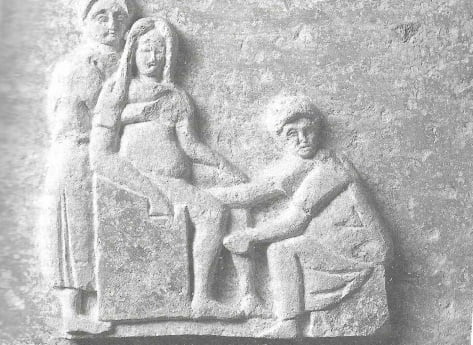
Midwives and midwives were often used. Helping pregnant women to give birth was then a much admired profession. Many of the women of this profession placed reliefs on their tombstones depicting them at work. The photo shows one of the bas-reliefs from the tomb of a Roman midwife from Ostia. A woman is at work helping a Roman woman give birth. It is worth looking at the birthing position. Chair delivery is the least painful and most comfortable. It was already used by the ancients, and today it is a practice that, unfortunately, is rarely used.
Newborn
Child mortality was even higher than that of their mothers. It is estimated that as many as half of them died before the age of ten. In addition, it happened, as in ancient Greece, that newborns were disposed of by taking them to landfills. The reasons were various: diseases, deformities, unwanted pregnancy or… sex. It is said that girls were a problem mainly for not very wealthy parents who had to prepare a substantial dowry for them7. An excerpt from a surviving letter may serve as evidence in which the husband gives his pregnant wife instructions on what to do immediately after birth: If you have a happy birth, if there is a boy, leave him, when the girl – abandon “8”]. The only salvation for an abandoned child was a slave trader. For him it was a free source of income, for this child only a chance to survive. High child mortality had a major impact on women’s pregnancies. It is estimated that in order to maintain the Roman population, each of them would have to give birth to up to six children. However, it should also be taken into account that there were sterile ladies and widows. Then this number grew to nine9.
Contraception and increasing fertility
Such a large number of potential pregnancies could terrify Roman women. The vision of premature death was also not appealing. Therefore, the women tried all methods to prevent fertilization. One hundred percent certainty was, of course, complete sexual abstinence, which probably rarely worked. For us, the methods of contraception used by the ancients may seem comical and sometimes even absurd. One of them was long-term breastfeeding10.
We find various pieces of information in the sources. Medics of that time recommended to feed the baby until it starts teething, i.e. to 6-7 months of age. The writings of Lucretius and Quintilian, who proposed to do so until the age of 3, have also been preserved! In fact, this process usually lasted an average of 18 months11. Wealthy women who placed their children in the care of nurses were excluded from this method. The other methods of preventing pregnancy were: introducing a sticky substance into the vagina, carrying small worms with you, taking appropriate herbs in the form of infusions or juices. All these methods, however, turned out to be useless at the moment when the contemporary scientists reported that the most fertile days are immediately after the end of menstruation…12.
Apart from the absurd methods of contraception, there were also superstitions intended to support already pregnant women. Contributing to them was Pliny the Elder and his Natural History, as the name says, referring to folk medicine. Among other things, he recommended wearing amulets and making gifts to protect the health of the mother and the child. During childbirth, he advised placing the hyena’s right leg on the woman in labor. It was supposed to facilitate childbirth. The left hand, on the other hand, could lead to death. In Pliny’s recommendations, one could also find various infusions, such as a drink with the addition of powdered sow’s faeces, intended to alleviate the pain associated with childbirth, as well as specific “dishes” cock testicles, thanks to which a boy was born, not a girl13.
As the above examples show, the life of a woman in antiquity was not the easiest task, and it is only a small part of their everyday life. However, there were also situations in which a woman gained power and was independent. Take Zenobia of Palmyra as an example. Even so, it should still be remembered that these were only a few exceptions, individuals. I believe that the topic of women’s history also deserves attention, as a separate section of history, showing us the long road from the ancient Roman woman to the modern woman.