Chapters
Battle of the Catalaunian Plains (451 CE) took place between the Western Roman Empire and the Huns. It ended with a victory for Rome.
Background of events
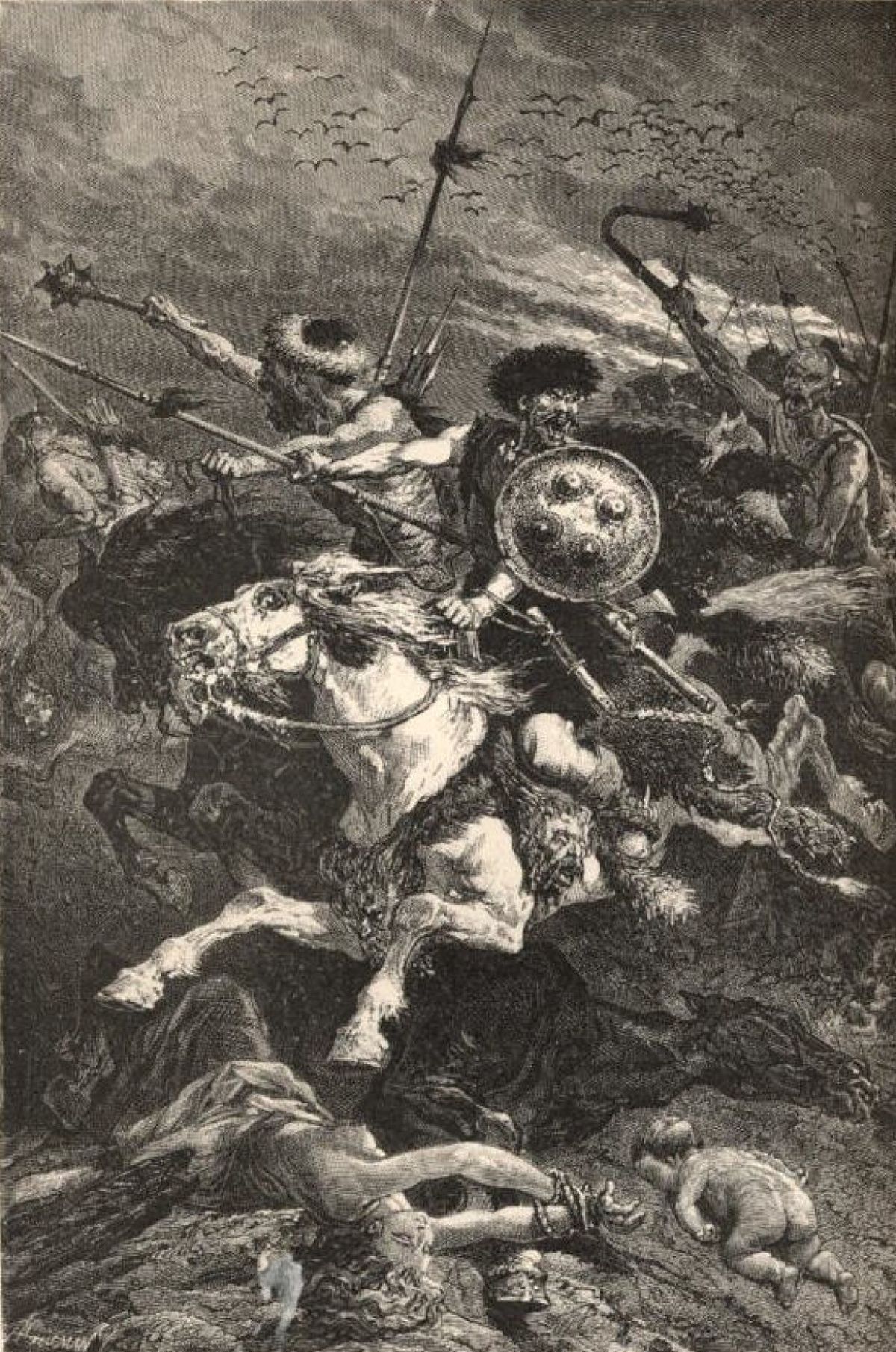
The Goths, Vandals, Suebi, Burgundians, Franks, Alans and Anglo-Saxons were nothing new to the Western Empire, which was dying out in the 5th century CE. Rome has fought more than once with Germanic tribes similar to them: Cherusci, Chaukami and Marcomanni. But the stone that moved the avalanche of migrations of peoples from the distant steppes of Asia, the tribe of Huns, was a completely new quality of warfare. It is true that the sons of the wolf had met the Scythians or the Sarmatians on the battlefield before, but these were not military events of this scale, as were the raids of new nomads.
The Huns were known to the Chinese before our era as the Hu peoples. It was against them that the Great Wall was erected. However, around the 4th century CE, the Huns left Mongolia and moved west and south. This was a characteristic principle in the history of the Great Steppe. The tribe that achieved hegemony maintained it until drought destroyed pastures for horses and cattle. Then the subordinate clans and tribes raised a revolt, forcing the existing rulers to emigrate. Thus, first the Huns, then their conquerors, Juan-juan (or Avars), and then those who defeated the Avars set out on the journey. Only the Mongols under the command of Temujin broke this cyclical regularity. Their expansion was no longer an escape for the defeated, but a perfectly organized march of winners.
The Huns split into two factions during the journey. One fell like a thunderbolt on India and Persia, the other moved westward towards the Volga and Transnistrian steppes. The Scythian, Sarmatian and Alan tribes succumbed to the Huns very easily, many of them were part of the great Orda, which was moving further towards Roman Europe.
The next dam in the form of the Ostrogothic state in today’s Ukraine and Poland was also broken very quickly. The Eastern Goths fell under the yoke of the steppe riders for several dozen years. In subduing the Slavic and Germanic tribes of Central Europe, the Huns used cruel and terrifying methods, even for those times. Mass slaughter and destruction of everything that stood in the way was characteristic of all subsequent invaders straight from the steppe. Unfortunately, exact information about this type of “activities” of the Huns has not survived, but some conclusions can be drawn on the basis of analogies with the Mongol conquests. Historians say that the steppe peoples were characterized by an extremely fierce hatred of all settled people. In the case of the Mongols, however, there is ample evidence that their famous cutting to the drawbar of a cart or massacring the population of cities with a quick and simple method (under horse’s hooves) was a pre-planned psychological action aimed at spreading panic and demoralizing possible opponents.

We do not know if the Huns were also such consummate “psychologists”, at least the panic and fear they aroused became the cause of the mass migration of the Germans. The fortified lines of the Danube and the Rhine seemed to the fleeing barbarians as a barrier that would hold back the Huns. From an early age, Rome was forced to admit entire Germanic tribes (eg the Franks) into its territory as “allies”. The invasion of the Visigoths into the Balkans, and then the Suebi, Burgundians or Herulas into Gaul, were also somehow sanctioned by giving uninvited guests some border areas.
The aforementioned invasion took place in 450 CE, the Huns plundered Germania and Gaul. Cities such as Colonia Agrippinensis (today Cologne), Magoontiacum (Mainz), Colonia Augusta Treverorum (Trier), Argentorate (Strasbourg), Divodurum Mediomatrici (Metz), Durocortorum Remorum (Reims) and others. Attila had to withdraw from the siege of Lutetia (Paris) when, according to the legend of St. Genowefa (to this day the patron saint of this city). It was said that “One virgin’s faith saved the city”.
The Huns, meanwhile, chose Panonia as their main base and from there they started devastating raids on the territory of both empires. Their attacks depopulated and led to economic ruin in many areas in the Balkans, northern Italy and Gaul. In Pannonia itself, the Huns became semi-settled. Their combat tactics have also changed significantly. Following the example of the Sarmatians and Alans, they increased the number of heavy horsemen among their troops. The appearance of a capable and ambitious ruler among the Huns, Atylli, who gained absolute power by murdering his brother, Bleda was to bring a new quality to the Hun invasions. Chaotic attacks quickly turned into organized raids. Successive tribes of Slavs and Germans paid tribute to Atylla and provided armed contingents.

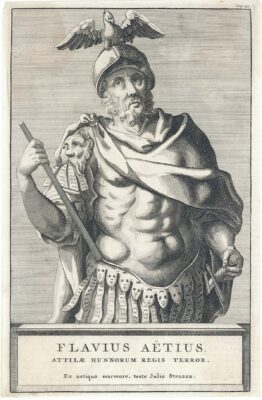
It can be called a fortunate coincidence that in the face of this deadly threat, the dying Western Empire had a man capable of withstanding Attila. Aetius, because we are talking about him of course, tradition dictates that we call “the last Roman”. Indeed, his military and political talents, ambition and energy were the final bonds of the Caesars of Milan or Ravenna. Aetius cunningly manoeuvred between the kings of his Germanic allies and the powerful latifundists, separate rulers of his estates. Aetius was greatly assisted in ensuring obedience, and as such order private army, composed primarily of the Huns.
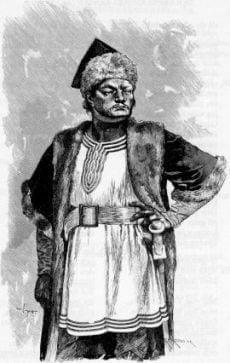
It is not entirely certain whether Aetius knew Attila personally, at least until the memorable invasion of Gaul in CE 451, the relationship of the “last Roman” with the Huns was perfectly correct. Only Attila’s ambitious plans forced Aetius to change his policy. The news of the Hun king’s preparations for the invasion acted on Gaul as “a bucket of cold water.” Faced with the common threat, the hitherto fierce opponents have stood shoulder to shoulder. The fate of the Burgundians, smashed by the Huns a few years earlier, was remembered all too well (this event was even recorded by Germanic mythology, including the song about the Nibelungen). The army that Aetius had opposed to Attila certainly did not deserve to be called Roman. It is true that a large part of it were imperial legions, but it should be remembered that for a good hundred years, Germanic mercenaries constituted the vast majority of soldiers under the sign of the Roman eagle.
After taking over the rule of Attila, the Huns moved towards Orléans, where the only bridges on the Loire were located. Orleans was then a mighty fortress, and Attila realized that a long siege would lie ahead. It was troublesome for him due to the difficulties in supplying. Despite attempts to pay for the passage, the commander of the defence, Bishop Anian, did not agree to let the invaders pass, hoping for Aetius’ reinforcements to arrive quickly. The siege began.
Catalaunian Fields (Campi Catalaunici) as her place.
Military
The Roman army was headed by Flavius Aetius, Theodoric (king of the Visigoths) and Sangiban (king of the Alans). The greatest, undoubtedly, the non-legionary contingent was brought by Theodoric. Perhaps his warriors made up about half of the allied forces. The Franks were also numerous. This jumble also included a contingent of Alans. They were those of those heavily armed horsemen who had not surrendered to the Huns many years before but had fled with the Germans to Gaul.
40,000.
The Hun army was headed by Atylla. The King of Huns went to Gaul with all the might of his empire, even more, diverse than the army of his opponents. The conquered and dependent tribes sent their warriors, of course, the vast majority of them horses. There were Huns, Slavs, Germans, and also Alans, who were to cross arms with their compatriots on the other side of the barricade. His army was probably about 60,000.
Battle

The battle took place in the Catalaunian Plains, so-called because the Celtic tribe of Katalauns once inhabited this area. The clash is also sometimes called from the early modern town – Challons. Ancient menhirs still stand on the battlefield and there were at that time. We know from sources how fierce the clash was.
The battlefield was a vast plain with the characteristic hill to the right of the Hun formation. Attila, although the first to arrive on the battlefield, makes the mistake of not taking the strategically located hill. On the left-wing stood legionaries and Clibanarii (elite heavy cavalry) and the Franks under the personal command of Aetius, on the right side the Visigoths stood. Aetius left a small detachment at his side, led by Theodoric’s son, Torisimund, who would, like a hostage, guarantee his father’s loyalty. The Alans stood in the centre. Behind them, the Roman commander additionally set up a specially designated contingent of legionary infantry so that they would make sure that the wavering allies did not run away or go over to the enemy’s side. Attila, on the other hand, concentrated the best of his forces in the centre. He was counting on his elite Hun cavalry to smash the wobbly Alans. Opposite the Visigoths stood their fellow Ostrogoths, led by Valamir, and on the right-wing stood the Gepids of King Ardaric.

The battle was started by a sudden attack by the Romans, led by Tortsimund, to capture a strategic hill. He managed to take them before the enemy troops, thanks to which he had no difficulties with repelling the Gepid attack. Furious, Attila ordered a frontal attack by the Huns on the centre of Aetius’ army. The heavy driving charge managed to shake him, but ultimately the attack broke down under a barrage of terrible axes hurled by the Franks. The Alani contingent of allies practically ceased to exist. On the wings where the Roman commander placed his best troops, fate also hung in the balance for a long time. The death of the Visigothic king, instead of breaking the morale and will to fight his warriors, awakened in them a desire for revenge. Under their furious onslaught, the wing of Attila’s army collapsed, as did the other side, where the legions were fighting.
Strangely, Aetius did not take advantage of the opportunity and did not pursue the enemy’s retreating line. He let Atylla reverse, even though he had a chance of a definitive victory. Perhaps he did not want to lose his, in a sense, ally, because when the war was over, he started to hire Huns again in his private troops.
Consequences
According to some sources, approximately 50,000 people died in the Catalaunian Plains. Historians are wary of this number but do not question it. After all, almost all the peoples of Central and Western Europe of that time clashed in the battle. The number of fighters and those who died must therefore be enormous.
Much more controversy is the assessment of the significance of this battle. Some even include it among the battles that decided the fate of the world. They argue that Aetius’ victory saved the West from becoming part of the rulership of the Huns, which were completely alien to the culture, and allowed the ancient heritage and European civilization in general to survive. This view is questioned by many researchers. Indeed, in light of the fact that after Attila’s death, his empire collapsed like a “house of cards” and the Huns simply vanished from history, it seems unlikely that the capture of Gaul would somehow extend the life of the Hun state. And even if we assume that the empire of the steppe riders would somehow survive for a few dozen or even a hundred years, the hypothesis whether they would actually be able to destroy the entire Roman heritage should be raised a big question mark. After all, it was deeply rooted in Gaul or Spain. The Franks soaked it up involuntarily and built a continuation, the next stage in the history of European civilization.
Returning to the events of 451 CE, as is well known, the defeated Atylla changed the direction of the march and entered Italy. For unknown reasons, however, he returned halfway to Rome. As the legend says – he obeyed the persuasion of the bishop of Rome, Leo the Great. A few years later he was murdered in his wooden palace in Pannonia. The same fate befell his opponent, and perhaps his friend. Aetius was murdered on the imperial order, as a result of not entirely clear intrigues, woven by powerful representatives of the senatorial state. His death robbed the Western Empire of its last glue. The power of the Caesars was limited to only a few scraps of land in Italy (because the rest were states in the state – latifundia), and Rome was burned down in the same year 455 CE by the Vandals of Genzeric. The great victory of the “last Roman” only managed to delay the official recognition of what had been a fact for decades – the fall of the Western Empire.