

Chapters
Arminius was the son of the chief of the Germanic Cherusci tribe. Although he was raised as a Roman, he rebelled against his tutors over time and dealt them with one of the greatest failures in the history of the Roman Empire – in the Teutoburg Forest in 9 CE.
Youth and career in the Roman army
[…] young man of noble birth, brave in action and alert in mind, possessing an intelligence quite beyond the ordinary barbarian; he was, namely, Arminius, the son of Sigimer, a prince of that nation, and he showed in his countenance and in his eyes the fire of the mind within. He had been associated with us constantly on private campaigns, and had even attained the dignity of equestrian rank.
– Velleius Paterculus, Roman history, II.118
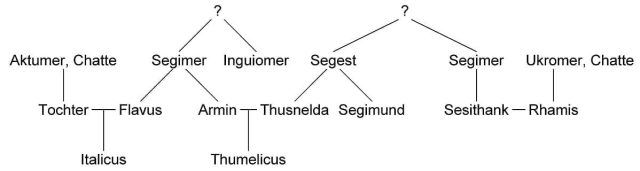
Arminius was born probably in 17 or 18 BCE, as the son of Sigimer, the leader of the Germanic Cherusk tribe, who had fought for a long time against Rome, eager to extend the influence of its reign. Ultimately, however, they were defeated and forced to sign a peace agreement with the aggressors. Sigimer also had to hand over his two sons, Arminius and Flavus, to Rome as hostages. Hostage-taking among the elite of defeated enemies was quite common practice for the Romans. On the one hand, their lives were to be a guarantee of maintaining the concluded contract, and on the other, the Romans wanted to raise the sons of the tribal aristocracy in their conditions and convince them of the superiority and power of Roman culture over any other.
So both brothers went to Rome, where they learned Latin and learned about Roman customs, war tactics, culture and the power of the Eternal City; as well as his faults, vices and weaknesses. Over time, both young men received Roman citizenship, and were also given the titles of equites and high officer ranks in Roman auxiliary divisions. In the 4th year of our era, both brothers went to Pannonia as commander of the Cherusci auxiliary cavalry units. They both achieved considerable successes and showed considerable courage, earning respect and trust among their Roman allies.
Betrayal and war against Rome




In 7 CE, Arminius returns to Germany and takes over the leadership of his tribe. The Romans at that time controlled the areas east of the Rhine, along the Lippe and Main rivers. However, they intended to expand their expansion eastward, to the Elbe and Weser and counted on the Romanized leader to rule in their way and to support all their actions. In reality, however, it was completely different. Arminius, alt