Chapters
| Name | Marcus Annius Catilius Severus |
|---|---|
| Ruled as | Imperator Caesar Marcus Aurelius Antoninus Augustus |
| Reign | 7 March 161 – 17 March 180 CE |
| Born | 26 April 121 CE |
| Died | 17 March 180 CE |
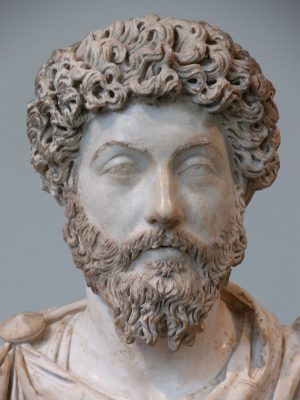

Marcus Aurelius was born on April 26, 121 CE in the south of Rome. He was one of the most outstanding and educated emperors of Rome. Due to his extraordinary interest in philosophy, he was called “the philosopher on the throne”.
Marcus came from a great family of Roman aristocrats with Spanish roots. He was the son of Marcus Annius, who died when Marcus was only 11 years old, and Domitia Lucilia. After his father’s death, he found himself under the care of his grandfather, Marcus Annius Verus, a three-time consul and prefect of the capital. He grew up on his Lateran estate. There he obtained his first valuable lessons from distinguished teachers. He received a thorough, comprehensive education.
Youth
As he came from an aristocratic family, his career was bright and he could even reach the highest state offices. From literally boyhood age, he held higher and higher positions. Emperor Hadrian drew attention to the extremely prudent, serious and hardworking boy. At the age of 8, he appointed Marcus a priest of the ancient college of Salia, priests of Mars. The boy efficiently recited from memory the prayers from centuries ago, which at that time almost no one understood anymore. Hadrian jokingly called him “the Truest” (Verissimus), probably because Marcus abhorred lies. Marcus Aurelius, at the age of 15, put on a men’s toga.
Unexpectedly on February 26, 138 CE, only 17 years old Marcus was adopted by his aunt’s husband, Antoninus Pius, the successor to Emperor Hadrian. He also became the foster brother of Lucius Verus, later co-emperor. The boy changed his name and guardian.
Having found himself in the circle of the imperial family, he continued his education under the guidance of the greatest thinkers and sages of that period. Marcus, unlike Verus’ adoptive brother, was extremely talented and clever. He studied philosophy, Greek, art, etc. He had a dozen teachers whom he never forgot. It was they who instilled in him the principles of stoicism. Marcus was very eager to learn, he was fascinated by philosophy and stoicism. He persevered in his views to the end. His philosophical studies resulted in the wonderful work of “Meditations”, which has survived to this day.

Herodes Atticus was his teacher of Greek, and Cornelius Fronton in Latin. His third master was a modest painting teacher, Diognetos instilled in Marcus “an aversion to trivialities, disbelief in what wizards and jugglers say about ordering and expelling evil spirits, no interest in the cultivation of quails and similar nonsense, and for this aroused in him” a distrust with philosophy, the art of writing dialogues from an early age, as well as a love of a straight bed covered with leather”1.
However, the most important for Aurelius’ development were the philosophers. The breakthrough as a young man came when Marcus was 20 years old. Later he thanked the gods “[…] to have written dialogues in my youth; and to have desired a plank bed and skin, and whatever else of the kind belongs to the Grecian discipline”2.
He had two masters of Stoicism:
- Julius Rusticus, who taught him how to cultivate character, protect himself from jokes, understand even enemies. He also taught writing letters and thorough reading. It was from him that Marcus received a copy of Epictetus’ lectures.
- Severus who “converted” Marcus to stoicism. It was he who showed the young student the history and fate of the great representatives of this species in Rome. Above all, he revealed to him “the concept of the essence of a democratic state with the same law for all, a state governed by the principles of equality and justice, and the essence of such harmony, which above all respects the freedom of its subjects”. The life of Marcus Aurelius as primary emperor was based on the philosophy of Epictetus.

Aurelius respected his teachers all his life. He bestowed them with dignities. And so Rusticus became his adviser, he received the consul’s office for the second time, and after his death, statues were erected for him, similarly to the Pediment. In the house chapel, Aurelius had statues of all his teachers made in gold. He also remembered about their graves where he laid flowers on anniversaries.
In 141 CE, at the age of 20, Marcus became a consul with Antoninus Pius.
As Marcus himself says, he had excellent contacts with his father who treated him like his beloved son. To strengthen this relationship, in 145 CE Marcus married Pius’ daughter, Anna Galeria Faustina, known as Faustina the Younger. Aurelius’ personal life was quite correct. He loved and respected his wife, Faustina, about whom, however, there were numerous rumours about her alleged love affairs with nobles, slaves and gladiators. During their 30 years of marriage, he had thirteen children with her, of which only one son and four daughters survived him.
Offspring of Marcus Aurelius |
|
At the will of Antoninus, the Senate, on the day of his death, March 7, 161 CE, transferred all titles and rights to Marcus Aurelius. It was widely known what a great character Marcus is. He was diligent, modest, devoted and patient. His brother was known to be a reveller devoting his full attention to feasting.
Marcus, however, to general surprise, asked that his younger brother, Lucius Verus, be appointed co-ruler. Thus, for the first time in the history of the Roman Empire, two equal people sat on the throne.
view
Marcus Aurelius loved philosophy, he became one of the most outstanding representatives of the Stoic school. His philosophical dissertation “Meditations” had a different title. The emperor called his work “For himself”, the current title was given by posterity. This work was a kind of collection of personal reflections, not intended for publication. This situation resulted from the fact that this item contained statements that were not due to the emperor. “Meditations” arose at Carnuntum and other military camps on the Danube. In the first book, Marcus expressed warm thanks to the gods that he had not been brought up long in the house of his grandfather’s mistress, which probably had “loose relationships”.
[…] I received clear and frequent impressions about living according to nature, and what kind of a life that is, so that, so far as depended on the gods, and their gifts, and help, and inspirations, nothing hindered me from forthwith living according to nature, though I still fall short of it through my own fault, and through not observing the admonitions of the gods, and, I may almost say, their direct instructions; that my body has held out so long in such a kind of life; that I never touched either Benedicta or Theodotus, and that, after having fallen into amatory passions […]
– Marcus Aurelius, Meditations, I.17
The deliberations of the ruler after many centuries still reflect his duty, modesty, seriousness, love of ancient Roman virtues and kindness to mankind. However, the emperor also retained a sceptical attitude, which had its source in the fear of the passing of time, inexorable even for heroes and distinguished husbands.
The emperor must have felt the pleasure of making love. However, he also felt a certain scepticism about the sensual side of life. In “Meditations” he noted that “body intercourse is the rubbing of the intestines and the secretion of mucus combined with spasm”. There were even rumours in Rome for years that Faustina was cheating on the emperor with vulgar gladiators, sailors and actors.
It is worth adding that Marcus’s court physician was Galen (CE 129-199), a native of Pergamon. His work, over 300 medical treatises, covers the entirety of ancient knowledge. He believed that disease is an imbalance of the four primaries that make up the human body: fire, water, earth and air. He corrected some of the misconceptions in the medical field – he described the function of the brain and spinal cord through experiments with spinal cutting in animals. He studied the circulatory system, breathing and vision mechanisms. He did not avoid mistakes, drawing his anatomical knowledge from the section of animals. He experimented with various forms of medication, from liniments to tinctures and powders at his pharmacy on Via Sacra in Rome. The name galenic preparations has remained to this day.
War campaigns

The news of the emperor’s pacifist attitude exceeded the borders of the empire and encouraged border peoples to attack the Roman state. When the war with the Parthian Monarchy came (162 – 166 CE), Marcus sent his brother Lucius Verus to the east, who defeated the Parthians without taking an active part. Aurelius himself remained in charge of the state, aware of both internal and external unrest. In Brittany there could have been usurpation, the Germanic Khattic tribe broke up across the Rhine, and in Italy itself, in 162 CE, the Tiber flooded, which brought about crop failure and hunger.
However, the situation beyond the Danube was very worrying. There was a great shift of peoples due to the procession of the Goths. Tribes pushed out of their headquarters looked for new lands, which increased the pressure on the empire’s borders, especially on the central Danube. Eventually, the Germanic tribes broke the border. When in 166 CE Marcus and his brother Lucius Verus triumphed on the occasion of defeating the Parthians, they decided to organize a campaign. Ultimately, they personally set out in the fall of 167 CE to block the way of the Marcomanni and Quadi, peoples of today’s Bohemia. Marcus Aurelius, with the help of an excellent military staff, drove the barbarians from Aquileia, and finally chased them over the Alps and the Danube.
On his return, at the beginning of 169 CE, Verus unexpectedly fell ill and died, which was a huge shock for Marcus. Even after his death, the emperor turned out to be generous, appointing him to the deities.
Aurelius was determined to put an end to the Danube threat, so in 169 CE he entered into a new, this time offensive war. The fighting in today’s Slovakia, Czech Republic and Hungary lasted until 175 CE. The defeated peoples had to give up the Romans a wide belt on the northern side of the river and agree to the presence of Roman garrisons in the interior of their countries. According to various sources, Marcus even planned to create two new provinces in the areas beyond the Danube: Marcomannia and Sarmacja, which would occupy the territories of today’s Czech Republic and Slovakia. However, these bold intentions were not realized.

“Hippocrates cured many illnesses—and then fell ill and died. The Chaldaeans predicted the deaths of many others; in due course their own hour arrived. Alexander, Pompey, Caesar—who utterly destroyed so many cities, cut down so
many thousand foot and horse in battle—they too departed this life. Heraclitus often told us the world would end in fire. But it was moisture that carried him off; he died smeared with cowshit. Democritus was killed by ordinary vermin, Socrates by the human kind”[przypis id="3"].
When the situation on the Danube was eased, the problem suddenly appeared in the east. In April 175 CE, Lucius Verus’ chieftain during the Parthian War, the main factor in the victory of the Romans, Avidius Cassius proclaimed himself emperor. Aurelius, having no choice, set off against the usurper, who was betrayed and killed. The civil war was averted.
That same year, Aurelius’ beloved wife died during his return from the campaign, which was a huge private blow to the emperor. He established a foundation for girls named after her, and the Senate recognized the deceased as a divine being and appointed priests of her cult.
In November 176 CE, Marcus made a triumphant entry into Rome because of the victories over the Danube. At the same time, he showered his son of Commodus with titles and honours that made him formally co-ruler of his father (on November 27). In 177 CE, Marcus and his son again went to the Danube against the Marcomanni to spread Roman domination. After four years of fighting, the emperor felt weak. His poor health was caused by the plague brought by the troops of Verus from the east, as it turned out.
Death
He died during a military expedition against the Marcomanni on March 17, 180 CE in Vindobona, today’s Vienna. It was a huge blow to the empire, which was passed into the hands of Aurelius’ son, Commodus. He was in such a hurry to live comfortably in Rome that he granted peace to the weakened Marcomanni and Quadi, and withdrew legions from the conquered lands beyond the Danube. Thus, the young emperor thwarted Aurelius’ achievements after years of fighting.
As Cassius Dio writes:
One thing prevented Marcus from being completely happy, namely, that after rearing and educating his son in the best possible way, he was vastly disappointed in him.
– Cassius Dio, Roman history, LXXII.35