Chapters
| Name | Lucius Domitius Ahenobarbus |
|---|---|
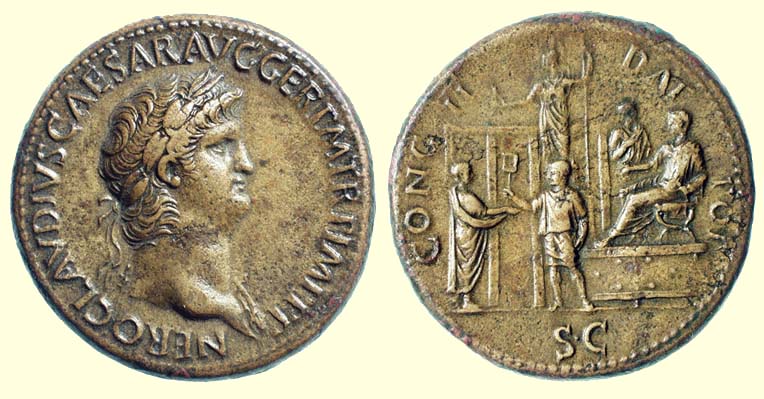
| Ruled as | Nero Claudius Caesar Augustus Germanicus |
| Reign | 13 October 54 –9 June 68 CE |
| Born | 15 December 37 CE |
| Died | 9 June 68 CE |
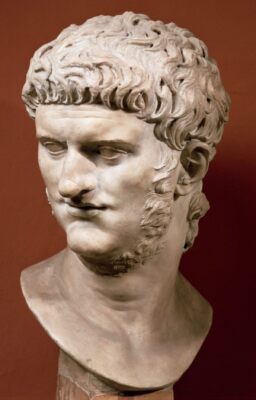

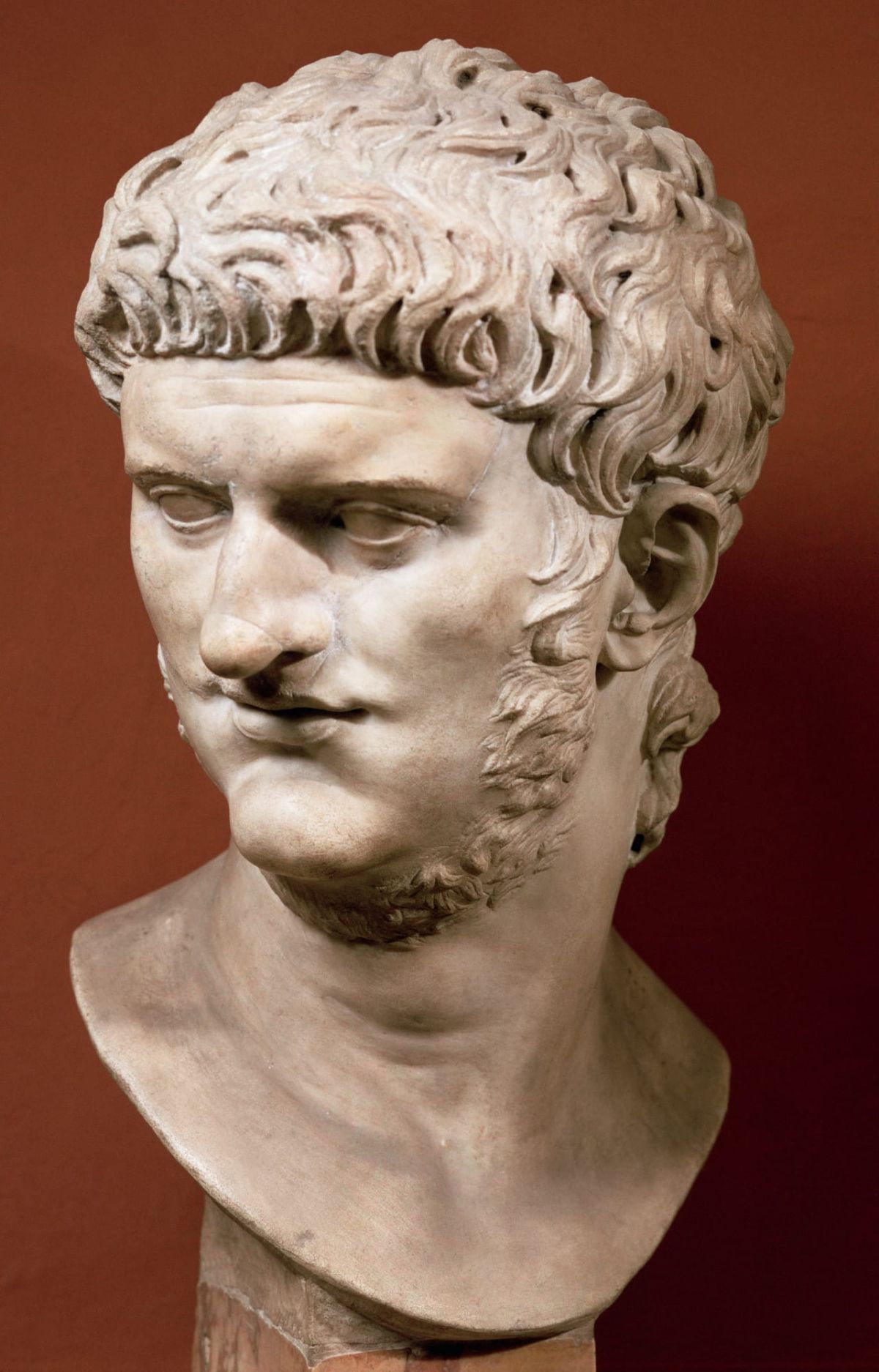
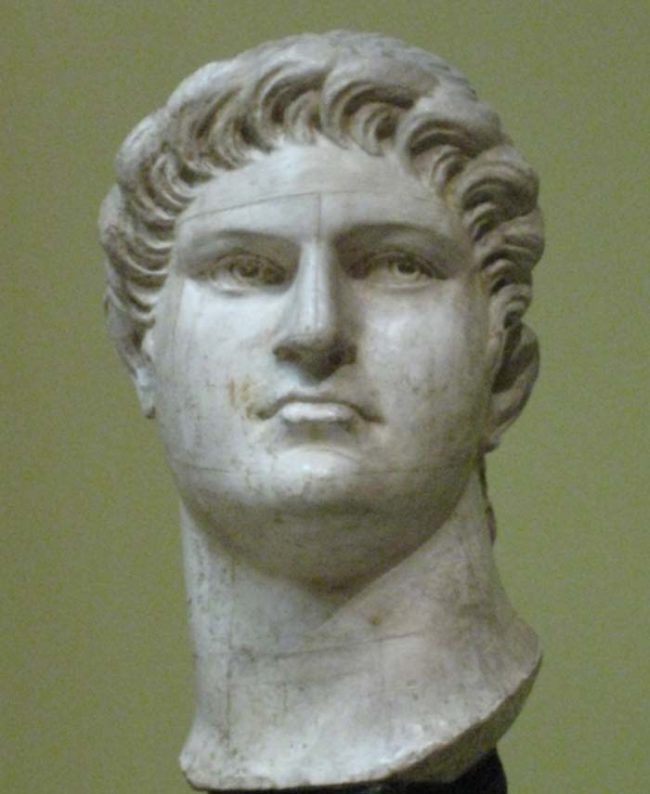
Nero was born as Gnaeus Domitius Ahenobarbus on 15 December 37 CE in Antium near Rome.
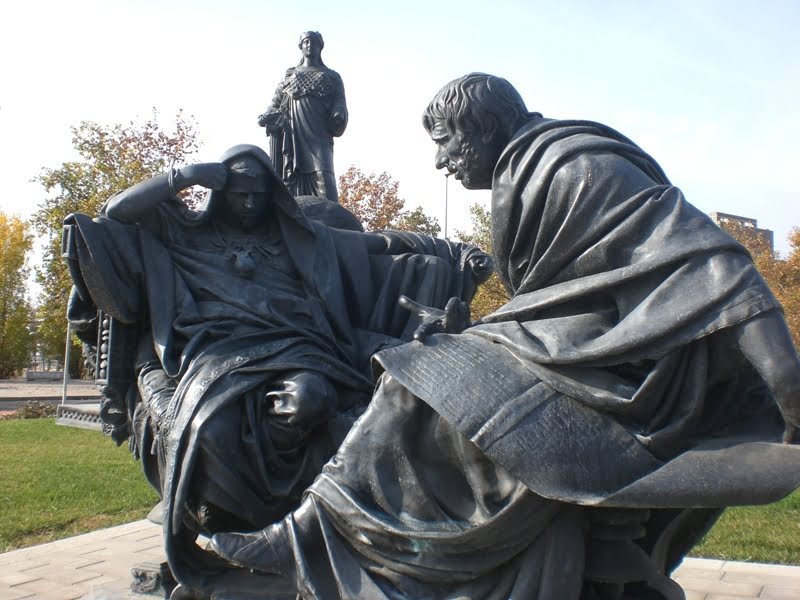
This emperor ruled as the fifth in turn and passed into history as one of the tyrants. He was the only son of Dimities Ahenobarbus (of bad reputation) and of Agrippina the Younger, daughter of Germanicus, and sister of Caligula. He was being taught by Seneca the Younger and, contrary to the generally prevailing opinion (from the historian Tacitus), he had a great talent for poetry and acting.
Early life
From early age, Nero was subjected to many ordeals. At the age of two, when his mother was sentenced to exile, he found himself under the care of an extremely severe father. Domitius is portrayed by writers as a murderer, cheater and traitor. In the age of 39 he died of hydrops and only three years old Nero was given to his aunt’s house, Domitia Lepida, where he suffered from poverty and discomfort.
The situation of Nero and his mother improved under the rule of Claudius, who immediately took the throne in 41 CE. He let Agrippina return from exile. Nero’s mother immediately began to create a new life in Rome for them. The most important goal was to find a strong man who would protect her and her son from Messalina’s wrath. That same year, she married a wealthy and witty senator, Gaius Sallustius Crispus Passienus.
Probably five-year-old Nero with his mother and his new father set off to Asia, where Salustius was nominated as the governor of western part of Turkey. The boy experienced there power and got to know the first secrets of management. In 44 CE the whole family returned to Rome, where Salustius became consul. Nero lost his father again in 47 CE.
In 49 CE the empress and wife of Claudius, Messalina, were sentenced to death. A new candidate was sought for despite the reluctance of the ruler himself. The choice ultimately fell on Nero’s mother, Agrippina.
His mother’s marriage meant that Nero went to the inner circle of the royal family and met prince Britannicus, 8 years old, every day, and two princesses: twenty-one-year-old Antonia and nine-year-old Octavia. In 50 CE Nero was officially adopted by the emperor and received a new name, Nero Claudius Caesar Drusus.
His mother, taking care of her son’s future, decided to hire a man who was supposed to be a guide, a philosopher and a friend. The ideal candidate was naturally Seneca, a good acquaintance of Agrippina. At her request, Claudius agreed to return from Corsica, from exile, a great Roman writer and philosopher. He also received the position of praetor this year. His task was extremely difficult, because he was to direct the life of a young, twelve-year-old Nero, who was a pretender for the throne. Soon, Seneca became an admired figure for Nero, like a father. The teacher taught him two languages: Latin and Greek, and engrafted him with a passion for Greek culture.
Two other teachers also watched over Nero’s education: Berillus, Cheremon from Egypt and Alexander from Aegea.
In addition to learning, Nero loved spending time surrounded by culture and entertainment. His greatest passions were theater, poetry, music, and horse racing. To these passions, the young emperor devoted himself immensely. They became the greatest enemy of Nero with time. They led him to vanity and unbounded presumption.
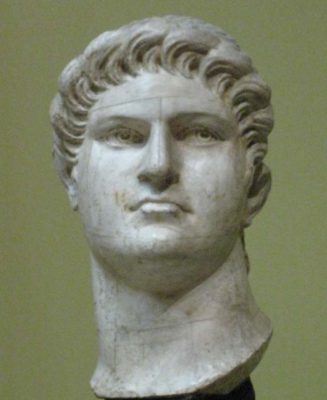
At the beginning of 53 CE, fifteen-year-old Nero made his first public speech in the Senate. Most likely, the text was written by Seneca. That same year, the emperor, who had barely recovered, agreed to Nero’s wedding with his younger daughter, Octavia. This marriage brought Nero closer to the imperial family, putting the young man on the straight road to succession.
In 54 CE Nero received full power in the capital, for the duration of Claudius’ three-day trip to a religious festival. His role at that time was to preside during court meetings and pass judgments.
When it turned out that Claudius had plans to pass the throne to his own son, Britannicus, Agrippina decided to murder the emperor and thus allow Nero to take over the throne. To this end, in the evening on 12 October 54 CE Claudius was given mushrooms poured with poison. The emperor died in the morning the next day. Agrippina kept the news about the emperor’s death for a long time, and at the same time did everything to let her son take over the power.
Emperor
Nero assumed power at the age of 17. Nero’s rule was initially controlled by his teacher, Seneca the Younger, prefect of the pretorians – Sextus Afranca Burrus, and naturally his mother, Agrippina. Agrippina had the greatest influence on Nero until the beginning of 55 CE, when Nero became a Consul. In the first years of his reign, Nero listened to the counsel of his educators. This is what Tacitus writes about:
And the general trend was toward slaughter, had not Afranius Burrus and Annaeus Seneca stepped in. These mentors of the Commander’s youth were mutually har-monious (a rarity in an alliance of power) and equally forceful by different means, Burrus in military concerns and the severity of his behavior, Seneca in his pre-cepts for eloquence and an honorable affability.
– Tacitus, The Annals
After Burrus’s death in 62 CE and the Seneca’s withdrawal from political life, Fenius Rufus and the new praetorian prefect, Ofonius Tygellinus, began to have strong influence on politics. Gains Petronius, also known as Arbiter elegantiae, also had influence on the court. Nero, surrounded by good associates and efficient administrators, ruled wisely for the first few years.

The young emperor began his reign with commemorating Claudius. Then he accepted all titles from the Senate except from one, father of the fatherland, because of his young age. In order to win the both Senate’s and people’s sympathy, Nero announced his intention to rule in the spirit of Augustus. To this end, he abolished the severe tax burden.
Nero was not interested in politics, and all decisions were made by his mother and Seneca.
He preferred to to entertain with his collegues and get into fights.This was of course convergent with the goals of Agrippina, who wanted to rule on her own.

After the death of Emperor Claudius in 54, his wife, Agrippina, called Seneca to Rome to take care of her 17-year-old son Nero.
Unexpectedly, Nero fell in love with a Greek slave, Acte. He wanted to leave his wife, Octavia, despite his mother’s violent objection. Thus appeared the first serious conflicts between mother and son. The angry son eventually deprived his mother of military guards, took her lictors and litter and threw her out of the palace. Seneca was trying to mediate between them.
In the meantime, in February 55 CE, Britannicus died. To this day, it is not sure whether it was natural death or not.
Nero began the process of strengthening his power. He removed Pallas, a good acquaintance of his mother from the post of the imperial estate manager, and then imprisoned him. The Emperor began to make accusations against everyone around him, starting with Seneca and Agrippa, ending with Burrus.
In 58 CE Nero fell in love with Poppaea Sabina, the wife of his friend and later Emperor, Otto. Poppaea took the place of his former mistress, Acte. His wife, Octavia, as well as her mother, who would certainly not approve a new marriage, stood in the way. Nero went as far as murder, ordering to assassinate his mother in her private palace in March 59 CE. The next victim was Octavia. Anicetus, the fleet commander at Misenum, pleaded guilty to adultery with the emperor’s wife. He was rewarded with being sent on a nice island where he lived in wealth to the end of his life. Octavia, however, was sentenced to death. Nero, thus, could marry Poppaea without any problems in January 62 CE.

The emperor was less interested in politics from day to day. During the day he played the lute, he sang, he was driving chariots, leaving state affairs in the hands of his advisers: Seneca and Burrus. In 60 CE the emperor established so-called “Neronian games”, contest that was to take place every five years. “Neronian games” combined, for the first time in the history of Rome, in imitation of Greek contests: music, gymnastics and horse-riding. The first such event took place in Pompey’s theater, and the winner was naturally Nero himself.
In the course of time, Nero was no longer satisfied with showing off only in Rome. He wanted to perform and present his talents also in other countries. And so in Olimpia he organized music competition, against the custom.
After Burrus’s death, Seneca’s position in Nero’s eyes decreased so much that he preferred to leave the palace. However, this did not prevent him from being accused of participating in a conspiracy against Nero’s life, who at that time was already greatly disgusted with Seneca and sought opportunity to get rid of this uncomfortable witness of his crimes. Finally in 62 CE Seneca, being accused of malversation, was expelled from the court. Three years later, in the year 65 CE, after a decade, Seneca was visited by a group of soldiers who gave him the death sentence issued by Nero. Tacitus writes about Seneca’s reaction to this verdict:
The latter, unafraid, demanded the tablets of his will and testament; and, on the centurion’s refusal, he turned to his friends and testified that, since he was prevented from rendering thanks for their services, he was leaving them the image of his life, which was the only thing—but still the finest thing—he had; if they were mindful of it, men so steadfast in friendship would carry with them the reputation for good qualities. At the same time, partly by conversation and partly in the more intense role of a reprimander, he recalled them from their tears to fortitude, asking repeatedly where were the precepts of their wisdom? Where, after contemplating it for so many years, was that reasoning in the face of loom-ing adversity? For who had not known of the savagery of Nero? Nothing else remained, after the killing of his mother and brother, except that he should add the execution of his tutor and preceptor.
When Seneca had spoken such words as these as if for general consumption, he embraced his wife and, softening for a moment in the face of her manifest alarm, + asked and begged that she should moderate her pain and not accept it for ever, but, by reflecting upon a life lived in virtue, she should use this honor-able consolation to make tolerable the loss of her husband.– Tacitus, The Annals
Self reign
Without Seneca’s supervision, restraining his extravagance, Nero began to act according to his own whims. His extravagant surrounding, increased war expenses (wars with Parthia in the 60s), new praetorian prefect, Tigellinus, frowning over Nero’s most ridiculous ideas, caused the deterioration of the state’s economic condition. The resumption of trials for lese-majesty, death sentences and the confiscation of property in favor of Nero made the emperor less and less popular. In addition, the Senate, concerned about Nero’s dangerous power, still remembered his promise from 54 CE, when he mentioned that he would give the Senate a greater power. These factors influenced the creation of so-called the Pisonian Conspiracy in 65 CE which aim was to assassinate Nero. It was commanded by a senator, Gaius Piso. The conspiracy eventually did not work out, as one of the conspirators and the closest advisors of the emperor, Fenius Rufus, betrayed his companions. The conspiracy was crushed by the pretorian prefect, Ofonius Tigellinus. Gaius Piso was forced to commit suicide. Other people who had to die as they were accused of taking part in the conspiracy were Lucan, Rufus, Seneca and Gaius Petronius.

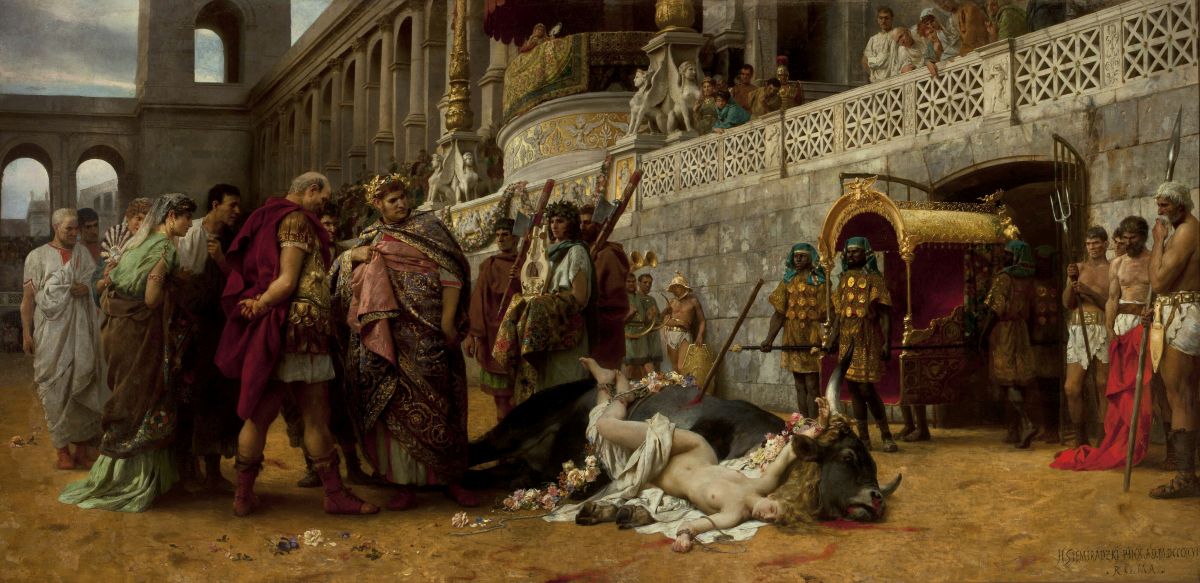
However, even before the attack, in 64 CE, one of the biggest fires in Roman historytook place. Nero, as he had arrived in Rome, watched the fire with interest, destroying the capital of the empire. Many people claimed that he initiated it. According to the legend, he was forced to find the culprits because of those rumors. And found in the person of Christians. Romans were rather hostile towards Christians as they were accused of poisoning the wells and acting to the detriment of the Romans. Many Christians were supposed to be caught then, who then died in arenas or crosses. According to Tacitus, Nero, in order to take the suspicions off himself, accused the Christians living in Rome, which caused this bloody repression. Suetonius recalls these repressions: “They were punished with tortures, the believers of a new and murderous superstition.”
After the fire, on Nero’s orders and according to his plans, the capital was being rebuilt. From 64 to 68 CE one of the emperor’s largest designs was erected, the luxurious Nero Palace on the Esquiline, called the “Golden House”. Due to the high costs associated with eg. lavish décor, the project was never completed.

The fact of building the palace on the scorched ground caused suspicions, spread by the hostile group in the Senate, saying that Nero would order to set on fire. This is probably not true, because then Rome used to burn frequently, which was related to the way the buildings were built. The greatest fire of Rome of that time took place during the reign of Octavian Augustus, however, the one from the time of Nero was more memorable because of the hostility towards the ruler on the part of both aristocracy and later also Christian authors.
The undeniable merit of Nero was designing a new city plan with wide streets, large spaces between buildings and the obligation to have fire fighting equipment in every large tenement house. This had not existed before and was forgotten, as this fire was seen as the largest, the last of the great, because later the city was better prepared for this type of disaster.
Emperor Nero at the end of 65 CE found a new lover, Statila Messalina, the wife of Marcus Julius Vestinus Attica. At his order, her husband was executed without accusation and trial so that he could marry her at the beginning of the year 66 CE. Statilia was his third and last wife.
Conspiracy and death

Nero’s despotism caused more and more dissatisfaction. In addition, there were numerous alarms within the empire’s borders. In March 68 CE Vindex, the administrator of the province of Gaul Lugdunensis, rebelled against the emperor, as he opposed new fiscal policy. However, the rebellion was crushed and Vindex died.
In Judea, on the other hand, there was an open Jewish uprising in 66 CE against Roman domination. Nero, after a number of Roman defeats, decided to send in the rebellious region Vespasian, later emperor. Finally, the son of Vespasian, Titus, managed to deal with the situation and got Jerusalem in 70 CE.
The Senate, concerned about Nero’s despotic reign, decided to proclaim Galba, the governor of the province of Hispania Citerior, the new emperor in 68 CE and to recognize Nero as a public enemy. From that moment, every Roman citizen had the responsibility to kill the former Emperor. Abandoned even by the praetorian guards and betrayed by close associates, Nero committed suicide. His last words were: “What an artist dies in me” (Qualis artifex pereo!).
He died on 9 June 68 CE in Rome. His death meant the end of the Julio-Claudian dynasty. After his death, it was speculated that the emperor only pretended to commit suicide in order to escape the executioners. His grave was worshipped, flowers were laid on it. Several times appeared pretenders claiming to be Nero. This fact suggests that Nero was in fact liked and valued by the lower classes of the society, since the pretenders counted on the response of both the legions and among the society, and what is more, to a certain extent their expectations were fulfilled.
Marriage and offspring |
|