
Chapters
| Name | Flavius Valentinianus |
|---|---|
| Ruled as | |
| Reign | 25 February 364 – 18 November 375 CE |
| Born | 3 July 321 CE |
| Died | 18 November 375 CE |
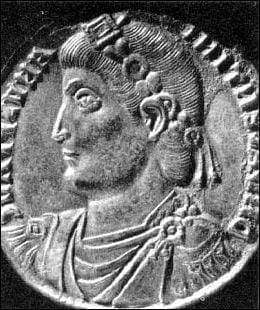

Valentinian came from Pannonia. He was the son of Gratian, most likely from the lower ranks of a military commander. Gratian served as the emperor’s bodyguard and rose to the rank of tribune. Then he was given the title of comes and the position of commander of the troops of the diocese of Africa. After falling out of favour for a short time, he left the scene, then returned as the commander of the troops in Britain. He was deprived of all his property for hosting the usurper Magnentius in his home in Pannonia.
Valentinian, Gratian’s eldest son, following his father’s example, joined the army, where, at least in the initial period, he benefited from his father’s protection. During Caesar’s Gallic campaigns, Julian was already a tribune in the legion of choice. In 357, a major operation was conducted against the Alamans, with Julian in command in the north and Barbacj in the south. Julian sent Valentinian and a second officer to the area of the Barbatio’s troops to find out what was the reason for the inactivity of the latter, enabling the barbarians to sneak out of the prepared cauldron. However, the officers were driven out, and Barbacjan himself accused them before Constantius II of inciting his soldiers. The emperor relieved both of them from service.
Valentinian was restored to service with his former rank in two years and transferred to Mesopotamia, which had been disturbed by the Persians. Soon he was given the title of comes, and then the rank of tribune in the troops of Constantius II. He served in the army even after the death of Constantius, certainly enjoying at least initially Julian’s favours, but as part of removing Christians from the emperor’s immediate entourage, he was most likely sent to Egypt. Some Christian historians have claimed in their accounts that he has left the service, but it seems unlikely.
After Julian’s death and the election of Jovian as Augustinian, Valentinian returned to favour and, together with the Emperor’s father-in-law Lucylian, set off for Milan, from where they headed for Gaul, where they were to guard the peace. Soon there was a revolt of soldiers in the Durocortorum Remorum, during which Lucylian was killed. Valentinian managed to escape, which allowed him to enter Jovian’s court in Asia Minor. The emperor, in gratitude for his loyalty, appointed Valentinian schola secunda scutatorum (commander of the second formation of shield bearers).
Reign
When Emperor Jovian died on February 17, 364, the army marched to Nicaea. There, during a conference of commanders and civil dignitaries, it was decided to entrust the purple to the absent Valentinian. He was in Ancyra at that time but arrived immediately – on February 22nd. However, he did not reveal himself immediately, since the beginning of his reign would be on February 23, and the year 364 was a leap year in Rome, and that day was counted twice. Valentinian, despite the fact that a Christian was a very superstitious person, and the twenty-third days of February in leap years were considered unhappy, therefore he wanted to avoid bad omen at the beginning of his reign and finally took the reign only on February 25.
He reigned as Emperor Caesar Flavius Valentynianus Augustus. At the time of his election to the throne, he was married to Marina Severa and had a son, Gratian, born in 359.
The first day of the reign of the new emperor began with hailing him as August, handing out a purple cloak and putting on a diadem on the podium, in front of the troops. Then, like Julian the Great four years earlier, he was raised on a shield. When the emperor was about to deliver the speech, the assembled troops drowned him out, demanding that a co-regent be chosen right away. Such behaviour was explained by the experiences of recent years, when the death of Julian, and later Jovianus, put the Empire in a state of danger. It seems, however, that this speech was not accidental, and was inspired to prepare the ground for the appointment of Valens as co-ordinator. Meanwhile, Augustus criticized the soldiers for their lack of discipline and announced that he would soon appoint the appropriate person as co-ruler. Ammianus Marcellinus in his work recalled the words in which the new Augustus thanked him for entrusting him with this honour, “I am glad, bravest defenders of the province, and I am proud and will always be proud that it was thanks to your courageous attitude that I received the helm of power over the Roman world as the most suitable person, although I neither expected nor pursued it”.
Valentinian called a council of civil and military dignitaries and asked them who he should choose as co-ruler. Everyone was prudently silent, and only Dagalaiphus, the chief of the cavalry, dared to say, “If you love your own, best emperor, you have a brother, if you love the state, look for someone to wear purple”. We know these words thanks to Ammianus Marcellinus. Thanks to his message, we also know that the emperor did not respond to this opinion, but whether he loved the state or his family more was shown by subsequent events.
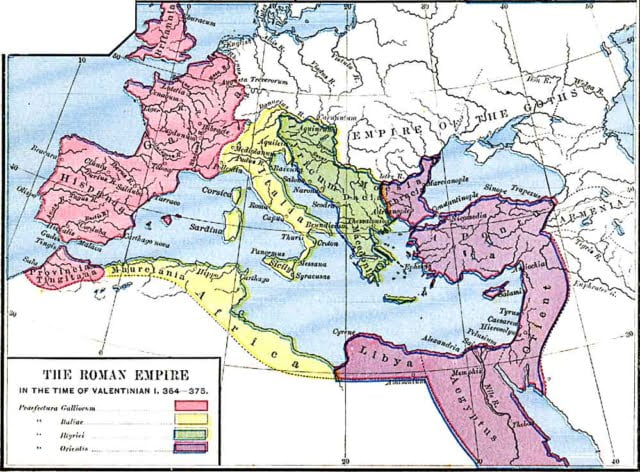
On March 1, 364 in Nicomedia, Valentinian appointed his brother Valens as the tribune of the stable. Then, a month later in Constantinople, a military rally was called, during which the emperor proclaimed his brother Augustus, covered him with purple, and put a tiara on his head. However, it was not until April 364, during a meeting in Naissus, that the rulers divided the empire and the army between them. Valentinian took the west, along with the African and Balkan provinces (excluding Thrace), and Valens east, with Thrace and Egypt. The court and the civil administration were also divided, after which the brothers split up in Sirmium. Valens later became famous for his morbid suspicion, the result of which was the bloody persecution of pagans, and, consequently, of educated people (at that time, the vast majority of educated Romans were still faithful to traditional religion) and the burning of books. The beginning of the next year was announced by the brothers taking over the consulate. Valentinian celebrated this event in Milan and Valens in Constantinople.
Soon after their meeting in Naissus, the rulers fell rapidly ill, struck down by an attack of fever. When they came to their senses, they concluded that the most likely cause of the disease was magic practised by some of the great Julian’s old followers. The task of detecting the perpetrators was entrusted to the head of imperial offices, Ursacius, whom Ammianus recalled as a “vulgar Dalmatian”, and to Viventius of Syscia, who held the office of quaestor. Despite all efforts, no confirmation of the secret frauds of Julian’s friends could be found and the matter was forgotten. According to Zosimos, a Roman historian from the turn of the 5th and 6th centuries, the dangerous situation was remedied thanks to the “sharp mind” of the prefect of the praetorium of Sallust.
In defence of the borders of the Empire

The situation of the Empire had worsened in recent months. The death of Julian, the conqueror of the Alamanni, made them shake off their fear caused by the very name of this great Roman commander, and they successfully struck the border on the Rhine and Upper Danube, attacking Gaul and Retia. It was not better on other sections of the border – the Middle Danube was crossed by the Kwadas and Sarmatians attacking Pannonia, the Saxons, Scots and Picts harassed Roman Britain. It was also disturbing in the African provinces, where nomadic tribes ventured into Roman farmlands. This was the situation in the territories subordinate to Valentinian, but the eastern border was also under threat, so the emperor could not count on his brother’s help.
The Alamans in January 365 dealt a painful blow to the Romans, smashing the army of two comes Charietton and Severian, trying to block their way, killing both commanders and killing a significant part of the army.
At the end of the summer of 365, Valentinian set off for Gaul, taking the route to Lutetia Parisiorum. While still on the way, the emperor received information about the usurpation in Constantinople of Comes Procopius, a relative and associate of the great Julian. However, not knowing whether Valens was still alive or had already been killed, he decided that he would continue his march towards the border. After a short stay in Lutetia, the emperor moved his headquarters to the Durocortorum Remorum, closer to the expected threat.
As early as January 366, three great packs of Alamanes crossed the frozen Rhine and plunged into Roman lands. The sluggish actions of the Roman leader Dagajalf led to his dismissal by Valentinian, the vacancy was taken by the head of the cavalry, Jovinus. It was him who managed to defeat the separated Alaman packs in three separate battles in the spring, thanks to which the threat was temporarily averted.
The refusal of the Alamans was not the only good news for Valentinian in 366, shortly afterwards he received the severed head of the usurper Procopius as a gift from his brother.
In the winter of 366/367, the emperor fell ill. He was at the Durocortorum Remorum at the time. His surroundings were convinced that the Emperor’s death was imminent. The situation seemed so serious that the search for a successor began. In the course of these events, a strong dislike of the emperor and his relatives, even in close vicinity, was revealed. It was the result of the cruelty that characterized Valentinian. To everyone’s surprise, however, the Emperor recovered. However, he learned from this incident and clearly indicated a successor: in Samarobriva Ambianorum he recommended his nine-year-old son Gratian to the army, who has proclaimed Augustus on that occasion.
The situation forced the emperor to stay in northern Gaul. The Franks and Saxons harassed the Gallic and British coasts with constant sea attacks. To the island, Valentinian sent Jovinus, because the situation there was not good. Bloody riots in Rome, between hostile Christian parties, bypassed the emperor.
The winter of 367 and 368 found August in Trier, from where he led an expedition across the Rhine in the summer. He managed to defeat the Alamans in a major battle near Heidelberg, then, devastating the lands on Nekar, he stopped on the Lower Rhine. Probably there he received the alarming news from Britain, in which the populations oppressed by dishonest officials and inept administration revolted, and desertion was spreading in the military branches. The horror of the situation was intensified by external factors – attacks by the Saxons and Franks on the coast and the Caledonian tribes through the Hadrian’s Wall on Roman territories. As Jovinus was unable to deal with the crisis, Valentinian sent an officer from Spain to the island of Theodosius (the father of the later emperor of the same name). It took him two years to get the situation under control, displace the barbarians, re-fortify the border at Hadrian’s Wall, reform the administration and fortify the coast. After his return, in recognition of his merits, the emperor appointed him the head of the cavalry.
In the course of the hostilities, the emperor probably crossed the Rhine twice.
To strengthen the border on the Rhine, Valentinian decided to build a huge line of fortifications along the river, composed of various interconnected fortifications. This network was significantly developed in-depth and stopped the aggressive aspirations of the Germans for 30 years. The border defence was additionally strengthened by the alliance with the Burgundians.
Empress Maryna Severus, the mother of August Gratian, probably involved in the property scandal, was sentenced to exile by Valentinian. After dismissing his first wife, in 370 CE, the emperor married Justyna, widow of the former usurper Magnentius, popular in Gaul, who, defeated by Constantius, committed suicide in 353. Justyna, apparently of extraordinary beauty, was a follower of Arianism (and Valentinian favoured the Nicene creed). This relationship resulted in the birth of four children, one son and three daughters. The son is known to us as the future Emperor Valentinian II, and among his sisters, only Galla Placidia is recorded in the history books (the other two are Justa and Grata).
While remaining in Trier, Valentinian was active in the field of legislation, regulating, inter alia, the status of students of the Roman university.
Mutiny in Africa
Meanwhile, a revolt of mountain tribes broke out in Mauritania. Worse still, the rebels were supported by poor strata of the population in areas where the latifundia of great landowners dominated. The population was reluctant to power due to heavy tax oppression and gross abuses perpetrated by Roman officials, especially Romanus – the commander-in-chief of Roman troops in Africa. The communities revealed their grievances before the emperor, but usually, instead of punishing the perpetrators, it only resulted in additional repressions against the oppressed population. A revolt threatened a wealthy North African city. The situation was further exacerbated when the leader of the rebellion – the prince of one of the Firmus tribes, was hailed as Augustus by two auxiliary formations of the Roman army!
Firmus skillfully played disputes within the African church, presenting himself as a supporter of the Donatists, who enjoyed great support among the masses of the poor. Soon the rebels were in the hands of a large part of Mauritania and a large part of Numidia, even Caesarea surrendered to them.
To deal with the crisis in 373, Valentinian sent Theodosius, the recent winner from Britain, to Africa. He did so in two years. The armies of the rebels were defeated, the population was calmed down, among other things, by the arrest of Romanus, and Firmus committed suicide. Theodosius covered himself with glory again. However, he did not enjoy it for long. He was killed in 376.
374 brought another blow to the Western Empire. Taking advantage of the relocation of a significant number of troops to Africa, the Kwadas and Sarmatians crossed the Danube and flooded the territories of Roman Pannonia. Only walled cities defended themselves. It was miraculously avoided by the barbarians, Constancia, the daughter of Constantius II, who was on her way to Trier at that time. Only the army of Moesia, commanded by the young Theodosius, the son of a leader fighting in Africa, put up effective resistance to the Sarmatians.
Valentinian had to react. In 375 he left Trier, headed by an army to Sirmium and then to Karnuntum. Getting to know the scale of the evil actions of Roman officials and commanders in Illyria in this great military camp, he punished many with death. Then he went to Aquincum, from where the army crossed the pontoon bridge to the other side of the Danube, sowing death and destruction in the lands of the barbarians.
Death
After the end of the operation, the army went to Sawaria to lay the hare there in winter. On the way, in the town of Brigetio, the emperor received the Qadian envoys. During the listening session, his anger rose sharply, then became speechless, his face turning purple, and profuse sweating. Moved into the bedroom, he tried to say something, but to no avail. There were no doctors, at that time they were in the wards where the plague was spreading. He soon died on November 18, 375.


