
Chapters
| Name | Titus Flavius Vespasianus |
|---|---|
| Ruled as | |
| Reign | 1 July 69 – 23 June 79 CE |
| Born | 17 November 9 CE |
| Died | 23 June 79 CE |

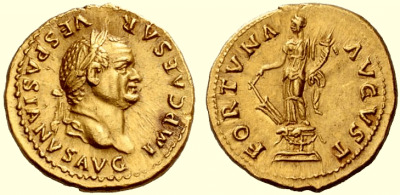
Vespasian was born on November 17, 9 CE in Falacrinae (northeast of Rome) as Titus Flavius Vespasianus. He was the son of Titus Flavius Sabinus (I) and Vespasia Polla and the younger brother of Titus Flavius Sabinus (II).
Background and career
Paternal grandfather – Titus Flavius Petro – fought at Pharsalus in 48 BCE in Pompey, as a centurion. Vespasian’s father was a tax collector (the so-called fortieth tax – quadragesima, which was a port tax) in Asia. In those cities, he has been even erected monuments with the signature “Reliable collector”. Later he dealt with interest loans in the Helvetian country (present-day Switzerland), where he died. He also had a daughter who died once she was less than one year old.
Vespasian’s maternal grandfather became camp prefect and her brother became a senator.
Vespasian was from the equine layer; So he had no guaranteed offices or property. He had to work hard for his position and at every step, he had to prove that he was worthy of high positions. Interestingly, Suetonius gives a parable that in the Flavian family there appeared a sign about the destiny of the three children of Flavius Sabinus and Vespasia:
On the suburban estate of the Flavii an old oak tree, which was sacred to Mars, on each of the three occasions when Vespasia was delivered suddenly put forth a branch from its trunk, obvious indications of the destiny of each child. The first was slender and quickly withered, and so too the girl that was born died within the year; the second was very strong and long and portended great success, but the third was the image of a tree. Therefore their father Sabinus, so they say, being further encouraged by an inspection of victims, announced to his mother that a grandson had been born to her would be a Caesar. But she only laughed, marvelling that her son should already be in his dotage, while she was still of strong mind.
– Suetonius, Vespasian, 5
Vespasian began his career as a military tribune and quaestor. He earned his credit in the invasion of Britain for the reign of Claudius (final phase – 1940s I century CE), which was remembered and opened the way for him to the office of consul in CE 51. After his term in office, he became governor of Africa. Neroentrusted him with a very difficult task. He was about to end the the uprising in Judea which had lasted from 66 CE. In 68 CE he re-conquered all of Judea except Jerusalem. Jerusalem was not conquered by his son until his reign in CE 70. From the moment of the conquest of Judea, a Roman legion would always be stationed in the province, and Judea itself became the new Roman province.
Vespasian’s wife was Domitilla the Elder, with whom he had 3 children: Titus, Domitian and Domitilla the Younger. His wife was the daughter of Flavius Liberalis, a quaestor scribe from Ferentium. Originally she was the official mistress of one of the African princes, and then around 38 CE she became the wife of Vespasian.
Year of the Four Emperors
After expiration, with the death of the Nero (June 9, 68), dynasty Julio-Claudianthe so-called Year of the Four Emperors in which they competed for power Galba, Vitelliusand Othon. Initially, Vespasian did not take part in the succession struggle. However, when Otho committed suicide on April 25, 69, and in July of that year Vitelliusmurdered his rival’s centurions in Rome, the situation forced the elite in the East to react. These shameful events encouraged the prefect of Egypt, Tiberius Julius Alexander, and the governor of Syria, Gaius Licinius Mucianus, to propose Vespasian, the commander of the troops suppressing the uprising in Judea for the Roman throne. It was the prefect of Egypt who proclaimed Vespasian the emperor, starting a further competition for power. Vespasian was also sworn by the rulers of the neighbouring states.

In early July 69 CE Vespasian was elected emperor by his legionaries in Alexandria. His title was soon confirmed by the legions in Moesia, Pannonia and Illyria. Vespasian personally focused on securing the grain supply and seizing Egypt when his armies under Mark Antony Primus attacked Italy from the North East. The battle of Bedriacum was victorious, Cremona was seized and the siege of Rome began.
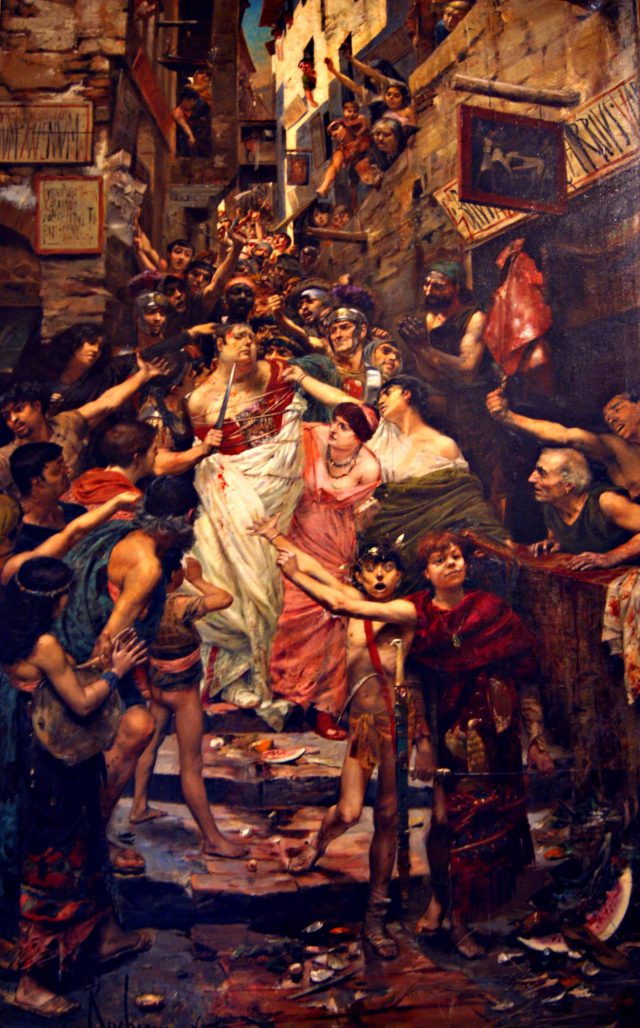
At that time Vitellius made a deal with Vespasian’s brother, Flavius Sabinus (Prefect of Rome). According to it, he was to save his life in exchange for a hundred million sesterces. He then made two public statements about his resignation from the throne. However, at the urging of the praetorians, he repeatedly took up his spirit and took up the fight against Flavius Sabinus and the followers of Vespasian in the city. Eventually, the city was conquered, and Vitellius was tortured and thrown into the Tiber on December 22, 69 CE at the age of 54. A fire burned down the Capitol and Vespasian’s brother was accidentally smashed by the crowd.
Emperor
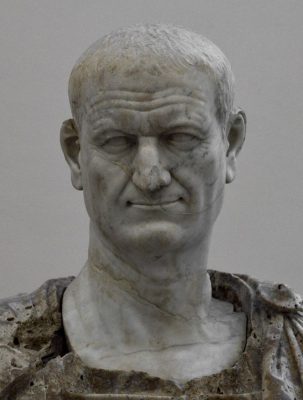
Taking power
The Roman Senate recognized Vespasian as emperor on December 21, 69 CE, while he was still in Egypt. During his absence, the power was exercised by Mucianus, who carried out tax reforms to repair the budget. Vespasian, after losing his brother, sent his younger son Domitian (Titus was suppressing the rebellion in Judea at that time), who was to oversee Rome on his behalf.
The ruler was known for his sense of humour, which he often expressed in short sentences. To his son Domitian, who freely represented his rule in the ruler’s absence, he wrote in a letter: “I thank you, my son, for permitting me to hold office and that you have not yet dethroned me”1.
In addition to introducing the reform, stricter checks on the treasury and public spending were ordered.
Strengthening power
Vespasian as the new emperor came to Rome in July 70 CE. He officially handed over the army besieging Jerusalem to his son Titus, who soon conquered the city and destroyed the temple of Jerusalem. The remnants of Judean insurgents still defended themselves in Masada until CE 73. Faced with defeat, not wanting to be captured by Rome, the defenders of Masada committed mass suicide.
In order to secure and legitimize power, Vespasian announced an amnesty to those accused of offending majesty and handed over awards, especially to the army. Troops loyal to Vitellius were either disbanded or punished. Amendments were also made to the senatorial and equestrian status – many of Vespasian’s supporters became senators and equites. In order to strengthen the rule, writers, incl. Suetonius reported miraculous phenomena to herald the reign of Vespasian.
Later, when Vespasian was aedile, Gaius Caesar, incensed at his neglect of his duty of cleaning the streets, ordered that he be covered with mud, which the soldiers accordingly heaped into the bosom of his purple-bordered toga; this some interpreted as an omen that one day in some civil commotion his country, trampled under foot and forsaken, would come under his protection and as it were into his embrace.
Once when he was taking breakfast, a stray dog brought in a human hand from the cross-roadsc and dropped it under the table. Again, when he was dining, an ox that was ploughing shook off its yoke, burst into the dining-room, and after scattering the servants, fell at the very feet of Vespasian as he reclined at table, and bowed its neck as if suddenly tired out. A cypress tree, also, on his grandfather’s farm was torn up by the roots, without the agency of any violent storm, and thrown down, and on the following day rose again greener and stronger than before.
He dreamed in Greece that the beginning of good fortune for himself and his family would come as soon as Nero had a tooth extracted; and on the next day it came to pass that a physician walked into the hall15 and showed him a tooth which he had just then taken out.
When he consulted the oracle of the god of Carmel in Judaea, the lots were highly encouraging, promising that whatever he planned or wished however great it might be, would come to pass; and one of his high-born prisoners, Josephus by name, as he was being put in chains, declared most confidently that he would soon be released by the same man, who would then, however, be emperor. Omens were also reported from Rome: Nero in his latter days was admonished in a dream to take the sacred chariot of Jupiter Optimus Maximus from its shrine to the house of Vespasian and from there to the Circus. Not long after this, too, when Galba was on his way to the elections which gave him his second consulship, a statue of the Deified Julius of its own accord turned towards the East; and on the p295 field of Betriacum, before the battle began, two eagles fought in the sight of all, and when one was vanquished, a third came from the direction of the rising sun and drove off the victor.
– Suetonius, Vespasian, 5
Propaganda was also visible in the coinage, where the coins had either references to the peace that came under the new emperor’s rule or his military victories.
Internal policy
Vespasian was one of the kinds of people who wanted to become rulers not to satisfy their own ambitions but to do something good for the state. No wonder then that as soon as he dealt with his enemies, the new emperor set about repairing the country. Knowing that his position was not so sure, he maintained good relations with all important forces in the empire, ie senators, the Roman people and the army. He did not terrorize senators, and according to Cassius Dio, he had a proper attitude towards the senate2. Thus, in the eyes of the ancients, he was a model for the later ruler of the Severus dynasty, Septimius Severus. As he stayed for a long time in the Roman provinces and knew what was wrong with their management, he took care to improve this situation. He systematically granted Roman citizenship to people outside of Italy. In addition, due to the opposition of the old aristocracy, he ordered the expulsion of the stoic philosophers from Rome.
Vespasian was undoubtedly a non-war emperor. He devoted much more attention than combat to the aforementioned administration. He replenished the equities and senators by removing the unworthy and selecting those who deserved it. Not only from Italy, but also from distant provinces. He wanted those who did not live in Rome to feel fully part of the Empire. Rome was destroyed at that time after the last civil war and a fire during the reign of Nero. So he allowed everyone to occupy and build up vacant lots if the owner did not do it. He ordered the rubble to be removed from the city and apparently removed quite a lot of it himself.
Emperor Vespasian was a separate person, extremely neat and economical. He translated his features into public life. He reformed the state’s finances, first of all, he strengthened the treasury, which was badly ruined under Caligula and Nero. In about 70 CE, he introduced a tax on public toilets. He was criticized, among others, by his own son Titusfor dealing with such frivolous aspects of the economy.
When Titus found fault with him for contriving a tax upon public conveniences, he held a piece of money from the first payment to his son’s nose, asking whether its odour was offensive to him. When Titus said “No,” he replied, “Yet it comes from urine.”
– Suetonius, Vespasian, 23
Interestingly, the following words have gone down in history: Pecunia non olet, meaning “Money doesn’t stink” – words that Vespasian was supposed to use as a reaction to his son’s criticism. We do not find any confirmation of them in ancient sources, and they have certainly become simply a phrase to emphasize that money can be made from any business.
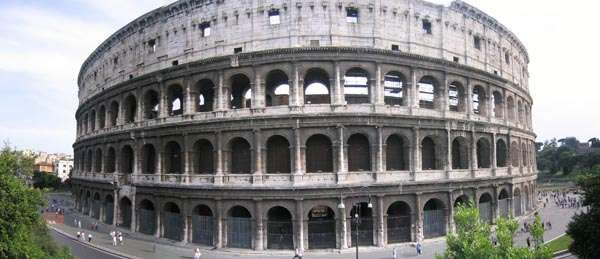
Vespasian undertook the reconstruction of the Capitol, which burned down in a fire. In addition, he built Temples of Peace, the Tabernacle of the Divine Claudius, and an amphitheatre in the centre of Rome. On-site Nero’s “Golden House” began building the famous Colosseum in 70 CE. The building was quite unusual at that time. It could hold 50 thousand viewers, and its construction lasted 10 years and was completed after his death.
In domestic politics, he strove to strengthen the imperial power, he was a good organizer, an energetic and strict ruler. In foreign policy, he aimed at preserving peace.
Internal unrest and fighting in Britain
Certainly, during the reign of Vespasian, there were attacks on his life, but from ancient accounts, we know only one plot, by Eprius Marcellus and Aulus Caecina Alienus. Both leaders were executed, and their motives are unknown.
In Gaul, at the turn of 69-70 CE, the Roman aristocrat Gaius Civilis won over the local tribes and proclaimed the Galician empire. Vespasian dispatched eight legions to fight, first to subdue Civilis’s ambitions and then to move to Britain where the powerful Brigant tribe disturbed the Romans.
Under Vespasian, the greatest expansion was in Britain. The governor of this province was Julius Agricola, who in 78-85 CE extended the Roman rule to the north, including battles against the Caledonians.
Death
In CE 79, Vespasian had a fit of fever. This is how Suetonius describes his deterioration of health:
In his ninth consulship he had a slight illness in Campania, and returning at once to the city, he left for Cutiliae and the country about Reate, where he spent the summer every year. There, in addition to an increase in his illness, having contracted a bowel complaint by too free use of the cold waters, he nevertheless continued to perform his duties as emperor, even receiving embassies as he lay in bed. Taken on a sudden with such an attack of diarrhoea that he all but swooned.
– Suetonius, Vespasian, 24
Vespasian, sensing the end of his life, according to Suetonius, was supposed to ironically say: “Woe’s me. Methinks I’m turning into a god” and ordered himself to rise saying “An emperor ought to die standing”3. Vespasian died on June 23, 79 CE at his estate in Rome. Just as Julius Caesar, Octavian Augustus and Claudius were declared divine – divus.
One month after his death – during the reign of his son Titus – there was the eruption of Vesuvius, during which Pompeii, Herculaneum and Stabiae.
Summary

Emperor Vespasian was known for his intelligence, amiable demeanour and leadership skills. In the event of natural disasters, he supported poorer senators or equites. He was especially generous with writers and rhetoricians, who were paid 1,000 gold pieces each year. The first to receive such a grant from the ruler was Quintilian – a public teacher. Pliny the Elder, in turn, wrote his main work “Natural History” during the reign of Vespasian, and dedicated it to the Emperor’s son, Titus. Writers during the reign of Emperor Vespasian were very favourable towards him (including Tacitus, Josephus Flavius, Suetonius), and criticized the previous Julio-Claudian dynasty. Any person unfavourable to the new ruler was removed to the shadows.
Vespasian had a completely different opinion of philosophers (especially Stoics), whom he considered to be unmanly and whining. The wise men, in his opinion, talked a lot and was unreasonable. They often spoke with delight about the times of the Republic, which made Vespasian very angry. The emperor threatened to restore the old laws that would be against philosophers. As it turned out, during the reign of Vespasian only one thinker was sentenced to death – it was Helvidius Priscus, who repeatedly opposed the emperor’s policy. The ruler tried to ignore public slander against him; he even once stated: “You are doing everything to force me to kill you, but I do not slay a barking dog”4. Ultimately, however, after the second banishment, Priscus was killed by Vespasian.
Apart from the case described above, Emperor Vespasian was extremely respected by the people (he suffered only once – in Alexandria – when a turnip was thrown at him5). According to Suetonius, he was even respectful of the opposition. He endured all comments and jokes of his petitioners with patience and respect. Even when a certain Licinius Mucianus, a man suspected of homosexual inclinations, did not show due respect to the emperor, he did not allow himself to publicly humiliate the Roman but only privately said: “I am at least a man”6.
Despite the fact that the emperor was considered too frugal and sometimes miserable, he tried to bring the people of Rome as many benefits as possible. A lot of money was spent on public works and renovations: there was a new forum, a Temple of Peace, public baths and a huge Colosseum.
Finally, in some Romance languages, urinals are named after the emperor: in Italian they are called vespasiano and in French vespasien. This is probably because Vespasian restored the urine tax that already existed during Nero. In Roman public toilets, urine flowed into large amphora-shaped tanks. Later it was sold as a valuable raw material needed for leather tanning and fabric dyeing. The emperor was right to believe that the state should derive income from these transactions.


