
Chapters
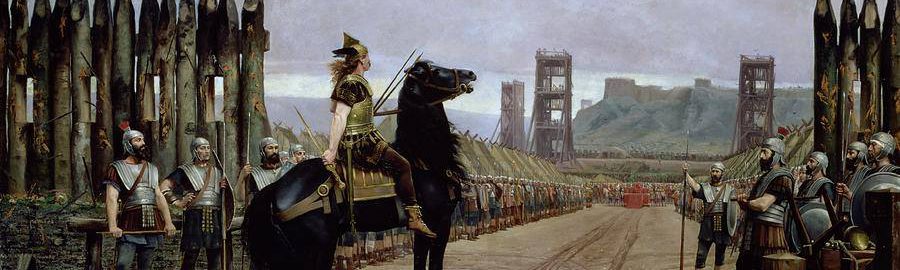
The Roman law of war guaranteed its inhabitants relative protection if they surrendered as a result of negotiations with a Roman commander. However, if they refused to capitulate and the fortifications were conquered by storm, then the whole town became a prey for the army. The city that lost the war with Rome had to rely on the grace or disgrace of the “sons of the she-wolf” and often only coincidence, the mood of the legionaries or the attitude of the leader decided about her fate. The worst was, of course, the fate of those cities that were conquered by force, in such a situation nothing could stop the soldiers from cooking hell for the unfortunate inhabitants. They enjoyed a privilege which the Romans called direptio. During the direptio, soldiers had the unlimited right to murder, rape (rapere) and plunder, but this right was limited in time (usually up to 1 day). It should be remembered that during the republic, the legionaries did not appropriate the spoils, but only took them to camps where, after their sale, they were distributed equally among individual centuries (this was of course only theoretically and in historians trying to colour the facts).
Josephus Flavius, a Jewish historian wrote in the “Jewish War” that after the capture of Jerusalem (70 CE), the Romans:
So they now left these towers of themselves, or rather they were ejected out of them by God himself, and fled immediately to that valley which was under Siloam, where they again recovered themselves out of the dread they were in for a while, and ran violently against that part of the Roman wall which lay on that side; but as their courage was too much depressed to make their attacks with sufficient force, and their power was now broken with fear and affliction, they were repulsed by the guards, and dispersing themselves at distances from each other, went down into the subterranean caverns. So the Romans being now become masters of the walls, they both placed their ensigns upon the towers, and made joyful acclamations for the victory they had gained, as having found the end of this war much lighter than its beginning; for when they had gotten upon the last wall, without any bloodshed, they could hardly believe what they found to be true; but seeing nobody to oppose them, they stood in doubt what such an unusual solitude could mean. But when they went in numbers into the lanes of the city with their swords drawn, they slew those whom they overtook without and set fire to the houses whither the Jews were fled, and burnt every soul in them, and laid waste a great many of the rest; and when they were come to the houses to plunder them, they found in them entire families of dead men, and the upper rooms full of dead corpses, that is, of such as died by the famine; they then stood in a horror at this sight, and went out without touching any thing. But although they had this commiseration for such as were destroyed in that manner, yet had they not the same for those that were still alive, but they ran every one through whom they met with, and obstructed the very lanes with their dead bodies, and made the whole city run down with blood, to such a degree indeed that the fire of many of the houses was quenched with these men’s blood. And truly so it happened, that though the slayers left off at the evening, yet did the fire greatly prevail in the night; and as all was burning, came that eighth day of the month Gorpieus [Elul] upon Jerusalem, a city that had been liable to so many miseries during this siege, that, had it always enjoyed as much happiness from its first foundation, it would certainly have been the envy of the world. Nor did it on any other account so much deserve these sore misfortunes, as by producing such a generation of men as were the occasions of this its overthrow.
– Josephus Flavius, Jewish war, VI.8.5
We have a similarly cruel message from the capture of the Gallic Avaricum in 52 BCE. Caesar himself wrote that on that day the legionaries “did not let decrepit old people, neither women nor tiny children.”
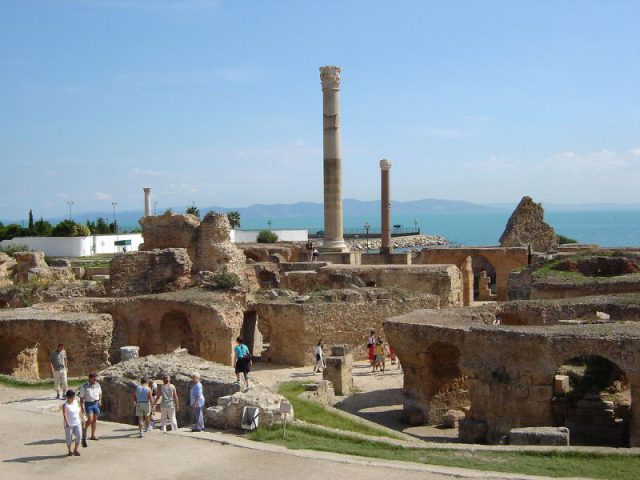


At the time of the direptio POWs were a kind of prey that the legionaries possessed only for temporary use, the fate of which, in turn, depended on the chief. As a result, taking prisoners was not in the interest of ordinary legionaries. This may explain the frequent massacres of defenceless populations carried out by the Romans. During the Punic Wars, only one city conquered by force escaped the direptio, that was New Carthage, and later the city of Synopa (conquered in 70 BCE – it was saved by L. Licinius Lucullus, but it caused a general hatred towards him among the subordinate soldiers and resulted in the denunciation of obedience in the later period). There is a story connected with the conquest of the aforementioned New Carthage. The men of the victorious Roman leader of the Scipio Africanus brought him the most beautiful woman in town as a captive. The chief caused great consternation when he released this “prey”, for it was unusual and unusual behaviour.
Confirmation that the war by the Romans was brutal is the column Marcus Aurelius, which is a monument to the emperor’s glory over the Marcomanni and the Quadi. On the building, we see women hiding and hiding from Roman soldiers, being led into captivity, and even trying to cover their children with their bodies in a dramatic gesture. Also on the column of the Dacian