Chapters
Discipline in the Roman army was for centuries a model for European rulers. In order to maintain well-trained and obedient soldiers, an extremely strict military law had to be introduced, to which both ordinary and high rankings were to be subject to. This procedure was primarily to make the legionaries completely devoted to the commander. The soldier was to be more afraid of what could happen to him in the Roman camp for not completing the task than of dying on the battlefield. At the same time, a reward system was introduced to motivate soldiers to even better combat and sacrifice.
There was a strict internal order in the army, sometimes leading to pedantry. Various books, lists of awards, services, outsourcing and leaves were carefully kept in the branches. There were detailed regulations for the guard service. Both minor and serious offences were punished immediately.
A Roman soldier, starting his service, took a military oath, initially of allegiance to the Senate and the Roman People, and during the empire to his general and ruler. It was the so-called sacramentum. According to this oath, the legionary agreed to all suffering, punishments, and even death – related to the defence of these values. When joining the legions, Roman citizens did it voluntarily, and therefore they were not forced soldiers to join the army, but people who were fully responsible for their decisions. After all, it was a professional army. They lived on it.
Discipline in the army was extremely strict. The general even had the right to immediately sentence to death any soldier under his command for even the slightest offence.
Polybius divides military penalties issued by a commander into two categories: crime and disobedience.
Offence
- fustuarium or bastinado – according to the court-martial, a soldier was stoned to death or killed with a club for desertion or neglect of duty to the death against soldiers whose lives were threatened as a result of a guilty crime. The soldier who escaped and escaped punishment was not prosecuted but was sentenced to eternal exile from Rome.
- pecunaria multa – pay deduction.
- beating a soldier in front of a Century, Cohort, or Legion.
- taking the military oath, sacramentum.
- throwing a convict in a sack with snakes into a river or lake for treason or theft.
Disobedience

- decimatio (decimation, decimation) – a form of extremely severe punishment applied to a cowardly or rebellious group of soldiers. The cohort, doomed to be decimated, was divided into groups of ten soldiers. Each one drew lots and the one who failed was killed by his nine companions by stoning or killing them with clubs. The survivors received barley instead of flour and were punished with additional quarters outside the fortified camp until they cleared their sins in the fight. Due to the serious deterioration of the personality, the use of decimation was gradually abandoned.
- castigatio – beating by a centurion and his subordinates or by animadversio fustium.
- reducing food rations, or giving the soldier barley instead of regular grain.
- beating the guilty (with flagrum) which was much more painful than hitting with a regular club. The Flagrum was a type of whip with a handle (usually wooden), which consisted of three rather long straps, ended with metal hooks that torn off body particles with each strike and carried them with each other. The tips of the whips twisted and injured the front of the body as well, though it was used to flog a condemned man’s back and buttocks.
- gradus deiectio – grade decrease.
- missio ignominiosa – shameful expulsion.
- loss of benefit of long and good service.
- militiae mutatio – handing over shameful duties to the guilty.
- quick execution.
- munerum indictio – to impose additional obligations.
If, when checking the guard, the guard was not found at the post or found sleeping, the next day he was brought before a court martial. In the case of a conviction, a military tribune touched the guilty with a reed, and then the soldiers, mostly his colleagues, beat him with sticks or threw stones at him.
The commanders had very high disciplinary powers. The consul could punish even death by disciplinary means and had the right of decimation, that is, to punish every tenth soldier of each unit with death.
The tribune, on the other hand, had the right to impose a financial penalty and apply the most severe corporal punishment, from flogging to stoning, including, in fact, he passed death sentences.
The centurion, however, played the greatest role in maintaining strict discipline. As the immediate superior of the rank and file, he exercised constant supervision over them and reacted immediately to any misdemeanours of his subordinates.

The punishment system in the Roman army is presented by Polybius:
While the soldiers are subject to the tribune, the latter are subject to the consuls. A tribune, and in the case of the allies a praefect, has the right of inflicting fines, of demanding sureties, and of punishing by flogging. The bastinado is also inflicted on those who steal anything from the camp; on those who give false evidence; on young men who have abused their persons; and finally on anyone who has been punished thrice for the same fault. Those are the offences which are punished as crimes, the following being treated as unmanly acts and disgraceful in a soldier — when a man boasts falsely to the tribune of his valour in the field in order to gain distinction; when any men who have been placed in a covering force leave the station assigned to them from fear; likewise when anyone throws away from fear any of his arms in the actual battle. Therefore the men in covering forces often face certain death, refusing to leave their ranks even when vastly outnumbered, owing to dread of the punishment they would meet with; and again in the battle men who have lost a shield or sword or any other arm often throw themselves into the midst of the enemy, hoping either to recover the lost object or to escape by death from inevitable disgrace and the taunts of their relations.
If the same thing ever happens to large bodies, and if entire maniples desert their posts when exceedingly hard pressed, the officers refrain from inflicting the bastinado or the death penalty on all, but find a solution of the difficulty which is both salutary and terror-striking. The tribune assembles the legion, and brings up those guilty of leaving the ranks, reproaches them sharply, and finally chooses by lots sometimes five, sometimes eight, sometimes twenty of the offenders, so adjusting the number thus chosen that they form as near as possible the tenth part of those guilty of cowardice. Those on whom the lot falls are bastinadoed mercilessly in the manner above described; the rest receive rations of barley instead of wheat and are ordered to encamp outside the camp on an unprotected spot. As therefore the danger and dread of drawing the fatal lot affects all equally, as it is uncertain on whom it will fall; and as the public disgrace of receiving barley rations falls on all alike, this practice is that best calculated both to inspire fear and to correct the mischief.
– Polybius, The Histories, VI.37-38
The greatest punishment the legion could face was the complete dissolution of the unit. This befell three rebellious Rhine legions: I and IV Macedonica and XVI Gallica. These legions joined the uprising of Julius Civilis (69-70 CE) in Gaul. Following the suppression of the uprising by Petilius Cerialis, Emperor Vespasian disbanded these legions. In place of the disgraced legions, he and his son Domitian set up new troops. Some of them consisted of rebellious soldiers, but these legions already had other names. Two new legions were sent away from Germania.
Awards
On the other hand, for their bravery and good performance of all duties, soldiers received numerous awards that were to motivate them to work and fight even more efficiently. Among the awards for an ordinary walker, the following can be distinguished:
- reading in front of the squad’s name highlighted;
- awarding an honourary epaulette, ring or pennant;
- granting the right to wear a small silver shield on the chest;
- reward, for bravery in battle, with various wreaths: gold wreath (corona muralis) for breaking the walls first; a wreath of gold ship bows (corona navalis) for breaking into an enemy ship; laurel leaf wreath (corona civica) for saving the life of a comrade in battle.

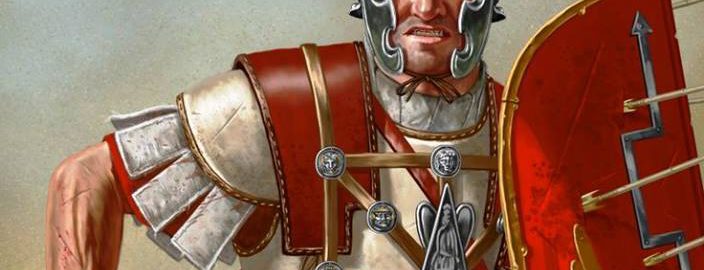
Officers were awarded honourary banners, spears or gold wreaths. Medallions made of bronze, silver or gold, sometimes inlaid with gold, were also awarded for bravery demonstrated in combat. They were called “heads” (phalerae) and decorated the armour with them. The armour also featured silver and gold hoops (torches) and armillae.
Entire units were rewarded with cash donations for military merits or for improving morale. The highest distinction for the commander-in-chief was the triumph in Rome, which was proof of the senate’s special recognition for an independent and won war in which at least 5,000 enemy soldiers were killed.
During the Empire, soldiers could not be awarded regardless of their rank. No one below the rank of centurion could get wreaths for winning a wall or a moat. The centurion could receive awards such as those given to the rank and file of legionaries, and a gold wreath. Honoured young tribunes and centurions received hasta pura (or hasta donatica) – a spear without an arrowhead (“without iron”). There is a known history of awarding hasta pura to the official Tiberius Claudius Balbilus and probably also giving him corona aurea by the emperor Claudius during the triumph organized on the occasion of the conquest of Britain in 44 CE. It seems that Balbilus received such a title rather honourably. The meaning of the spear has not been explained to this day, nor has the gold wreath – corona aurea. The older tribunes could get two gold wreaths, two hastae purae silver wreaths and two gold vexilla miniatures. Legates were entitled to three decorations of each type, and provincial governors and consuls were up to four. Hasta pura was presented to primus pilus – the centurion of the 1st cohort – after serving.
The rewards system in the Roman army presents Polybius:
They also have an admirable method of encouraging the young soldiers to face danger. After a battle in which some of them have distinguished themselves, the general calls an assembly of the troops, and bringing forward those whom he considers to have displayed conspicuous valour, first of all speaks in laudatory terms of the courageous deeds of each and of anything else in their previous conduct which deserves commendation, and afterwards distributes the following rewards. To the man who has wounded an enemy, a spear; to him who has slain and stripped an enemy, a cup if he be in the infantry and horse trappings if in the cavalry, although the gift here was originally only a spear. These gifts are not made to men who have wounded or stripped an enemy in a regular battle or at the storming of a city, but to those who during skirmishes or in similar circumstances, where there is no necessity for engaging in single combat, have voluntarily and deliberately thrown themselves into the danger. To the first man to mount the wall at the assault on a city, he gives a crown of gold. So also those who have shielded and saved any of the citizens or allies receive honorary gifts from the consul, and the men they saved crown their preservers, if not under their own free will under compulsion from the tribunes who judge the case. The man thus preserved also reverences his preserver as a father all through his life, and must treat him in every way like a parent. By such incentives they excite to emulation and rivalry in the field not only the men who are present and listen to their words, but those who remain at home also. For the recipients of such gifts, quite apart from becoming famous in the army and famous too for the time at their homes, are especially distinguished in religious processions after their return, as no one is allowed to wear decorations except those on whom these honours for bravery have been conferred by the consul; and in their houses they hand up the spoils they won in the most conspicuous places, looking upon them as tokens and evidences of their valour. Considering all this attention given to the matter of punishments and rewards in the army and the importance attached to both, no wonder that the wars in which the Romans engage end so successfully and brilliantly.
– Polybius, The Histories, VI.39