Chapters
The Roman Legion (legio) was the basic and largest tactical unit of the Roman army consisting primarily of heavy-armed infantry. The name literally means “abstraction.” In the early period of the Roman state’s existence, the legion meant the whole army, i.e. all men called to arms. For many centuries, only Roman citizens could serve in the legions, but with the development of the empire, men who were not fully Romanized were also reached. Legia, because it was also adopted to be called this unit, was modernized many times in various periods of the Roman state.
Monarchy period
Database presenting data collected so far about the number and history of individual legions.
The Roman army of the early kingdom was very close to the Greek army in both strength and armed terms. The fighting style was also similar, because phalanx was often used. However, the apparent weaknesses of the hoplite formation forced the Romans to seek new solutions. Changes took place gradually. One legion per year began to be issued, which constituted the entire army of the state. The legion included light infantry and cavalry, whose role was later replaced by allied troops.
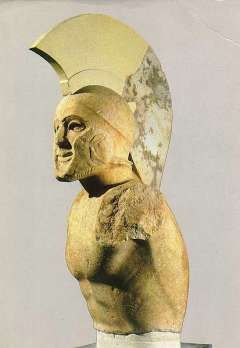
The original Roman army consisted only of landowners. The Roman population, divided into three tribus, undertook to issue 3,000 (1000 from each tribus) walkers (peditates), supplemented with a troop of 300 horsemen (100 from each tribus). Each ward, issued by one tribus, was divided into 10 centuries with 100 soldiers. So the legion during the early monarchy had 3300 soldiers (3000 infantry and 300 cavalry). Infantry was commanded by tribunus militum, while driving by tribunus celerum.
However, ways to strengthen Rome’s combat strength were still sought. According to legend, an important reform was carried out by the King of Rome himself, Servius Tulius in the sixth century BCE He divided the population of Rome into five property classes. The first class was equipped with a spear, sword, helmet, armor and a round shield (clipeus); the second and third had weaker armor than the first; the fourth might not have armor, for all it needed was a small shield, a spear and a javelin; the fifth, final class is the firing squad. The Roman army still consisted of only one legion, but its number doubled. The infantry had 6,000 soldiers, divided into 60 centuries. Roman ride was set at 600 horsemen, divided into 6 centuries. However, to increase cavalry strength, Serwiusz Tulius decided to add 1200 additional riders to the formation. Cavalry in the legion was 1,800 men divided into 60 smaller units turmae, 30 horsemen each. To sum up, at the end of the monarchy the Roman legion consisted of 7800 soldiers (6000 infantry and 1800 cavalry).
Early republic period
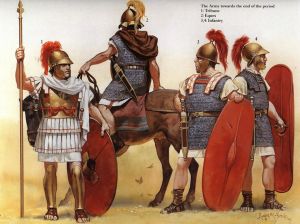
With the establishment of the republic, the reform of the Roman army, previously adapted to monarchy, had to be carried out. Two consuls appointed by the state and responsible for border protection needed two separate armies. To this end, the existing one legion was divided into two separate, where each was assigned to one of two consuls. The existence of only two legions allowed consuls until the 4th century BCE to conduct modest but effective warfare in areas not far away from the capital. However, with the expansion of the Apennine Peninsula at the beginning of the 4th century BCE, it was decided to increase consular armies to two legions. During the campaign, the legions were also further strengthened with meals demanded by the Romans from their allies.
Men aged 17 to 60 were subject to the general duty of military service. Men aged 17 to 45 (iuniores) were sent to the front. Men over 46 (seniores) served in cities and were a reserve for the main army. Relief from duty (mission honesta) followed 20 walking or 10 horse riding trips. In the early Republic, military service was not paid in the form of pay, and was received as a civic duty.
The turning point was 331 BCE, when the army tribune was introduced in the army, initially responsible for commanding the legion. In addition, the existing compact front line used, for example, by the Greeks was abandoned, and the focus was on the manipular system, i.e. dividing the army into manipulators, smaller tactical units, which allowed to make the army more flexible. Each manipulation consisted of 2 centuries. The centuria was 60 soldiers, which together resulted in 120 men in manipulas (the exception were triaria, of whom 60 were manipulates, and one centuria was 30 people). In the legion there were usually 15 maniples hastati, 10 manipulators pricipes and triaria, 1200 velites (velites) and 300 rides (equites). Thus, the strength of one legion was about 5000 soldiers during this period. The manipulation was headed by two centurions. First, the commander of the first century was called prior and was a senior officer in the manipulation. Second, the commander of the back centurion was called posterior.
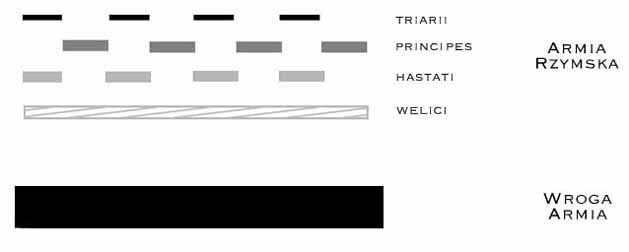
The republican army was set up to fight in a three row order. This side-by-side manipulation enabled the tired soldiers to retreat quickly behind the ranks of colleagues in the distant lines. It also allowed to escape behind the lines of heavily armed light armed velets (velites) after firing all the ammunition. The youngest and least experienced soldiers, hastati stood in the front row. The second was older, better armed principes, and the last was the oldest and most experienced, triaria. Legionaries were therefore divided by class, according to experience and age. First, hastati joined the fight, then if their attack failed, they attacked principes. If the attacks of the first two ranks failed to fight, they started triaria. Infantry wings were protected by cavalry (equites), which often assisted infantry at critical moments of the battle.
Ride was called out of 18 centuries of the richest citizens. Together they formed one tactical unit (ala). Each ala was divided into 10 turnae, 30 riders each, and this in turn it consisted of 3 decuriae, 10 horse riders each.
Period of the late republic

Conducted by Gaius Marius from 107 to 102 BCE military reform (separate department) enabled the creation of a fully professional and professional army. Legions have received an image that has survived to our times and will always be associated with them. We are talking here about perfectly trained, heavily armed legionaries.
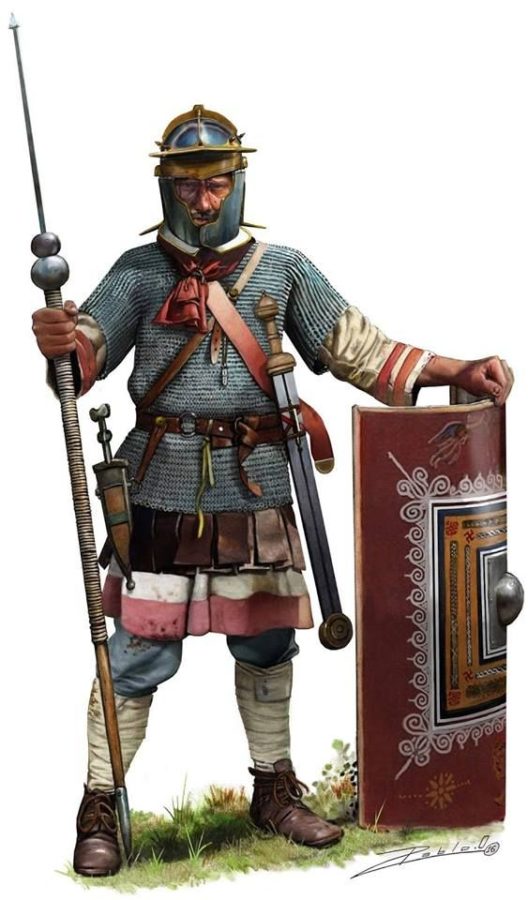
The reform allowed even the poorest layers to join the army, which definitely increased the size of the army. Three different types of heavy infantry units have been replaced by one unit, based in some sense on principes. All soldiers were equally armed: sword (gladius), shield (scutum), armor (lorica hamata or lorica segmentata), helmet and javelin (pilum).
Allied forces were significantly reduced, which allowed to integrate the army. The role of the allied forces fell to the new unit called auxilia. It included special units such as: engineers, scouts, artillery workers, craftsmen, servants, mercenaries, and allied and local militia units. These units were organized into larger units: light cavalry, light infantry or troops and workers. A scout unit of 10 light horsemen (speculatores) was also created. All recruits who had no Roman citizenship previously received them when they entered service.
The legion’s structure was also definitely reformed. Legia was divided into smaller tactical units cohorts (cohorts). There were usually 6 to 10 cohorts in the legion, each consisting of 5 to 8 centuries. The centurion was commanded by a centurion, accompanied by optio, a soldier who could read and write. The highest age of centurions was called primus pilus. He was the highest centurion in the Roman legion and commander of the first legion cohort. He was also called primipilus.
In order to increase the speed of the army’s march and make the legionaries independent of the rolling stock, each soldier had to carry, in addition to his equipment, food for 15 days. In this way, a huge chain of mules carrying supplies for the army was eliminated, which definitely slowed down the march. Apparently, the legionary soldier carried a load of 37 kg on his shoulders.
The legion of this period ranged from 4,000 to 5,000 soldiers. However, given the fact that servants marched along with the legion, engineers and other auxiliary fighters could put up to 6,000 men. However, as a result of numerous campaigns, the Roman legion in the 1st century BCE had an average of 3,500 legionaries.
Early Empire period
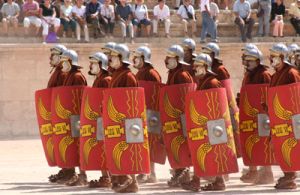
Numerous war campaigns and civil wars conducted in the 1st century BCE led to an incredible increase in the number of legions. After defeating in 31 BCE in the battle of Actium Mark Antony, Octavian Augustus had almost 50 legions under his command. His first step after taking office was to reduce this number by half to 25 and to settle all financial matters, i.e. overdue pay and remuneration. In addition, the princeps dramatically increased the number of auxiliariers, who in the legion from then on had the same number as legionaries. Ultimately, successive descendants of Augustus had 30 perfectly trained and dedicated legions under their command. Each legion had between 4,000 and 6,000 soldiers supported by a similar number of support troops.
Officially, the Roman legion of the late republic and early empire should have 5,248 people, including 128 horsemen, 640 commanders, contubernium, 59 optio, 59 centurions of different rank, camp prefect, one actually a significant military tribune and legate.
During the period of peace, called by the Romans Pax Romana, a better legion ranged from 8,000 to 12,000 soldiers and was usually stationed at the border or in inflamed areas. It happened that some legions reached up to 15,000, 16,000 soldiers.
Legions, just like during the fall of the republic, began to play an increasingly important role in politics. Legionaries noticing their strength, not only military, began to have an increasingly greater impact on the fate of the state, through the choice of emperors. You can mention, for example, the Vespasian chosen by the army as emperor and generally the event called the year of the four emperors in 68 CE.

The legion was commanded by a legate (legate or legatus). This commander was 30 years old and usually sat on the senate benches for 3 years. Under his orders there were 6 military tribunes, where five were officers and one important figure of the senate. Other important personalities in the legion are: medical officer, engineer officer and camp commander (praefectus castrorum).
In the 2nd century CE, the emperor Hadrian established special units of light infantry (numerus) and cavalry (cunei). Soldiers from newly conquered lands were recruited to the numerus units. To protect himself from unexpected complications in the form of rebellion, Hadrian ordered to send them far from his homeland. The soldiers kept their native armament and the manner of fighting, however they were commanded by Roman officers. In addition, Hadrian formed a side imperial cavalry unit (equites singulares imperatoris), with 500 selected riders from auxiliary units.
In the second half of the 3rd century CE, during the reign of Galien, new formations were created. It was a reserve army composed solely of cavalry (equites), whose commander soon became the most powerful person in the state.
Late Empire period

During the late Empire, the number of legions and the number of Roman troops increased significantly. It was mainly caused by unrest at the borders, huge territory and many civil wars that broke out in the country. A clear change in the structure of the legion took place during the reign of Diocletian, at the end of the third century CE. Then the legions were transformed into the so-called legiones palatinae. We do not have certain information as to the size of the new troops, but researchers say about 1000-2000 people along with the cavalry. The first legions of this type were: Lanciarii, Joviani, Herculiani and Divitenses.
Constantine II began the process of multiplying small and less significant legions. At that time, two more types of units were created: comitatenses and pseudocomitatenses. It is also worth mentioning the unit newly created in 325 CE by Constantine the Great, auxilia palatina. According to sources in the 4th century CE, under the leadership of the emperor there were: 25 legiones palatinae, 47 legiones pseudocomitatenses, 70 legiones comitatenses and 111 auxilia palatina.
However, the most important change in the reforms of Diocletian and Constantine was certainly the division of the army into appropriate formations: limitanei, candidati and the mentioned comitatenses. Limitanei were scattered across borders, and their main task was to repel enemy attacks. Comitatenses, to some extent constituted by barbarians, were the main part of the army and were to support the troops defending the borders. Candidati, in turn, were the Imperial Guard. The modernization of the army and structural changes in the legion were to help the soldiers defend the great empire. The constant problems with the number of recruits and the disappearance of civic values led to a decline in the combat strength of the Roman army.