Chapters
Baths (thermae or balnea) were composed of a complex of facilities located on a vast area, accessible to everyone, both free people and slaves, for the rich and the poor at specific times. The fee for using the thermal baths was very low. Periodically, it was abolished by the emperor by way of grace in order to win over the Roman people. Baths were available to everyone, although there was most often a division that strictly defined the hours of bathing for the sick, women and men.

Baths were a permanent element of social life in Roman cities. They were built mainly with state money, but their construction was often commissioned by private persons. Baths were found both at aristocratic villas and in Roman camps (castra). Thus, public and private baths stood out.
At the entrance to the thermal baths, in the vestibule, a certain casparius collected money and valuables from the entrants.
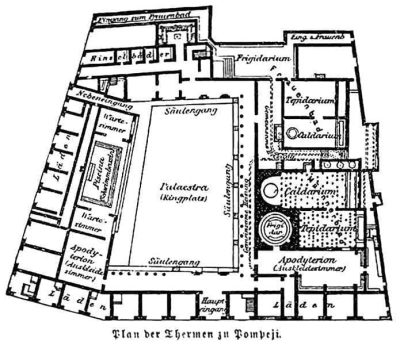
The rooms included:
- cloakrooms (apodyterium)
- cold water pools (frigidarium)
- a small heated room to prepare the body to face higher temperatures (tepidarium)
- hot water pools (calidarium)
- baths: dry (laconicum) or steam (sudationes)
- massage rooms (oleoterion) where the bodies were anointed with oils
- relaxation room (tepidarium)
In addition to these rooms, the thermal baths also included sports fields, gymnasiums (gymnasiums), stadiums, massage rooms, oil and perfume rooms, exheders and porticos for discussing, talking or listening to the recitations of poets and speakers. There were also libraries, music rooms, buffets and dice game rooms in the thermal baths. The objects were placed among the greenery. The rooms themselves had rich decorations. The walls were tiled with marble, decorated with paintings, and the floors were covered with mosaics. The rooms were decorated with sculptures, greenery and all elements of decor.
Roman Baths were certainly one of the favourite places where the Roman could relax his body. Tepidarium was probably the first place visited by bathers and it was a kind of introduction to further hot (caldarium) or cold (frigidarium) baths. Tepidarium was distinguished by the richest decorations among other baths and was the central hall in Roman baths and was surrounded by other rooms. The room was heated by the floor and had hot water. Then they usually went to the warmest room – caldarium (the temperature could be in the range of 50-55 degrees Celsius), heated with an under-floor heating system called hypocaustum. Earlier, the patient had to sweat a lot in order not to switch too quickly to the hot caldarium. In caldarium there was sometimes a separate room with a dry hot room – laconicum, which allowed the body to sweat “poisons” well. The pores of the skin opened in both of these places, which then closed in the cold waters of the frigidarium. In this way, it was possible to clean the skin in inaccessible places. It happened that the water in the frigidarium was cooled with snow.
Central heating system
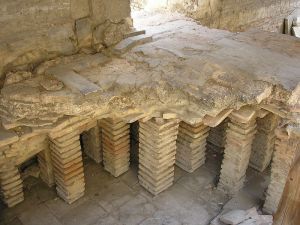
In the construction of the Roman baths, a central heating system, called by the Romans hypocaustum, was used. It was used from the first century BCE in ancient Rome. The hypocaustum system was used to heat houses, public and private thermal baths with hot air. The word literally means “fire”, from the Greek words hypo – “below” or “below”, and kaiein – “burn” or “light a fire”. In the central room, under the floor, there was a stove that heated the air. The floor was placed on a row of supports (pilae) about 80 cm high. The ceilings were tiled with a layer of tiles, then a layer of concrete, and then a layer of tiles on top. The spaces left in the walls served to allow hot air and furnace smoke to pass through them and be discharged to the outside through duct openings in the roof. As a result, hot air and smoke did not get inside the rooms. Ceramic tiles were placed to heat the wall. The rooms that required the most heat were placed closest to the stove, the heat of which could be increased by adding more wood to the fire. Launching the hypocaust was a laborious activity requiring constant supervision of the firepower. The system was expensive to use, so it was mainly equipped with villas and public baths.
It is usually believed that hypocaustum was invented by Sergius Orata, although this is not fully confirmed. Vitruvius describes its construction and operation according to the work of Sergius Orat around 25 BCE, adding detailed information on the fuel. It also describes the heat regulation device – a bronze fan in the dome of the ceiling.
Many hypocaust remains have survived among Roman architectural ruins all over Europe, West Asia, and North Africa. Hypocaustum is widely recognized as a Roman invention that improved the hygiene and living conditions of citizens and was a precursor to modern central heating.
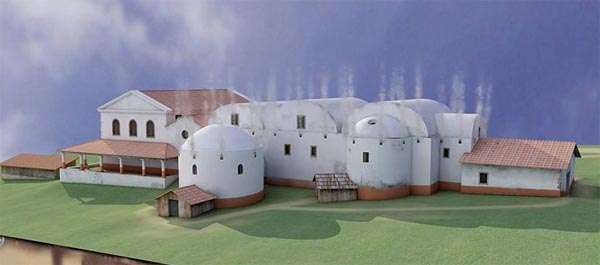
The spacious rooms supported by columns housed steam and water baths, swimming pools with hot, cold and cold water, swimming pools, bathtubs and showers. Next to it, there were gyms where weights were lifted, wrestling and fencing were performed. Baths were also a meeting place for social and philosophical disputes. Willing people could spend time in the library or eat a meal at the buffet. Some thermal baths were admitted for free, while others were charged a very small fee. The swimming pools and gyms were also used by women. There were usually separate rooms for them.
Due to its destination, the thermal baths were naturally a place of numerous social gatherings, which some people did not like. This is how the Roman termes are described by Seneca the Younger in “Moral Letters to Lucylius”:
Imagine what a variety of noises reverberates about my ears! I have lodgings right over a bathing establishment. So picture to yourself the assortment of sounds, which are strong enough to make me hate my very powers of hearing! When your strenuous gentleman, for example, is exercising himself by flourishing leaden weights; when he is working hard, or else pretends to be working hard, I can hear him grunt; and whenever he releases his imprisoned breath, I can hear him panting in wheezy and high-pitched tones. Or perhaps I notice some lazy fellow, content with a cheap rubdown, and hear the crack of the pummeling hand on his shoulder, varying in sound according as the hand is laid on flat or hollow. Then, perhaps, a professional comes along, shouting out the score; that is the finishing touch. Add to this the arresting of an occasional roysterer or pickpocket, the racket of the man who always likes to hear his own voice in the bathroom, or the enthusiast who plunges into the swimming-tank with unconscionable noise and splashing. Besides all those whose voices, if nothing else, are good, imagine the hair-plucker with his penetrating, shrill voice, – for purposes of advertisement, – continually giving it vent and never holding
– Seneca the Younger, Moral Letters to Lucylius, XVI

The first thermal baths were probably built in the 2nd century BCE. Their construction, however, spread in the first century BCE. During this period, they turned into huge complexes. The most famous thermal baths are those built-in in Rome:
- Hot springs of Agrippa
- Baths of Augustus
- Baths of Titus
- Baths of Domitian
- Thermal baths of Caracalla
- Baths of Diocletian
- Baths of Constantine
Baths were built not only in Rome but also throughout the empire, for example in Patara, Paris and Hierapolis, Trier and Alexandria.