Chapters
In the early days of Rome, cattle were the common means of payment. Anyway, the later name of money in Latin, pecunia, comes from the word pecus, meaning nothing but “cattle”. The pound unit was used to determine the face value – libra – which was 327.45 g.
The monetary history of ancient Rome
Originally, the state property of Rome was kept in the form of herds of cattle. Interestingly, theft was defined by the word peculatus, which referred to cattle and meant the theft of animals.
Launch of bronze coins

With the more and more frequent contacts of the Romans with the Greeks living in southern Italy (so-called Great Greece), a need appeared in Roman society to imitate their Greek neighbours. Scientists estimate the probable time of the emergence of a new currency in the middle of the 5th century BCE. Then it was started to use untreated bronze, in small pieces, for payment, the so-called aes rude. For each transaction, the appropriate amount of aes had to be weighed. It is possible that in 406 BCE During the siege of the Veins, it was this new means of payment that paid soldiers. It should be noted that bronze was a cheap metal and was made of 90% copper and 10% tin. The pure metals were weak and the tin strengthened the material.
Over time, rectangular, untreated bronze bars (aes signatum or “embossed bronze”) appeared, often depicting cattle or a branch with side branches (the so-called Ramo Secco). The bars did not have a constant weight and weighed from 0.5 to 2.5 kg. The Romans also placed the inscription “ROMANOM” on the bars, emphasizing their statehood. Probably aes signatum was used until the end of the Third Punic War, i.e. in the middle of the 3rd century BCE.
In the meantime, the Romans also began to make smaller bronze coins, which imitated the Greek counterparts, and which resembled the shape of the familiar coins. These activities also had a prestigious aspect – belonging to higher civilizations. And this is how money called aes grave (Libral As) appeared, probably already in the 3rd century BCE. The following types were distinguished: as, semis, triens, quadrans, sextans and uncia. Additionally, the coins began to depict scenes from mythology and deities.
During the 3rd and 2nd centuries BCE, Rome used various bronze coins: decussis, quincussis, tressis, dupondius, as, dextans, dondrans, bes, semis, quincunx, triens, quadrans, sextans, uncia, semuncia, quartuncia, each with a different denomination and value. The value of the coin was based on its weight. So 1 as weighed 1 Roman pound (libra). Libra, in turn, contained 12 unciae; uncia it was both the coin and the unit of measure for calculating the weight.
Introduction of the silver coin – didrachma
At the beginning of the 3rd century BCE, during the conflict with Pyrrhus (282-272 BCE), Rome introduced the first didrachma silver coin, which naturally was taken from Greek cities. Their production initially took place in Campania. The coin featured the image of the god of war Mars in a Corinthian helmet and the inscription “ROMANO” – these were minted in Campania. With time, the inscription “ROMA” began to appear, which began to be stamped in Rome. This coin was probably created at a similar time as aes grave, but it had a typically propaganda dimension and was primarily intended to pay for soldiers taking part in the war, both their own citizens, mercenaries and Greek allies. The weight of the coin was 7.3 g.
With time, a new image appeared on the coin – Hercules and the she-wolf with twins began to be shown. In the years 235-225 BCE the quadrigatus coin appeared, the name of which was due to the image of Jupiter on the coin that he was driving in the quadriga.
Launch of new silver coins
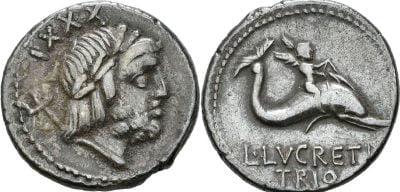
Even at the beginning of the Second Punic War, the Romans relied on didrachma in their payments. However, in 212-211 BCE a new silver coin appears – denarius (nummus denarius) – which had the equivalent of 10 ases. The huge amounts of silver obtained in Syracuse, a city in alliance with Hannibal, were used to mint the coins. At that time, the denarius was marked with the letter “X” and weighed about 4.5 grams.
A smaller silver coin was also introduced around this time – quinarius (labeled “V”) – which had a value of 5 asses and sestertius (“IIS”) worth 2.5 asses. It should be noted that at that time the as became the basic Roman bronze coin and the unit of account.
During the war with Hannibal, Viktoriatus also appeared, the name of which comes from the image of the goddess Victoria, minted on the coin. Victoriatus served as a means of settlement in international transactions, or to be more precise, mainly in trade contacts with the Greek states in the south, and was in the ratio: 1 victoriat=1 Greek drachma.
In the middle of the 2nd century BCE The denarius was already equal to 16 asses, which was marked on the obverse with the number XVI or a crossed X. With time, however, the as was superseded as a unit of account and it was replaced by sestertius, which was marked as HS. For the notation of larger sums, the following abbreviations have been used:
- HSX – 10 sestertii
- HSM – 1000 sestertii
At that time, the law introduced the official weights and values of Roman silver and bronze coins, which were used in the territories subordinate to Rome.
First hyperinflation and serrated coins
End of the 90s to 84 BCE this is the decline in confidence in the denarius and the high prices that resulted from the so-called war with allies and the economic collapse of the state. It is mentioned by Cicero in his treatise De Officiis1, stating that money at that time lost so much value that no one knew how much he really had. Hyperinflation also resulted from the wrong decisions of the people’s tribune Druzus Livius, who “spoiled” the coin by adding 1/?part of the bronze to the silver. In this way, plated coins, i.e. with a smaller amount of silver, were introduced to the market on a large scale. The changes were withdrawn by praetor Marcus Marius Gratidianus, who appointed a special commission to recognize defective coins, redeem them and exchange them for good denarii.
The aforementioned procedure of releasing the so-called Clad coins, i.e. coins with an outer coating of precious metal (e.g. gold or silver), when the centre was mostly a worse metal (iron, copper or bronze), dates back to the middle of the 2nd century BCE. In order to counteract the minting of coins, the so-called serrated coins (denarii serrati), i.e. the issued coins had to have specially cut edges in order to be able to easily verify the value of the coin by looking at its cross-section.
Moreover, under the dictatorship of Cornelius Sulla (82-79 BCE) the lex Cornelia de falsis law was implemented, which prohibited the circulation of coins false in practice, however, the denomination was still spoiled. I mean, of course, by mentioning:
- plating – an interesting example is Marcus Antony, who, according to Pliny the Elder, was supposed to add iron to the denarius2;
- and lowering the amount of precious metal in the coin, thereby reducing its weight.
Arrival of the Roman gold coin

The first mentions of gold coins in Rome appear about the Second Punic War when coins based on Greek patterns were minted: stater and half-stater. However, due to the lack of a constant supply of gold, the minting of coins was abandoned at a constant level.
The first mention of a new gold coin comes from the public activity of Lucius Cornelius Sulla, who was getting ready for the war with Mithridates VI. Coins were minted for the purposes of war; similarly, later Julius Caesar did before the planned expedition to the Party.
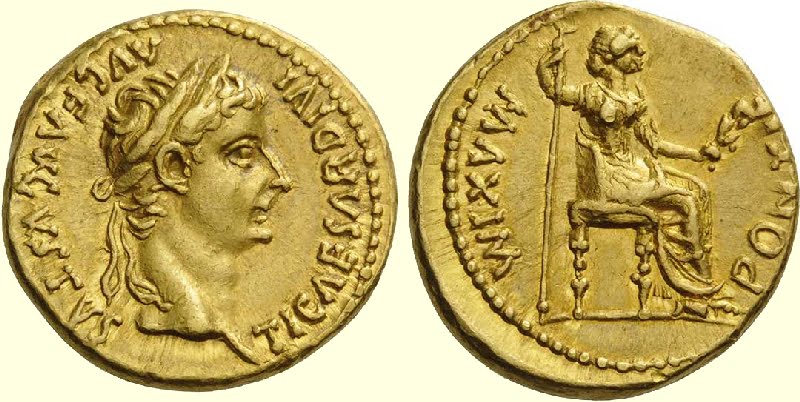
During the reign of Octavian Augustus, formal minting of the gold aureus was started, the equivalent of which was 100 sestertii, or 25 denarii. From then on, the gold coin became a common currency, until the time of Constantine the Great, who in 309-311 CE replaced it with solidus. Aureus was at that time weighing 7.79 g.
Basic monetary conversion used in the Roman Empire throughout the 1st and 2nd century CE |
|
The denarius was most often used in payments.
Progressive depreciation of the value of money
The constantly increasing expenses of the emperors, in the face of the decreasing revenues from wars, meant that the value of money decreased, and the emperors decreased the amount of gold in the coin. Nero during his reign, in 64 CE, devalued Roman coins – the content of gold was reduced: in silver by 14%, in gold by 7%. Despite various reductions, however, the ratio of aureus to the denarius was still the same: 1 to 25. Naturally, apart from the decrease in the real value, the weight of the coin was reduced to 7.27 g. Under Marcus, Aurelius the denarius weighed only 3.2 g and contained 76% silver.
Septimius Severus (193-211 CE) lowered at the end of the 2nd century CE the pure silver content in the coin was up to about 47%, so the Septimius denarius was worth half the Octavian Augustus denarius. Caracalla (211-217 CE) again reduced the number of coals and the aureus weighed 6.5 g. coin replacing the denarius – the so-called antoninianus – in 215 CE Antoniniana was often called a double denarius and it had a value of 2 denarii and a weight of 5.1 g. Initially, it was a silver coin, later it was minted from bronze and covered with a thin layer of silver.
The deepening anarchy in the Roman state in the 3rd century CE and the rule of “military emperors” were also important for the further devaluation of money. Emperor Aurelian tried to rebuild the Antoninian strength, but without success. Only during the reign of Diocletian and his reforms in 294 CE. there has been some regulation of the currency.
What prices and salaries were there in ancient Rome?
Reforms of Diocletian

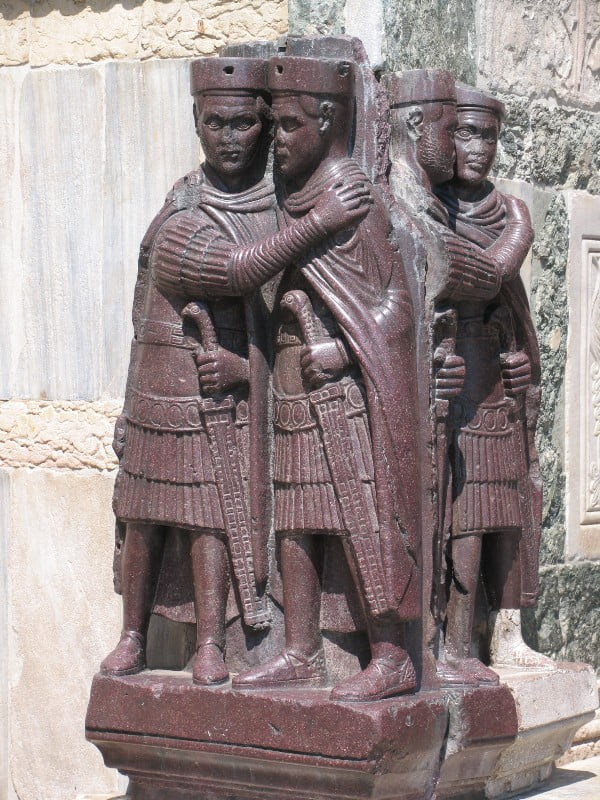
After the death of Alexander Sever in 235 CE, the last member of the Syrian dynasty, there was an economic and political crisis. It was known as the “Third Century Crisis ” and lasted until Diocletian in 284 CE Emperor Diocletian learned from the experience of previous decades and carried out a thorough reform of the Roman state. By focusing first on political stabilization, he realized that one person could no longer manage such a vast territory. It was not possible to react quickly and effectively in specific situations that occurred at their distant ends. So he introduced what he called the tetrarchy.
Political reform
The emperor appointed a co-ruler with the title of Augustus and entrusted him with the management of the western part of the state – he entrusted this position to Maximian. Diocletian remained in the East but retained sovereignty over all the rest. Each Augustów found a deputy with the title of Caesar to help him; Diocletian chose Galerius, and Maximian chose Constantius.
The division of power in the Empire caused a progressive bureaucratization, which required more and more financial outlays. The four seats of the emperors: Nicomedia (Diocletian), Milan (Maximian), Serdica, later Thessalonika (Galerius), and Trier (Constantius) required a sufficient number of officials to operate.
Monetary and economic reforms
In order to obtain more funds, the emperors imposed enormous fiscal burdens on the population and supplemented the shortages in the treasury by “spoiling the coins”. Denarius – the basic Roman coin – originally had 4.5 g of silver; during the reign of Nero, the amount decreased to 3.8 g; and by the end of the 3rd century CE, the denarius was in practice a copper coin with a small amount of silver. The “spoilage of the coin” over the centuries led to hyperinflation, which became the main problem of the Roman state in the 3rd century CE.
After the stabilization of the rule and political situation of Diocletian in the 90s of the third century CE made attempts to save the monetary system. The ruler tried to strengthen confidence in the coin by, inter alia, ceasing to use the current denarius and replacing it with another silver coin – argentus (literally “silver”) – which referred to the denarius of Nero’s time (3.41 g) in the amount of the metal. Additionally, the gold coin was stabilized at the level of 5.45 g and the fillis coin was introduced, which was minted from bronze with a small addition of silver (approx. 5%), weighing 10 g. At that time, 1 aureus was worth 25 argentus; and 1 argentus was equal to 5 fillis, 12.5 antoninianus and 25 denarii.
Diocletian additionally equated the provincial mints with the Roman mints – there were 15 mints of equal rank.
Diocletian’s reform was ambitious, but it did not live up to the changes due to a shortage of silver; thus the new follis was gradually broken down and lost any function in payments over time. Attempts were made to repair the budget through the possibility of partial payment of taxes with agricultural products. However, all these changes did not bring about a visible improvement in the situation. Diocletian along with the expansion of bureaucracy, which resulted from the appointment of three co-ordinates and the implementation of subsequent construction programs, including in Nicomedia, was unable to find savings. Therefore, at the end of 301 CE introduced the Edict of Maximum Prices which centrally imposed max prices on services and goods. The edict not only failed to improve the system but also created a black market, which only further worsened the country’s economic situation. After Diocletian left power in 305 CE the edict ceased to apply.
Changes by Constantine I

Thanks to the emperor Constantine I in 309-311 CE antoninianus came out of use. The emperor also replaced the aureus with a new coin – solidus. Solidus had a lower weight compared to the aureus – 4.5 g – and was referred to as aureus solidus (so-called solid). The gold coin turned out to be so durable that it finally became the main transaction coin. After the division of the Roman Empire in 395 CE, the solidus was recognized in both parts of the Empire, and eventually also survived the fall of the Western Roman Empire and was used in the Byzantine Empire until the 11th century.
Mintage of Roman coins
Originally, coin minting was only possible in Rome. Later, the mints in Taranto, Beneventum and Campania were also used; and finally, local mints were allowed to operate in the newly created provinces. The mint in the capital was located on Capitoline Hill, next to the Temple of Juno Moneta, and was established in 269 CE. During the time of Octavian Augustus, the number of mints grew sharply. Coins were produced in almost every corner of the Empire. It was not until the reign of the Flavian dynasty (69-96 CE) that this problem was remedied by a minting return to the area of the city of Rome.
The Senate, and more specifically the members of the tres viri monetales, college, also known as triumviri aere, argento, auro flanto feriundo, were responsible for minting the coins. The college consisted of three officials. In the years 44 – 40 BCE the college expanded its composition to 4 members. The college was responsible not only for the coin minting process but also for the stamps, inscriptions and images placed on them. In the 1st century BCE, the right to issue coins was also given to high Roman officials, who owned the imperium. In this way, Sulla, Caesar or Augustus could have minted their coins.
With the rise to power of Octavian Augustus in 27 BCE, there have been changes in the authority to mint coins. Silver and gold coins could be struck by princeps, bronze coins by the Senate. The Senate Mint was the Temple of Juno; the emperor, in turn, first owned a mint in one of the districts of Rome, then in the imperial palace. In 14 BCE the great imperial mint in Lugdunum in Gaul was opened. During the reign of Caligula, the imperial coinage returned to Rome, this time on Mons Coelius.
Nummularii were responsible for the quality control of the coins. Coins in ancient Rome were struck with hammers using official stamps. Smelting of coins was also attempted, but this practice was abandoned due to the fact that they were made of non-uniform weight or size.

What was put on Roman coins?
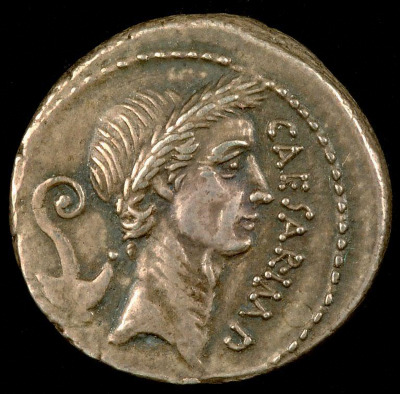
In the early days, Roman coins had images of cattle or branches. Over time, Roman deities began to appear (Jupiter, Janus, Junons, Mars or Minervas and symbols relating to the cult or traditional past of the country (e.g. the she-wolf suckling twins or the bows of ships). On the coins from the end of the republic, we also see images of politicians.
The first living man whose face was featured on a coin was Gaius Julius Caesar. It later became a tradition. The images of the rulers were on one side, while the other was intended for various types of personifications. The most common ones were: Freedom, Gentleness, Wiktoria, Roma and Joy.
Imperial coins provide material for the iconography of emperors. Single words or phrases (legends) stamped on coins often depict political slogans from a given period. The subject of inscriptions and images on coins from the end of the republic is extremely diverse. Coins were one of the means of propaganda. On their basis, information about political groups and politicians can be obtained. Moreover, they enable us to check the information provided by ancient authors.
Stamps were placed on all coins. The bronze coins had the image of Janus, usually two-headed (Janus Geminus), on one side, and a beak on the other side. the ship. On the silver coins, there were images of two-horse or four-horse carriages.
Originally, all mintage was commissioned by the senate and marked SC (Senatus Consulta). With the advent of the principate, the rights to issue coins were distributed. Coins made of less valuable metal (bronze) were subject to the senate; they still had the inscription SC (Senatus Consulta). Silver and gold coins, on the other hand, were minted at the behest of the emperors and had the inscriptions: Imp. (Imperator); Caes (Caesar); P.M. (Pontifex Maximus); Cos (Consul); Tr. p. (tribunicia potestate).
In the times of Constantine the Great, scenes from private life appear more and more boldly on coins. The next changes took place only at the end of the 4th century CE for Theodosius the Great, when the minting of the monogram of Christ and other Christian symbols was started on coins.
Money exchange
With the development of the monetary system in ancient Rome, the profession of the banker, one of whose activities were currency exchange, began to take shape. In addition to exchanging state money, he also dealt with the exchange of currencies outside the borders of the Republic or the Empire. A resident of the eastern provinces, coming to Rome, could exchange, for example, tetradrachmas for Roman denarii with a banker, in order to be able to use the market in peace.
What’s more, in the times of the Empire, many cities had the power to mint local currencies, and some of them could only be used in payments regionally, e.g. in the eastern part of the Empire. All this meant that the bankers (argentarii) could count on really good earnings and commission.