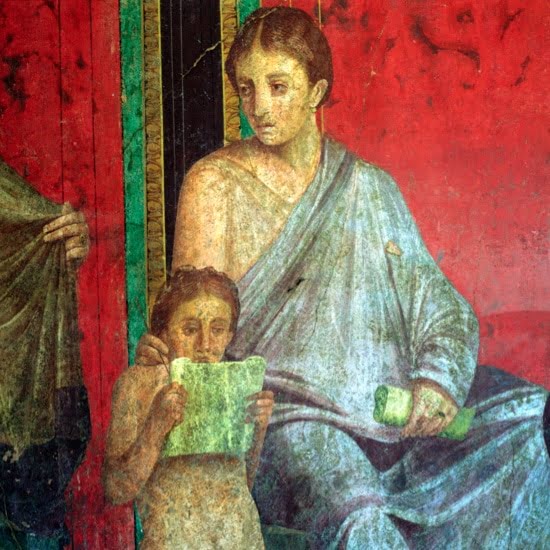
Fortuna was the goddess that guided human destiny. She was the equivalent of the Greek goddess Tyche. Her cult in Rome was introduced by king Servius Tullius. She was considered the first daughter of Jupiter and protector of the entire Roman people (Fortuna Publica Populi Romani Quiritum).
The goddess was initially portrayed as a woman (Fortuna Muliebris) blindfolded and with a cornucopia, which symbolized that she was the protector of fertility. If women came to Fortuna, she was called Fortuna Virginalis , if men Fortuna Virilis, and when children Fortuna Liberum.
With time, it began to be depicted with a rudder and a cornucopia, sometimes with a wheel in the background, and sometimes with an olive branch and a dish. These images were often depicted on the sides of Roman coins.
Her first temple in Rome was erected under King Servius Tulius. Over time, she received many altars and two more temples. During the Sulla dictatorship in the first half of the 1st century BCE the famous sanctuary in Praeneste was built.
Her holiday was refreshed every June 24. It was then that the Romans sailed on the Tiber boats decorated with flowers, going to her temple at the Boarium Forum.
- Kempiński Andrzej, Encyklopedia mitologii ludów indoeuropejskich, Warszawa 2001
- Schmidt Joël, Słownik mitologii greckiej i rzymskiej, Katowice 1996