Chapters
The cult of Hercules in Rome was nationalized in 312 BCE, i.e. in the year of his censorship by the reformer Appius Claudius Caecus, builder of Via Appia and the first aqueduct in Rome – Aqua Appia.
Hercules was worshipped as Victor (“the winner”) and Invictus (“undefeated”). The first and most important temple of the hero was Ara Maxima at the Forum Boarium (near Circus Maximus). According to legend, it was built by Evander, and Hercules himself was to perform the first sacrifice in honour of his father. From that time, for many centuries, the priests of this tabernacle were performed by members of different families. Dionisius writes that the altar itself was not a lofty and enormous building, in fact, it was very modest. Linguists and historians, therefore, believe that the word “maxima” in this case meant not “greatest” but “oldest”.
Other known temples of Hercules were:
- temple on the Field of Mars next to the Circus of the Flaminius, built on the orders of the Sibylline books and dedicated to Hercules, the Great Guardian of the City;
- temple in Tibur (Tivoli) near Rome.
In Roman mythology, Hercules was a deified hero. Later, his cult merged completely with the Greek Heracles, but even then the Romans retained some of their own myths about this character. Roman legend attributes Hercules to killing the giant Cacus and King Faunus. Hercules was to be hosted by Evander in his country, and after the death of the hero, he established his cult.
Initially, Hercules was worshipped in Rome as a guardian of property, guardian of entrances, and guardian of travellers and traders. Farmers and merchants tithed him of the profits and the crops.
lira. He was often presented with her in the company of Apollo and the musician.
the Feast of Hercules fell in Rome; On June 4, the Feast of Hercules the Great Protector (Hercules Magnus Custos) was celebrated.
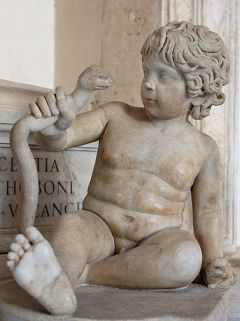
As the cult of the hero was extremely popular, in almost every town in the country there were chapels, altars and temples. In the Forum Boarium itself, next to Ara Maxima, there were three more chapels or small temples. Games were organized in honour of the hero and sacrifices were made to him in the Greek way. Once a year, the city praetor, with his head uncovered, crowned with a poplar wreath, offered a sacrifice of a young bull, who had not yet known the yoke, on the high altar. Then he performed a sacred libation (libatio – an offering to the deity in the form of pouring valuable liquids on the ground) with wine from a wooden chalice covered with tar, which Hercules was said to have used in Italy. The hero’s friends, who longed for him, threw themselves into the abyss of the Tiber, and a chapel was erected in every district of Rome as patrons of the Eternal City. In March each year, sacrifices were made to them.
could not be worshipped by women. They were so punished that they drove the hero out of the sacred grove of the Good Goddess (Bona Dea) on the Aventine Hill, where they prayed in her honour. So women could not swear by this god or pronounce the spell “mehercle”, which is popular in speech.
Hercules was especially popular among – merchants and travellers (for protecting them while travelling, especially in the mountains); – young Roman knights (as the most powerful and invincible hero); – chiefs and triumphs (they asked him for help in victory and gave him a part of the spoils of war).
A very popular form of hero worship was the ancient custom of giving away a tenth of your profits from successful transactions. In return for the favours received, many Romans even tithed to Hercules of their fortune. For example, the famous rich man Lukullus, in order to fulfil his promise, made costly sacrifices almost continuously. Chief Lucius Mummius, after subjugating Greece and conquering Corinth, erected a temple to Hercules Victor in Rome.

Patron of a victorious war
The cult of Hercules, especially as the patron of the victorious war, was most popular during the republic. Emperor Octavian Augustus, as part of “moral renewal”, stopped supporting the cult of the son of Jupiter, contrasting him with the no less popular Mars, who has since become a traditional patron of war and Roman legions.
Hercules was adopted as their patron by many Roman leaders and politicians:
- Pompey the Great: just before the Battle of Pharsalus in 48 BCE, the legions under his command raised a battle cry of “Hercules Invictus!” in response to the Caesarians’ shout, “Venus Victrix!” (Venus was the patron of the Julius family)
- Mark Antony: in the last period of his life, he imagined himself as the “New Hercules” and “New Dionysus”.
- Emperor Trajan: he considered Hercules and Jupiter as his guardians, who allegedly assisted him in his victories.
- Emperor Commodus: he deified himself during his lifetime, revealing himself as the incarnation of Hercules. As Hercules Romanus, he appeared in the attire attributed to this god: in the skin of a lion and with a club.
The imperial Antonin dynasty also recognized Hercules as their patron. During her reign, Stoic philosophers began to promote the concept of a good monarch who would devote himself entirely to the good of the state and its inhabitants, while concentrating all power in his hand. Hercules was supposed to be the model of such a ruler (and at the same time an ordinary, good man). Heros became a symbol of diligence, moral virtues, and protector of the common people. Twelve works have become a symbol of the eternal struggle between good and evil. In this way, the former strongman-favourite of aristocrats became a deity popular among the lower social classes.
Many of the Greek mythological figures transferred to Roman soil were not able to develop in the new culture. As you can see, the Greek Heracles smoothly transformed into the Roman Hercules, becoming an important figure in the pantheon of deities of the “Sons of the Wolf”.
The myth related to the reception of Heracles in Rome
The cult of Heracles reached Italy through the Greek colonies from the southern part of the Apennine Peninsula and in Sicily (Syracuse, Croton, Taranto). Already Etruscans worshipped the god Herkle, whom he identifies with Heracles. Traces of the influence of the Greek religion on the Roman religion appear in the 5th century BCE, and the intensive development of Hellenic patterns occurs at the end of the 3rd century BCE son of Zeus and the mortal Alcmena – Heracles, whom the Romans called Hercules. How did they manage to incorporate him into their mythology?
Returning to his homeland with the captured oxen of Gerion, he passed Hercules near the settlement of Pallatium, founded in Lazio by the hero Evander, who came from Greece. He decided to rest for a moment after the tiring journey, so he lay down under a tree and fell asleep, leaving the herd unattended. Then the giant Cacus, son of the god Vulcan, burst out of his cave, breathing fire and smoke. He grabbed some of the oxen with him and, to confuse the pursuit, turned their head back and dragged the tail to his hideout.
On awakening, Hercules was greatly amazed and saddened that someone had abducted part of the herd that he had hardly won. He began to look for the thief, but the leads continued to lead him to the clearing where he started his search. So he decided to set off on a further journey to Greece with the rest of the herd. The oxen roared loudly as they departed, and the roar reflected by the nearby rocks heard the cattle kidnapped by Cacus and began to make themselves heard loudly. Hercules heard this and realized what had happened to his oxen. He found the robber’s cave and, after a hard fight, killed Cacus. The inhabitants of Pallatium were grateful to the hero for killing the bloodthirsty beast. Evander built Hercules a great altar in a poplar grove. As the hero left the settlement, several of his companions remaining in Lazio rushed to the Tiber in grief.
According to some, the son of Alkmena also influenced the name of the Apennine peninsula. During the march along with the herd of Geryon, one of the ducks broke away from the group. Hercules searched for him in many lands, but without success. As young bull was called by the locals vitulus, the land – where this animal got lost – came to be called “Vitalia”, from where it is close to “Italy”. The myth probably arose in the 5th century BCE in the Greek colonies. Some researchers, rejecting the mythological envelope, indicate that the area of the Apennine Peninsula must indeed have been called Vitalia, that is, the Land of young bulls. It only confirms the truth that there is a grain of truth in every myth.
There is one more story related to the son of Alkmena from a slightly later period, but also from the times of the kingdom. Well, a certain keeper of the Temple of Hercules loved the game of dice. Once upon a time, he didn’t have a partner to play with, so he came up with the idea of playing with a god. He promised that if he lost, he would prepare a feast for the hero and bring his girlfriend for the night. If, on the other hand, he wins, Hercules will fulfil his wish. Unfortunately (at least for himself), the watchman lost, so he eagerly set the table and brought a girl named Larentia, known for her promiscuous lifestyle, to the temple. He then closed the temple, leaving Hercules with the rewards. The hero spent a pleasant night with the girl and, wanting to reward her, advised her: “Go to the square now and take care of the first man you meet”.
Larentia took the advice. The man Hercules talked about turned out to be a certain Tarrutius, an elderly but very rich man. He took the girl home, made her a hostess, and made her heir in his will. She, in turn, bequeathed all her property to the Roman people, for which the townspeople made annual sacrifices at her grave in the Velabrum district.