Chapters
During his consulate and governorship, Julius Caesar systematically sought to expand the territory of the Roman Empire in the north. To this end, he waged constant wars with the various Celtic tribes inhabiting Gaul (territories north and west of Italy and the Alps, roughly equal to today’s France).
Gaul before Caesar
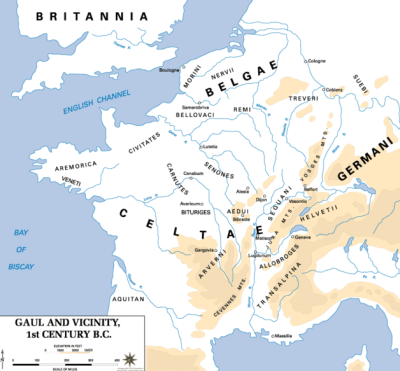
Gaul, inhabited by Celtic tribes, has long been the territory of Rome’s economic and political expansion. It was mainly facilitated by the political relations in this area, because despite ethnic and cultural unity, the Celts did not manage to create a larger political organism. The mass of the population, devoted mainly to agriculture, depended on the tribal aristocracy to wage fierce wars among themselves. As a result, two more important tribal centers were established in Gaul. The first was centred around the Sequans, the second around the Aeduii who were allied with Rome.
Gaul in Caesar’s time was divided into 3 parts. The Belgians settled in the territories of what is now northern France and western Belgium, among which the largest and strongest were the tribes of Nervii, Menapias, Treveri and Eburons. The Aquitans lived south of the Garonne River as far as the Pyrenees. However, the central part of Gaul was taken over by the Celts. The Celts, or rather the Protocelts, who dominated the other Gallic peoples, came to these areas in the middle of the first millennium BCE.
The Gauls grouped into larger groups only when the territory had to be conquered, then individual tribes occupied their territory to bleed out in fratricidal wars with other Celtic tribes. Their reluctance to unite into a single state was also equal to their reluctance to introduce royal power in the tribes. The chiefs were elected by the tribal elders and could not exercise their power absolutely, nor was it hereditary. Constant, incessant fratricidal wars bled and weakened individual Celtic tribes in Gaul to such an extent that they became easy prey for the neighbours of the Germanic tribes and ancient Rome.
The Eduans and the Sequans, who lived in the area of today’s central-eastern France, who waged constant wars with each other to control the banks of the Saone River, was called Arar in antiquity. One of such wars, fought in the 1st century BCE, was won by the Edu, but the Sequans could not come to terms with it, they decided to ally themselves with another tribe hostile to the Edu – the Arverni. Another war broke out, which also ended with a victory for the Edu. To save themselves from a complete defeat, the Sequans asked for help from the Germanic Suebi who lived across the Rhine.
King of Suebii Ariovist agreed to help, he had long struggled with the problem of the growth of his tribe’s population, not all of them had enough land. In 70 BCE he entered Gaul and defeated the Edu in a battle near Saone. The grateful Sequans were going to pay Ariovistus for help, hoping for his swift withdrawal across the Rhine. The latter, however, not only did not intend to return but also demanded land in today’s Alsace and began to bring the rest of his tribe to Gaul. The Sequans did not have the strength to fight him, so they agreed.
Ariovistov was not enough. Knowing that he had the largest army in Gaul, he decided to become the lord of the Gauls. He taxed not only the defeated Aeduii, but also other Gallic tribes, including the Seine. In 65 BCE, the Eduans, allied with the Seine, could no longer bear the tyranny of the Ariovistus, and revolted. At the Battle of Magetobryga, the entire tribe of the Aeduii was nearly destroyed. Ariovista became the undisputed lord of all Gaul, there was no longer a military force in Gaul to resist him, except for one unification of the tribes in the face of a common enemy, but the Gauls were not ready for this.
Two parties began to form with completely different ideas for liberation. The first, represented by aristocrats and supported by druids, stood in the position of seeking help against the Suebi outside among other peoples and states, mainly in Rome. To this end, in 61 BCE, druid Divitiac went to Rome, who tried to convince the Romans of the need to help the Gauls. Despite the support of Cicero, he did not get anything.
Rome then lived with internal affairs – Catiline’s conspiracy or Italy’s economic problems, as well as the war against King Pontus Mithridates VI and did not want to get involved in Gaul. The second was the people’s party, whose representatives came from nouveau riche Gallic families and sought to take power away from the aristocracy. They argued that one should not look back on allies, because after defeating the Germans, the former allies could turn into enemies, so you should fight back Ariovista with your own strength.
Orgetorix was one of the powerful Helvetian tribe in what is now Switzerland and secretly sought to gain royal power for himself in the tribe. To achieve this goal, he began to build his popularity, calling for the Helvetians to leave their homes and to look for new fertile areas for further expansion. To this end, he began negotiating with the Eduans and the Seine, officially to secure the area of a possible route, in fact seeking help from these tribes to make themselves king. The plot was uncovered, however, and Orgetorix was sentenced to death for his pursuit of royal power. But the Helvetians did not abandon their plans to march west of Gaul, and by about 58 BCE they began preparing for the trek.

Caesar in Gaul. Campaign of the year 58 BCE. Destruction of the Helvetians, Ariovistus’ exile beyond the Rhine
In 60 BCE there was a 1st triumvirate between Gaius Julius Caesar striving for consul dignity, Pompey, whom the Roman Senate deceived to confer triumph and land his veterans, and Marcus Crassus, the conqueror of the Spartacus uprising, one of the richest Romans, who also had great political ambitions, and for some time even belonged to the party hostile to Pompey in the Roman Senate.
The triumvirs made an agreement, the motto of which has now become nothing in the Commonwealth that would not be liked by any of the three. Initially, the existence of a triumvirate was not guessed in Rome, but over time everything began to fall into a coherent whole. Marcus Varron called this conspiracy a trikaranos – a three-headed monster. The first success of the triumvirs was the election of Caesar as the consul of 59 BCE. One of Caesar’s first orders was to publish the minutes of senate meetings in the official journal Acta Diurna, so that Roman citizens could read the course of the proceedings and make sure which politicians were acting in favour of the interests of the Roman people who are against.
The senators were outraged, but no one dared to question the power of the triumvirs. Efforts were made to persuade Pompey to break the contract with Caesar and Crassus, in theatres actors paid by politicians repeated words addressed to Pompey – There will come a time when you will bitterly regret your present greatness. However, this did not help, Pompey continued to support Caesar. Caesar, on the other hand, tried to secure the governorship of one of the key provinces, because he knew about the hostility of the senators towards him, he also knew that this was the only way to ensure his own safety.
The Senate, fearing such a move by Caesar, passed a resolution that the consuls of 59 BCE would have to remain in Italy as “forest and pasture commissioners”, which meant they took tertiary positions in the administration. The support is given to Caesar by Pompey and Crassus effectively neutralized this law. Caesar, however, tried to publicly convince him that he was indifferent to the choice of the future province, in fact, he ordered Vatinius, devoted to himself, people’s tribune, to pass a law at the people’s assembly giving Caesar Pre-Alpine Gaul as one of the most important provinces in the empire.
Three legions were stationed there, but the governorship of this peaceful province did not bode hope for military expeditions, while Caesar needed money badly. He decided on the Narbonne Gaul, and Pompey himself submitted the motion in the Senate. Caesar got only one legion, but he had the opportunity to prove himself as a leader and conqueror, and most importantly, gain money for the further struggle for power.
With his taking over the province of Caesar he faced quite a problem in March 58 BCE, the Helvetians left their former seats, burning everything to the ground so that they could no longer return here, and headed west. Caesar left Rome on March 20, and on March 28 he arrived in the new province. He immediately ordered the destruction of the bridge over the Rhone through which the Helvetians intended to pass. Caesar had no army, he had only one legion, and meanwhile, Helvetic envoys came to him at Genava, asking him to pass through the Roman territory without doing any harm.
Caesar ordered them to appear in the April Ides – April 13, at the same time he ordered the recruit to be collected here in the province and carried out the necessary fortification works on the mountainous bank of the Rhone River. When the envoys appeared a second time, he told them that: it is not the custom of the Roman people to let anyone through their territory. The Helvetians made an armed attempt to cross the Rhone – they used rafts and boats tied together, and conquered Roman fortifications on the other side of the river. Subsequent attempts were unsuccessful, so the Helvetians decided to open their way to the southwest in one great battle.
The Helvetians stormed the Edu land, burning everything in their path and trying to get around the Roman fortifications from the other side. Caesar hurried to Pre-Alpine Gaul, took the 3 legions stationed there with him, and returned to his province through the Mt. Genevre. In June 58 BCE he entered the lands of the Gauls. The first clash with the Helvetians took place on the Arar River, where the Romans defeated the Helvetic rear guards. Then he chased the enemy and for more than 2 weeks tried to force him to accept the battle. Time was on the side of the Helvetians, the Roman army ran out of provisions and Caesar could no longer pursue the Gauls, he decided to retreat to Bibrakte.
The Helvetians decided that the Romans were fleeing and decided to attack them at Bibrakte. The battle began with the Helvetii attacking the Roman cavalry on the road to Bibrakte. The Romans suffered heavy losses and had to withdraw. The Gauls then struck Caesar’s main force on the hill but were repulsed. Now the Romans have hit the Helvetic position. Then the Romans were almost defeated when they were attacked from the left flank by the Fighters and Tulingas, allied with the Helvetians. Caesar, observing the battle from his fortified camp on the hill, commanded the third rank of each legion to reverse their formation and, flanking, repel the attack of the Gauls.
Caesar then launched his reserves aided by the Roman cavalry, which reappeared on the battlefield. Thus, he sealed the fate of the battle. Over 130,000 people died on the battlefield. Helvetii (2/3 of the entire tribe’s population) and their allies. The Helvetic leaders threw themselves at Caesar’s feet, begging for peace under all conditions. Caesar treated the defeated relatively mildly, he only demanded the release of weapons and hostages, but he punished the Helvetic fugitives very severely, selling them into slavery. After the battle of Bibrakte, all the people of Gaul gained respect for Caesar and the Romans.

After the victory over the Helvetians, all the Celtic peoples of Gaul sent their messages to Caesar. Gauls began to appear as the liberator of Gaul from Ariovista. The deputies of individual tribes asked him for help in the fight against King Suebi. Caesar, without promising anything, assured them that he would get acquainted with the matter. He also advised the Eduom to stop paying tribute imposed by the Ariovista, which they did. Ariovistus decided to go to the Gauls, but before he did, Caesar’s envoys came to him, inviting the king to meet Caesar.
Ariovistus said boldly that if Caesar wants something from him, let him go to the trouble of himself. However, the meeting did take place, king Suebii demanded that they talk to the horses and have the protection of ten people with them. During the conversation, Ariovistus stated that all northern Gaul belongs to him, as does the south to Caesar, and if he does not exceed the boundary of the sphere of influence, Caesar should not do so either. They did not come to an agreement, but that was not the aim of Ariovista, he planned to kill Caesar during the conversation. The coup failed, but that meant war.
Before the battle, Caesar spoke to the soldiers, declaring to them that if they were afraid, he alone at the head of only the 10th legion would attack the enemy. The speech made a great impression on the soldiers and gave them confidence. The battle took place in the area of the Doller River, between Aspach-le-Bas and Cernay. At first, Ariovistus intended to cut Caesar from the hinterland, strengthening himself at his rear. However, the latter, having removed some of his forces, established a second camp south of the Germans, which thwarted the Ariovista’s plan. The troops stood opposite each other for several days, because Ariovistus wanted to tire the Romans as much as possible and avoided battle.
There were only small skirmishes of the German cavalry, supported by foot warriors, with Caesar’s Gallic army, which usually ended with the successes of the Suebi. Finally, after a dozen or so days, there was a battle. The Romans smashed Ariovista’s right flank, but on the left flank, the Romans had to retreat. Then, on the orders of Caesar, Crassus led the third row of the right legion out of the smaller camp and attacked the Germans from behind. It was the decisive manoeuvre to end the battle.
The Suebi rushed to flee, and the Germanic camps, where Germanic women were hiding, fell into the hands of the Romans. Two wives and the daughter of Ariowista were also killed during the slaughter. Ariovistus fled across the Rhine, and Caesar’s position in Gaul grew disproportionately. He gained control over the entire central part of present-day France. The Battle of the Vosges stopped the Germanic invasions of Gaul for almost 300 years. Caesar spread his troops to winter quarters, and he left for Pre-Alpine Gaul. This is how the first year of the Gallic War ended.
Campaign of 57 BCE. The subjugation of the Belgians

Caesar wanted to submit to his power also the tribes of northern Gaul – the Belgians. The Belgians themselves were also reluctant to see Caesar’s actions in Gaul. With the advent of the new year, 57 BCE, Caesar carried out new hauls and already had a total of 8 legions. However, such a far-reaching and strenuous campaign could not be carried out without the Senate’s consent and justify it by defending the province of Narbonne. However, Caesar was informed of the Belgians’ preparations for the war, he decided not to wait for the Senate’s decision, and in May this year he set off from Wezontio towards Belgium.
Within a few days, he reached the Matrona River (Marne). Surprised by this, the Rems surrendered to Caesar at once. At the same time, he was informed about the size of the Belgian army, it numbered around 350,000. warriors under the command of the king of the Bellows tribe – Galba, and Caesar’s forces numbered no more than 50,000. soldiers. In order to distract the Bellows from the main Belgian forces, Caesar ordered the Edu leader – Dywicjakus to invade the lands of the Bellows. He himself went to Axson. The Belgians attacked the Rems faithful to Caesar and besieged their capital Bibraks.
The Rems turned to Caesar for immediate help. He sent them light-armed troops, which, although not numerous, effectively discouraged the Belgians from further attempts to capture the city. The Belgians now turned to Axon, against Caesar’s forces. Their number was evidenced by the glow of lit torches, which extended over a distance of 12 kilometres. Now Caesar was in no hurry to battle, he wanted his soldiers to get used to the sight first.
Finally, he ordered the legions to stand in battle formation, and the Belgians also lined up for the battle, but the clash did not take place, neither side wanted to strike first. Finally, impatient Belgians decided to attack the Romans from the right flank. To this end, they began forcing the Aksony from the southeast. Caesar sent his cavalry there, which effectively prevented them from making this attempt. As dusk fell, news reached the Belgian camp of the Edu attack on the land of the Bellows.
They decided to come back to defend their homeland, but some Belgians still wanted to fight the Romans. There were minor disagreements in the Belgian camp, and finally, it was decided to turn back. Only in the morning, Caesar realized that the Belgian camp was empty. He chased them. The Romans caught up with the Belgian rear guard, which, however, rejected them, the sounds of the fighting reached the first Belgian units. Panic broke out, the Romans killed almost 300,000. Belgians who died in a panic escape. The Belgians, who were considered the bravest people in Gaul, were defeated without a battle.
Caesar now entered the lands of the Suebi tribe, their capital Noviodunum surrendered without a fight. Then Bratuspantium – the capital of the Bellows, surrendered, their leaders fled to Britain. Then Samarobriva – the capital of the Ambians. Caesar now turned north and reached the lands of the Nervii, they were not going to surrender to him. They allied with the Atrebates and Viromandes and then planted themselves on the Romans on the marshy backwaters of the Sabis River. Here, too, the unsuspecting Caesar ordered to set up the camp.
At a time when the Romans were busy building fortifications, they were suddenly attacked by hordes of Belgians, carrying away the advanced Roman ranks of legionaries. On the left-wing of the Romans, Titus Labienus, commanding 2 legions (IX and X), repelled all attacks of the Atrebates and ousted them for the Sabis. The VIII and XI legions also repelled the Viromand attacks, but by pushing them towards the forests beyond the Sabis River, they exposed their right flank. The Nervii took advantage of this by encircling the 7th and 12th Legions. The situation was becoming dramatic, the Romans were encircled, Caesar himself had to fight with a sword in his hand like an ordinary soldier.
Terror seized the Romans when the Belgians captured their camp. The Roman cavalry fled. However, despite the ferocity of the fight, Caesar ordered the VII and XII legions to protect each other. It was then that the thirteenth and fourteenth legions, previously covering the rolling stock, struck. Also, Labienus, seeing how desperate Caesar found himself, sent the 10th legion to his aid, which attacked the Nervii from the right-wing, destroying the Belgian defence. In the battle of Sabis, all the Nervii warriors died, several hundred thousand, and the tribe practically ceased to exist.
Campaign of 56 BCE Defeat the Venets
Upon the news of Caesar’s great victory in Gaul, the Senate, at the request of Caesar’s 2 remaining triumvirs in the capital, announced prayers of thanksgiving for more than 2 weeks, and games were organized for the Roman people. But Caesar’s situation in Gaul, despite his victory over the Belgians, even worsened. All peoples from the Rhine to the Loire disobeyed Caesar. Caesar spent the winter of 57 BCE/56 BCE in IIliria under his authority. It was related to the deteriorating political situation in Rome for the triumvirs.
Since Caesar left for Gaul, relations between Pompey and Crassus had deteriorated significantly. It was seen as a connection with the attacks of the armed troops of Publius Clodius gathered in 59 BCE, which terrorized Rome and were directed against Pompey, although they were forbidden to attack him, and a silent satisfaction because of this, even inciting them, Crassus. While Clodius was probably paid by Crassus, the armed bands of Titus Annius Milo, founded in 57 BCE, were officially financed by Pompey.
For the first year and a half, however, beginning in 58 BCE, when Clodius was elected with the support of Caesar as a tribune of the people, he earned great popularity among the commoners of the capital. He even became the “uncrowned king of Rome”. He passed an act on the free distribution of grain among the commoners of the city. It was a revolutionary move because until now the grain was sold, admittedly at reduced prices, but still to the Roman plebs. To maintain his position, he used his “troops” against his political opponents, especially the people associated with Cicero and Pompey. In order to legalize these gangs, he ordered them to be entered into the artisanal brotherhoods of collegia.
In the same 58 BCE, Clodius exiled Cicero from Rome. The reason was the law prohibiting the sentencing to death of Roman citizens, which Cicero had committed after discovering the Catiline conspiracy 5 years earlier in 63 BCE. He also got rid of Cato from Rome, sending him to Cyprus with the task of confiscating the royal treasury of Ptolemy, the younger brother of the king of Egypt Ptolemy XII, who was legally deprived of power, and incorporated his kingdom (Cyprus) into the Empire.
Clodius made the mistake of attacking against the prohibition of Caesar Pompey, whose gangs besieged at home. The next year, 57 BCE, he set up his troops under the command of Milo and called on his veterans for help. Rome became the arena of daily bloody clashes between the two bands. And Caesar, while waging a war, wanted his interests secured in Rome, for his enemies had already begun to remember himself. Pompey, on the other hand, by militating against Clodius, won the great support of the Roman people, which Clodius lost mainly due to attacks on merchants and the collection of tributes established by his armed troops.
He managed to annul the exile of Cicero, for whom, upon his return, he prepared a grand reception of 57 BCE. The Senate granted him extraordinary powers to supply Rome with Egyptian grain, the supply of which was in short supply. Pompey solved the problem quickly, gaining true “love of the people”. In March 56 BCE Cicero and Lucius Domitius Ahenobarbus launched a campaign against Caesar in the Senate. In two speeches pro Sestio and in Vatinum, Cicero attacked Caesar, but gently enough not to provoke Pompey’s anger. To counter this, Caesar requested a meeting with Pompey, and despite his initial hesitations, eventually went to Lucca, Italy, where a meeting of the three triumvirs was to be held to renew the alliance.
In Rome, horror seized many politicians, they flocked to Lucca with the intention of supporting the triumvirs. About a hundred senators attended. A new treaty was concluded, as a result of which Caesar extended his governorship in Gaul by five years. Pompey took over the province of Nearer Spain, and Crassus took over Syria. Caesar thus gave Pompey complete control over Rome. Cicero had to give up his rhetoric against Caesar. He even praised his achievements in Gaul and offered to extend his governorship in this land. Pompey was gaining more and more power over the state.
In Rome, however, the state of political chaos continued. In December 52 BCE, in a skirmish between the gangs of Clodius and Milo, Clodius fell at the gates of the city. An enraged crowd of his supporters moved to the Forum Romanum, burning down many buildings along the way, including the senate building. The Senate immediately granted Pompey special powers to restore order in the city. And the latter wasted no time, ordered conscription in Italy and moved against the rebels, massacring them. After this victory, the Senate granted Pompey a consulate with dictatorial powers. It was the first step to a civil war with Caesar.
Caesar arrived in Gaul in April 56 BCE. The situation here was not good. The Venetians, the Gallic people based in Aremorica (today’s Brittany), spoke out openly against Rome. They were supported by the Moryns and the Menapias. Belgium, conquered just a few months earlier, began to revolt, Caesar was informed of the alliance of the Belgians with the Germans. Anti-Roman sentiment prevailed in the south of Gaul in Aquitaine, and there were reports of meals coming from Celtic Britain.
Caesar sent a Roman cavalry to Belgium under the command of Titus Labienus. Publius Crassus with 12 cohorts was sent to Aquitaine. Caesar sent Sabinus to Normandy, and he himself moved against the Venetians. The campaign seemed simple, the Venetian settlements were not large and weakly fortified, but all of them were built on the shores of the Atlantic Ocean, on small promontories, to which a narrow road led from the coast.
The conquest of such a settlement, with such terrain conditions, could not be achieved without siege machines. When the Romans built such machines and attacked the settlement, the inhabitants were calmly leaving for another town scattered on the coast, and the siege had to be started anew. The legions were tired of strenuous marches that were to no avail. Caesar realized that without warships he would not defeat the Venetian tribe, so he ordered the construction of his fleet at the mouth of the Loire.
Caesar brought rowers and steersmen, slingers and archers to the built ships. The entire Caesar’s navy was commanded by Decimus Brutus – brother of Marcus Brutus. In September of that year, the Romans sailed against the Venets to the Quiberon Bay area. The Venetians, noticing the Romans, lined up 220 of their warships in battle formation. The ships of the Gauls differed significantly from the Roman galleys. They were large, massive ships made entirely of oak, while the Roman fleet were galleys with three rows of oars, smaller and lighter than Gallic ones, but much faster with a rowing-sail drive.
The Gauls, seeing such a fleet, were sure of an easy victory. The Romans could not use the traditional method of sticking the ship’s bow into an enemy ship, or even casting a corvus – a raven, the Gauls’ ships were too strong and too tall. A different solution was chosen. The Romans approached the Gallic ships, throwing sharp scythes attached to the poles on the enemy’s rigging, while they were sailing at a fairly high speed. As a result, the masts of Gallic ships were torn off, and two Roman galleys approached the immobilized ship, boarding it.
The Gauls tried to save themselves by fleeing towards the ocean, but they were very unlucky, the wind stopped completely, there was a sea silence, which sealed the complete defeat of the Venetians. Until now, Caesar, defeating his opponents, showed them grace, or at least he did not oppress the beaten, everything changed in the country of the Venetians. Caesar condemned all the elders of the tribe to death and sold all the people into slavery. This is how the Venets disappeared from the map of Gaul.
Campaign of 55 BCE Slaughter of the Germans. First trip to Britain
After defeating the Venetians, Caesar headed north of the country against the Morynas and the Menapias, but they fled from him into dense forests. Another danger has appeared. At the turn of 56 BCE and 55 BCE, the Rhine was crossed by the hordes of the Germanic tribes of Usipet and Tenkter. It was reported to Caesar that many Gallic tribes would wish for the return of the Germans to help expel the Romans from Gaul. Caesar, wasting no time, gathered the legions from the winter lairs and set off after the Meuse. Before he reached the camp of the Germans, Germanic envoys came to him, asking for the possibility of living in Gaul, and in return, they promised to accept the sovereignty of Rome.
Caesar refused but stated that they could settle across the Rhine in the country of the Ubii. The conversations were unsuccessful, but the Germans forcibly dragged them out, and at the same time intensely armed them. They attacked and crashed Caesar’s Gallic cavalry – formed of Gauls fighting on the side of Rome. As soon as the Germanic envoys came to Caesar, wanting to excuse himself from the attack, he ordered them imprisoned, while his legions were already marching to the Germanic camp. They were not prepared to defend themselves, panic broke out, and the Germans fled across the Rhine. Those who did not manage to cross the river were massacred, many drowned in the Rhine. 400,000 were killed Germans, including women and children. Nobody died from the Romans. Caesar prevented the Germans from entering Gaul for the second time.
Caesar decided once and for all to solve the problem of the Germanic tribes migrating to Gauland to defeat them on their own land. The Ubias promised Caesar to supply the boats needed to cross the Rhine, but he decided to use a different method of crossing the river. Caesar ordered a bridge to be built through which he would lead his legions to the other side of the river. He wanted to provide the troops with a permanent connection with Gaul, as well as demonstrate to the Germans his power.
In June 55 BCE, in ten days, a huge wooden bridge was built near today’s Koblenz, through which the Romans crossed to the other side of the Rhine. The psychological effect was achieved, the Germanic tribes one by one began to beg Caesar for peace, or to flee into the dense forests of Germania. After 18 days of the Germanic campaign, Caesar decided to return to Gaul. The goal was achieved, the Germanic tribes were so intimidated that they did not dare to cross rivers for 300 consecutive years. Retreating from Germania, the legionaries destroyed the bridge behind them.
First trip to Britain
Caesar’s conquest
The expedition of Roman legions led by Caesar to Britain is presented in detail.
After subjugating the Germans, Caesar decided to teach a lesson also to the Britons, who had been sheltering various refugees from Gaul for a long time. He also wanted to show them that the power of Rome would reach them even beyond the canal. Caesar appointed the headquarters of preparations for the invasion of Britain in the town of Gesoriakum (today’s Bolougne) and here he prepared an invasion fleet. Caesar’s fleet set out in the morning of August 26, 55 BCE, consisted of 80 transport ships carrying 2 legions (VII and X) and several dozen warships.
Around nine o’clock, the ships reached the shores of Britain near what is today Dover. However, here the Romans saw the Brut tribe of Britain standing on the beach and ready to fight, so it was decided to make a landing further north in the area of Deal town. Here, too, the beach and the surrounding hills were manned by the Bruts who marched along the coast from Dover to Deal. The Brutes were confident, they knew the Romans had to go ashore first to face them. They did not expect, however, shelling the shore with catapults. The great arrows fired from Roman ships wreaked havoc and havoc in the ranks of the Brutes. They had to leave the beach and retreat further afield.
Thanks to this, the Romans landed in Britain and launched an attack on the disorganized and decimated troops of the Brutes who rushed to flee. The Romans were unable to take advantage of the victory and smash the Brutes because their cavalry had not yet reached the shore. During this time, the Brutes withdrew. The ships carrying the Roman cavalry could not come ashore due to strong canal winds and turned back to Gaul. After the victory, British envoys came to Caesar, asking for peace, and pledged to hand over the fugitives and the prisoners. However, the situation changed on August 31. On the night of August 30-31, many Roman transport ships were destroyed in the canal as a result of strong sea currents, and warships were severely damaged.
The Britons, seeing how the Romans found themselves in a critical position, cut off from Gaul and without provisions, decided to attack them. The 7th Legion was attacked and managed to push back the attackers. The Britons gathered greater forces and set off against the Romans. The battle ended with the defeat of the Britons, who fled deep into the country, and the Romans, having no cavalry, again could not take advantage of this victory. A horse unit of 40 riders was hastily organized, but it did not matter much. Caesar knew that staying in Britain would completely weaken his strength, in mid-September, after having repaired some of the ships, the Romans returned to Gaul.
Campaign of 54 BCE. Second trip to Britain. The rebellion of the Belgians
At the beginning of 54 BCE, Caesar began great preparations for the next expedition to Britain. The planned expedition aroused great interest in Rome itself. Many politicians, expecting a great loot, asked Caesar to accept their relatives and protégés for military service. But it was also jealous, as was the unflattering poem by Mamurrus about Catullus – one of Caesar’s officers, disseminated in Rome, which envied him the wealth and success of the fair sex. Cicero also asked Caesar to admit his brother Quintus to the army, who had to flee Rome from his creditors.
Before Caesar left for Britain, however, he had to calm the feuding leaders of the Treveri tribe inhabiting Belgium. After the matter was resolved, he was finally able to go to Britain. The Roman fleet set out on July 21, 54 BCE. Caesar amassed 800 invasion ships carrying 5 legions with 2,000 soldiers. driving. As a result of strong winds, they had to land north of the expected place, in the area of today’s Sandown Castle. The Britons no longer defended the coast, Caesar, after landing and building a camp, moved deep into the country. The Romans encountered an enemy in the area of today’s Canterbury.
The Romans crashed the Britons’ cavalry and combat vehicles on the River Stour, and the 7th Legion cleared the area of the nearby forest of British infantry. Caesar intended to pursue the Britons and deal them with a decisive defeat, but news came to him of the destruction of many ships in the great storm that passed over the bay. He had to turn back. 40 ships were completely destroyed, the rest could be repaired. It took the Romans ten days to repair damaged ships, dig moats, and build embankments to cover the area where the ships were stationed. After completing the work, Caesar set off again for the Canterbury area, there he encountered a British army made up of all the tribes of the south-eastern part of the island, who appointed the king of the Katuwelaun tribe – Kassywelaunus.
The battle began with an attack by British cavalry and combat vehicles on Roman infantry. A Roman cavalry set out to help the legionaries, which beat the Britons and forced them to withdraw. The Romans, however, suffered great losses. Another British attack came as the Romans prepared to build a camp. As a result of the attack, 2 Roman cohorts and the advance guard were abolished, but the enemy was forced out, with heavy losses on the side of Caesar’s legions. The next British attack, which took place the next day, was unsuccessful. They were repulsed, losing many warriors. The Romans went to the counterattack with the help of the hostile Katuwelaunom – Trinovants, the legionaries struck and captured the fortified large city of Verulan on the Thames, the capital of Kassywelaunus.
The beaten king decided to use the tactics of scorched earth and small guerrilla forays into Roman positions, which became quite burdensome and in the long run could end in the defeat of the Romans. The more so because news came to Caesar that the seaside camp had been attacked by the Kant tribe allied with Kassywelaunus. The attackers were repulsed, but more such forays were expected. Caesar found himself in a difficult situation, torn by British troops, all he wanted was a room so that he could return to Gaul with his face.
So when Kassywelaunus’ envoys appeared in his camp, asking for peace, he eagerly took advantage of it. He wanted to return to Gaul, but to emphasize that he was the winner, he demanded hostages and gave individual peoples an annual tribute. It was just a ploy, for it was obvious that after the Romans left Britain, no one would pay the tribute. Caesar did not implement his plan – the conquest of Britain, but he successfully prevented the Britons from getting involved in the affairs of Gaul. The Romans departed in mid-September to come again after almost a hundred years under Emperor Claudius.
After his return from Britain, Caesar heard rumors of a rise in anti-Roman sentiment in Gaul. He decided not to deploy the legions to the winter lair in one place, but to place them in different regions of Gaul to summon any rebels to order. He himself intended to spend the winter in Samarobryvo – today’s Amiens, in the camp of Gaius Trebonius. Belgium was the most uncertain, and therefore the legions stationed there, led by Quintus Titurius Sabinus and Lucius Arunkulejus Cotta, were ordered to be particularly vigilant.
However, the stay of the Romans in the country of the Eburones promised to be successful. Both chiefs of the tribe Ambiorix and Katuwolkus assured of their loyalty and regularly provided grain quotas. The Romans stopped taking care of their safety, they went out with whole units outside the camp, without even trying to secure the area where they were collecting trees. During one such foray, they were attacked by the Eburon cavalry, and the tribe’s infantry struck the camp. Although the enemy was repulsed, the Romans were terrified by this development.
At night Ambiorix himself came to the Roman camp, he wanted to explain himself to the Romans about the attack. He stated that he had been forced to make this excursion by the will of his people, and that he himself was still a faithful ally of Rome. He also said that not only the Eburones took up arms, on the same day other tribes also attacked the Roman camps, and the hordes of Germans were already coming from across the Rhine, and he, as Caesar’s faithful friend, advises the Romans to leave the camp and go to the nearest winter camp in the south the country of the Belgians in order to join Roman forces. The Romans did not know whether the Eburon chief was telling the truth or bluffing.
There was a violent council in the Roman camp. Sabinus believed that in the present situation it would be better if they joined forces with the troops under the command of Quintus Cicero, stationed in the area of today’s Namur. Kott, on the other hand, believed that they were not allowed to leave the winter quarters without Caesar’s orders. However, then he relented, it was decided to set off in the early morning of the next day, which is October 21, 54 BCE. As soon as the Romans left the camp, the Eburon troops surrounded them on all sides. Sabinus was lost, he was unable to give meaningful orders, and Kotta ordered the legionaries to form a circle formation. This was advantageous, since this positioning of the troops was almost perfect, the legionaries shielded themselves from all sides, until the enemy found a gap through which to break in, then the legion went to disintegrate.
On the other hand, Kott’s carriages were to be left for the spoils of the enemies. However, also here Ambiorix outsmarted the Romans once again, forbade his robbing of the caravans and ordered them to attack with single attacks, then retreat before the legionaries’ blow, and again attack again. Seeing what was happening, Sabinus asked Ambiorix to speak to him. He agreed, and as soon as the Roman was outside the legion, he was disgraced and killed. Kotta died shortly afterwards in the fight. Almost 6,000 were killed on the battlefield. legionaries, only a few survived, who tried to reach Cicero’s camp through dense forests.
Ambiorix knew that everything now depends on the speed of his actions. Namurcum – Cicero’s camp, located about 70 km from Aduatuka, needed to be captured, before news of the defeat of Sabinus and Cotta reached there. He set off immediately, and on the way he was joined by two more Belgian tribes who had already learned about the first defeat of the Romans in Gaul – the Attukos and the Nervii. He managed to surprise the Romans collecting a tree. He beat them up and on the march struck the fortifications of the camp. However, he was repulsed. He undertook subsequent assaults, which ended in failure only thanks to the tireless perseverance of the defenders.
However, the situation of the defenders was getting worse. Namurcum had 4 thousand. legionaries, while the advancing Gauls over 40 thousand. All the wounded and the sick fought in the Roman camp, the example of sacrifice and tireless will to fight was the leader of Quintus Cicero himself. He, a man of frail stature, fond of luxuries and lovers of pleasure, did not allow himself a moment of rest, toured the fortifications, supervised fortifications, fought, did not sleep all nights, until his own soldiers forced him to sleep at least a few hours. Ambiorix was aware of the problems of the Romans, he decided to use the same trick as in the case of Sabinus and Cotta.
He sent envoys to Cicero who were to tell the Roman of Ambiorix’s loyalty, who advised them to leave the camp and join other troops. Cicero replied that it was not customary for the Roman people to take advice from an armed opponent, and added that if they lay down their weapons, he would plead for them to Caesar. Ambiorix did not do anything that way. The Belgians surrounded the camp in a Roman manner with a network of embankments extending over an area of 5 kilometers, which they erected in 3 hours. On the seventh day of the siege, the Gauls launched a great assault, managed to start a fire in the Roman camp, but achieved nothing, but suffered heavy losses. Cicero sent individual soldiers who could break through the enemy’s fortifications and notify Caesar.
The Eburones, however, caught and lost them after being tortured in front of the Romans. Finally, one managed to outsmart the Gallic guards and reached Caesar’s headquarters with a letter. He immediately ordered an alarm. They went to the rescue within 2 hours. The Gauls, too, learned of the relief, laid a siege and went against Caesar. They were sure of an easy victory, Caesar had only 7,000. soldiers. Halfway up, the two armies met and a battle ensued. The Gauls were smashed and fled north to their homes, and Caesar already had an open road to Cicero’s camp. When he entered the camp, all the soldiers who were alive greeted him with a thunderous Ave Caesar. The danger was averted.
Campaign of 53 BCE. Extermination of the Eburons
Caesar realized that his power over Gaul was slipping away from him. In November 54 BCE the allies of the Eburones – Trewers attacked the Roman camp of Titus Labienus in the area of today’s China. Although they were repulsed and their leader Indutiomarus was killed, all Gaul was already living with the news of the first defeat of the Romans at Aduatuka. The leaders of individual tribes officially promised loyalty, but secretly plotted among themselves to prepare for the uprising and expulsion of the Romans from Gaul. Caesar did not have time, he had to nip the rebellion in the bud.
At the beginning of the new year, 53 BCE, he moved to the land of the Nervii, devastated it and the inhabitants fled into dense forests. He moved now against the Senons and Carnutes, who had humbled themselves before him. He then headed north to the land of the Menapia, ravaged the land, and forced the tribal chiefs to surrender and pay tribute to him. Troubled by the news of the alliance of the Eburons with the Germans, he decided to solve the case of the Germanic allies once and for all.
The Romans built a second bridge over the Rhine near today’s Kasselheim, 5 kilometers east of the previous crossing in 55 BCE. Caesar realized that his forces were not great, he did not intend to conquer Germania, he only wanted to prove to both the Gauls and the Germans that the Roman army remains powerful and capable of offensive action despite the defeat at Aduatuka. He moved against the Suebi, with whom Ambiorix had allied. They fled from him and hid in the forests. The Romans ravaged the country of Suebi and returned to Gaul, destroying the bridge behind them. The campaign was successful, the Germans no longer intended to help Ambiorix in the further fight against the Romans.
Now Caesar has turned against his greatest enemy – Ambiorix. Thanks to the spies, he obtained precise information on the whereabouts of Ambiorix. The Eburones were completely surprised, Ambiorix was saved only thanks to the help of one of his warriors, who gave him a horse. The Eburon force had been killed, but Caesar knew that victory would be complete only when he imprisoned or killed Ambiorix. Ambiorix was aware that he had no chance in an open fight against the Romans, so he ordered all men and women with the children of his tribe to hide in dense forests and scattered throughout the territory of the Eburonese country. Caesar did not intend to risk the legionaries’ lives in fighting in forests where no formation could be developed. The legionaries would have to fight one-on-one, which could have ended tragically for them if the Romans did not know the area.
He has declared the land of the Eburones free to anyone who wants to loot and burn here. Multitudes of Gauls flocked here from all corners with the intention of murdering their fellows. Caesar even allowed the Germans to cross the Rhine to help exterminate the Eburon tribe. However, he quickly regretted it, the Germans had little to ravage the country of Ambiorix, they decided to attack the Roman camp in Aduatuka. The legionaries, with great difficulty, with great losses, managed to repel the attack. Ambiorix probably died with his tribe, although his body was not found. The last act of this slaughter was stabing to kill Akka, the leader of the Senon tribe, an ally of Ambiorix. All Gaul was pacified and conquered by the Romans.
Campaign of 52 BCE. Rise of Vercingetorix
Despite the capture of Gaul, Caesar’s position in Rome began to wane. In 54 BCE, Julia, Caesar’s only daughter, died, and at the same time had a living bond with Pompey, whose wife she was. The situation got even more complicated when in June 53 BCE Crassus, one of the triumvirs, died in the battle with the Parthians at Carrhae in the Syrian desert. Caesar tried to convince Pompey to marry his great-uncle Octavia, but the latter refused and married Crassus’s widow, Cornelia. In January 52 BCE, Clodius was killed, whose armed forces were for a time financed by Crassus, and had long belonged to Caesar’s supporters. Only Milo’s gangs remained in Rome, at the service of Pompey.
Soon after, the Senate granted Pompey special powers to prevent robberies in Rome by Milo’s troops. Pompey also obtained the right to carry out military drafts in Italy and was elected the consul of 52 BCE Pompey had accumulated great power in his hands, he could do everything in Rome and Italy, carry out any law, and thanks to armed troops, he turned Rome into a truly Pompeian territory. Pompey, however, did not take any steps unfriendly to Caesar, except for one that he carried out the recruit in Italy, which was perceived among the Gallic tribes as the beginning of a civil war with Caesar. The Gauls decided the time was right to start a great uprising against Caesar, hated even by the Romans.
Description of the Rise of Vercingetorix
Campaign of 51 BCE Finis Galliae
Despite the total victory, Caesar decided not to return to Italy, he was afraid of more Gallic “moves”. Though Vercingetorix and many of his chieftains were imprisoned, there was still no peace. Indeed, in November 52 BCE he had to go to the land of the Bituriges and Carnutes on the Loire to quell a small rebellion. A major uprising took place at the end of April 51 BCE in the country of the Belgian Bellows. These allied with the Atrebates, Kalets, and Eburones, while Korreus and Commius were chosen as leaders.
The Gauls camped in the woods near Compiegne on the hill of St. Marc. Caesar spread out on the opposite hill of St. Pierre. The Gauls avoided accepting the battle, sitting in a well-fortified and fortified camp, and managed to break up the Roman cavalry units sent by Caesar for provisions. By a strange coincidence, the news of this got to Rome. Rumors spread of Caesar’s complete defeat and his cut off from the rest of the army. Caesar, knowing that his forces were too small – 4 legions (about 20,000 soldiers), decided to bring in another 3 legions as reinforcements.
The Gauls, on the news of the approaching Roman reinforcements, decided to send back the camps and all “civilians” from their camp. Caesar fielded his legions and prepared them for battle. The Bellowaks also lined up, but neither did the Romans start the battle. Both armies stood there for several days, until the Gauls finally decided to retreat, set fire to the previously drawn brushwood and dry trees between the two armies, and safely departed, the walls of fire did not dare to cross the Roman cavalry. The Bellowaks camped at Mount Ganelon, north of the River Isar (today the Oise), in the Axona area. Here they prepared a trap for Caesar. The whole area was densely scattered with meadows, so it created an excellent room for maneuver for Roman cavalry, the Gauls hid their cavalry and supporting infantry units in the nearby forests, waiting for the Romans.
Caesar, however, learned about the prepared ambush from the captured prisoners and decided to direct the battle so that the Bellelli fell into their own snares. He threw all his cavalry to attack, which repelled the Gauls’ attack and broke them even before the arrival of the legions. Korreus fell in the battle, Commius escaped, the rest of the Gauls remaining in the camp surrendered. In order to save their lives, the Bellelli began to ask Caesar for forgiveness, blaming the blame for unleashing the battle on the fallen Korreus. Caesar forgave them, but in his speech said that “it is easiest to blame the fallen for everything.” From then on, Belgium was already pacified and subjugated, as well as the rest of Gaul. There was one more untamed city to which the last people willing to fight the Romans were drawn – Uksellodunum.
Caesar has now entered the land of the Eburones, pacified a few years earlier. The last living inhabitants of this once famous and valiant people hid themselves in the deepest forests. Labienus then pacified the people of Trewers, and Caninius was directed south to the mountain stronghold of Uksellodunum located on the Dorgodne River. There gathered the last of those Gauls who, despite total defeat, still wanted to fight Caesar. Drappes and Lukterius were elected chiefs. They were mostly Vercingetorix’s last chieftains, faithful to the oath to fight the Romans to the end and remembering the triumph of Gergovia.
The Romans could not besiege the fortress with a line of fortifications as under Alesia because of the steep mountains, and the Gauls made frequent forays, inflicting great losses on the Romans. At the end of July 51 BCE, the Romans managed to cut the food supply to the fortress and forced Lukterius to flee. At the same time, the second leader of Drappes was captured and committed suicide shortly thereafter. It was an undoubted success of the Romans, but the fortress was still not going to give up. Meanwhile, the last mutiny in the north – the Carnutes led by Dumnakus was bloodily suppressed by Caesar.
The latter treated the Carnut people kindly, demanding only the release of Kotuatus, the leader of the slaughter of the Romans at Cenabum in the previous year. He was beaten to death with sticks, just like Akkon, chief of the Senon tribe 2 years earlier. So all Gaul was conquered by the Romans, a group of enthusiasts in Uksellodunum still defended themselves. However, they no longer counted on a victory over Caesar, but only on time. The following year, Caesar’s governorship in Gaul ended, so it was hoped that then he would be able to withdraw from the city, and under favourable circumstances, he might start a second uprising.
Caninius’s actions at Uksellodunum were miserable, so Caesar hurried south from Cenabum, the Carnival capital with 2 legions, to finally capture the fortress. He also quickly realized that he would not conquer the city except by cutting off the defenders from the springs of water gushing from the nearby Lot river along the mountain slope to Uksellodunum. The siege works began, setting the 10-story scooter in front of the gushing spring. It allowed to effectively hit with projectiles fired from catapults to defenders who wanted to draw water from a mountain spring.
The Gauls gathered in a desperate attack, dying of thirst, on the scooters and managed not only to burn it to the ground, but also to destroy other Roman security located under the castle. It was quite a success for the Gauls, as they were regaining access to the source again. The euphoria of the Gauls was premature, because Caesar set up scooters as the so-called “Smoke Screen”, his real purpose was to completely cut off the defenders from the water. Roman miners dug underground tunnels in order to reach the water source and change its course. Finally, in mid-August, they managed to change the course of the underground source by means of an adit and divert it in the direction opposite to Uksellodunum.
The mountain spring suddenly dried up, the terrified Gauls thought it was the gods’ punishment for their evil deeds. The druids prayed to the gods to send the water back in pleading tones, for it was not believed that it was due to Roman military engineering. Finally, exhausted by thirst, the Gauls surrendered the fortress. Those taken prisoner on the orders of Caesar, their right hands – the ones in which they held their swords – were cut off and set free, so that they would become an example and a warning to other possible rebels as they wandered around Gaul. This is how the last defensive frontier of the Gauls fell, and Gaul herself lost her independence for almost 500 years.

Consequences
Over the next few months, Caesar fell into the hands of all Gallic leaders, from the Vercingetorix uprising to Uksellodunum. Commius humbled himself before Caesar and he let him go, then left for Britain, where he proclaimed himself ruler of some tribe. Lukterius paid his head for his irreconcilable position and faithfulness to old Gaul, and above all his participation in the uprising of Vercingetorix. Finally, Vercingetorix, the greatest Gaul chief in history, was imprisoned and transported to Rome, participating in Caesar’s triumph in Rome in 46 BCE after the end of the civil war with Pompey.
He was then strangled in a prison cell. As an aside it should be added that both Caesar and Vercingetorix were very similar in many respects. For both of them wanted to be “kings of kings.” Vercingetorix, however, did not succeed, but the Celtic legend of the “king of kings” survived, for example, in the later legend of “King Arthur and the knights of the round table”. The 9-year Gallic War was over, Caesar conquered 800 cities and towns, he conquered 300 peoples. One million Gauls died in battle, and another 2 million were captured. The effect of this war was also 7 books of memoirs written by Caesar at the turn of 51 BCE and 50 BCE, and entitled – “Commentarii de bello Gallico”.
The fame of this book is evidenced by the fact that until today it was and still is the main book for learning Latin. It is from these words “Gallia est omnis divisa in partes tres” – “Gaul is a whole divided into three parts” that students learn the secrets of the syntax of this beautiful language. It should also be added that Caesar did not write these books only as a historical and literary curiosity, his real goal was the opinion of the Roman people and their favour in the coming civil war.
Calendar of Gallic Wars |
|