Chapters
Marcomannic wars were fights between the Roman Empire and the Germanic tribes in the Middle Danube limes zone in the years 167-180 CE.
Background of events
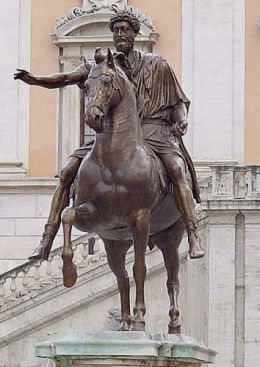
At the outset, it must be admitted that we do not really know much about the course of the wars that Rome waged for thirteen years with the Germanic peoples of Marcomanni and Quadi. It is only certain that, for the first time in 270 years, an external enemy threatened the heart of the Empire. On the other hand, never before or since have Roman legions moved so close to the present borders of Poland.
Prelude
The historians see the causes of the outbreak of the so-called Marcomannic wars (167-180 CE) primarily in the migration processes and civilization changes that took place in the 1st and 2nd century CE in Central Europe – then inhabited by numerous barbarian tribes. These migrations of peoples were a complicated and quite lengthy process, although most often it is associated with the great migration of the Gothic and Gepid tribes that moved from their native Scandinavia towards the Black Sea. The Migration of the Goths resulted in a chain reaction of a series of population movements and bloody tribal conflicts throughout almost all of Central Europe. The local peoples (mainly Germanic), displaced by the Gothic invaders, needed new territories, hence their gaze turned towards the rich lands of the Roman Empire.
Many tribes of various ethnic origins took part in the Marcomannic wars, adjacent to the Roman Empire along the Danube border. However, a leading role among them was played by Germanic Marcomanni and Quadi (hence the “Marcomannic wars”) and Sarmatian Iazyges. At the beginning of the millennium, the former managed to create a strong and well-developed state in the area of today’s Bohemia and Moravia. The war with the Marcomanni was already prepared by Emperor Augustus, but the unexpected and catastrophic defeat in the Teutoburg Forest (9 CE) forced him to abandon his expansionist plans. Eighty years later, the first war with the Marcomanni and Kwady (89-92 CE) – this time however defensive – had to be fought by Emperor Domitian. It soon turned out that the proximity of the Roman border significantly accelerated the civilization development of the Marcomanni. By skilfully observing their more developed neighbours, they managed not only to raise the level of craftsmanship but also to partially learn the Roman art of war.
The invasions of the Germans and Sarmatians fell on the Roman Empire at an extremely unfavourable moment. At that time (162-166 CE), Rome was at a heavy war in the east with the Parthian state. It proceeded with variable luck. At the very beginning, it was the Parthians who won victories, entering the Roman province of Syria and defeating the local legions – unaccustomed to fighting. On the offensive (163-166 CE), the Romans captured Armenia and northern Mesopotamia and destroyed the Parthian capital of Ctesiphon. However, a terrible plague decimated the legions and forced the Roman chiefs to stop the campaign. A peace was made, under which Rome had to be content only with the restoration of sovereignty over Armenia. Returning from the war, the legions dragged the plague that swiftly spread over almost the entire empire, reaching Rome (167 CE), and even Gaul and Britain. The situation was made even worse by the famine that struck Italy. No wonder then that the war on the Danube was the last thing he needed at this point, Emperor Marcus Aurelius. As it turned out, he didn’t have much choice.
There are two stages of wars |
|
Barbarian invasion
The first incident on the Danube border took place at the turn of 166 and 167 CE (the exact date is unknown). Nearly six thousand hordes of Germanic Lombards, displaced by their neighbours from their native lands on the lower Elbe, then crossed the Danube and entered the Roman province of Upper Pannonia. There the Lombards were beaten by the cavalry corps led by Macrinius Avitus Catonius Vindex. This failed invasion, however, was only an announcement of the events to come. As early as 167 CE, Marcomanni and Quadi, along with other tribes, demanded the right to settle in Rome.
The combined efforts of Roman diplomats and legionaries were then able to temporarily postpone the invasion. It even happened that the leaders of some Germanic tribes sentenced to death agitators calling for war with Rome. Among other things, the Kwadas lost their king (in not entirely clear circumstances), and then pledged not to choose rulers who would not receive Rome’s approval in the future. Emperor Marcus Aurelius continued to undertake various diplomatic and military steps aimed at securing the Danube border. For example, he granted certain Germanic tribes permission to settle in Roman provinces. In accordance with the ancient Roman principle of divde et impera, he hoped that in this way he would be able to divide the Germans and persuade them to fight with each other instead of Rome, driven by envy.
When it comes to matters of a military nature, it should be mentioned that from the times of Domitian (almost 80 years before the Marcomannic wars), the centre of gravity of the empire’s military effort was on the Danube. In Hadrian’s time, there were usually ten Roman legions on the Danube border (from the Black Sea to the Alps). On the eve of the Marcomannic wars, however, the Roman forces on the Danube were weakened, because due to the party war, Marcus Aurelius was forced to send two legions from the Danube to the East (Secunda Adiutrix with Aquincum in Dolna Pannonia and legio Quinta Macedonica from Lower Moesia) and one from Lower Germania (legio Prima Minervia stationed in Bonna). Numerous separated units, vexillationes, from other legions – mainly Danube ones, were also sent to the war with the Parthians (this can be proved by the fact that the contingent was headed by Publius Julius Marcjanus, the Danube legate Decima Gemina legion stationed in Vindobona).
Historians, however, often tend to overestimate the importance of these rearrangements. Meanwhile, Pierre Grimal pointed out that in the province of Pannonia – the most threatened by Marcomanni and Quadi – there were still three Roman legions, and the Secunda Adiutrix legio sent east from there was partially replaced by units of the Quarta Flavia legion. In total, at the outbreak of the war, Marcus Aurelius had nine legions on the Danube (scattered from the Alps to the Black Sea), four on the Rhine and two in Dacia. In the event of an invasion, they could rely on the system of fortifications (limes) built on the Rhine and Danube from the times of Domitian. In addition, Marcus Aurelius ordered the second line of defence – praetentura Italiae et Alpium – to protect northern Italy and prevent barbarians from crossing the Alps. It is only known about these fortifications that their defence was led by Quintus Antistius Adventus.
The beginning of the Marcomannic wars (usually dated CE 167) was, however, very unfavourable for Rome. Great hordes of Germans and Sarmatians broke through the fortifications on the Danube and then burst deep into the empire, spreading fire and destruction. Tens of thousands of people were captured and then chased across the Danube to increase the economic potential of barbarian states with their work and skills. In this phase of the war, the Barbarians occupied the Roman provinces of Pannonia, Noricum and Retia, and then crossed the Alps. Thus for the first time since the invasions of the Cimbri and Teutons (105 BCE), an external enemy threatened Italy itself. Emperor Marcus Aurelius, accompanied by his adoptive brother, Lucius Verus (officially co-ruling the Empire, de facto figurehead) personally set off against the barbarians. The fights were extremely fierce. The prefect of the Praetorian Guard, Furius Victorinus, died, Lucius Verus died (turn 168/169 CE). The beginning of 169 CE brought the crisis at its height. The barbarians captured and destroyed Opitergium (today Oderzo), and then besieged Aquileia. Panic broke out in Rome, further exacerbated by the still raging plague and the recent famine. At that time of confusion and fear, many different types of charlatans, “bards” or “messiahs” took advantage of, over and over again proclaiming the imminent end of the world. In this situation, Marcus Aurelius was forced to take extraordinary steps. The severe lack of a recruit resulted in a great draft organized throughout Italy, during which even gladiators, slaves and professional criminals were incorporated into the ranks of the legions. In connection with the crisis of state finances, the emperor had to pay for the defence of Rome from his own purse, resorting to the sale or pledge of a number of imperial movables, and even his own jewels and tableware. Finally, to reassure the people, extraordinary religious ceremonies (for example the so-called lectisternia) were organized, used in Roman tradition only in times of great danger.
The steps taken by Marcus Aurelius have brought the expected results. It was possible not only to rebuild the army but even to create two new legions. During the bloody campaign of 170-172 CE (two Roman chiefs were killed then), the Romans managed to force the barbarians back across the Danube.
Roman counteroffensive
Marcus Aurelius realized that despite repelling the invasion, Rome must reckon with further invasions by barbarians. In this situation, he decided to move the war to the territory of the enemy. The expedition across the Danube probably started as early as 172 CE, prepared efforts. The legions were headed by two talented leaders: Tiberius Claudius Pompejanus (imperial son-in-law) and Publius Helwius Pertinax. Moreover, the emperor himself supervised the course of the offensive.
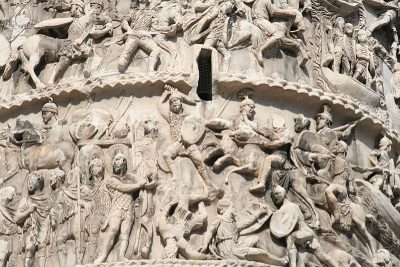
Not much information has been preserved on the course of the campaign, and the chronology of events is not certain. It is known that the Romans fought at that time with the Germanic tribes of Marcomanni and Quadi as well as the Sarmatian Iazyges, but it is not certain whether they fought with all opponents at the same time or with each of them separately. The hostilities took place on the central Danube – in today’s Czech Republic, Austria and Hungary. The barbarians turned out to be a tough nut to crack for Roman legionaries. These were no longer wild and badly organized hordes. The preserved testimonials prove that the Marcomanni and Kwadas were able to fight in a regular formation and use combat machines. The scenes depicted on the Column of Marcus Aurelius in Rome (in Piazza Colonna) also indicate that the war was extremely brutal. Prisoners of war were murdered en masse and all captured settlements were cut down.
After a series of victories over the Marcomanni, Marcus Aurelius decided in 173 CE to transfer the main burden of the war to the lands of the Quadi, who had held tens of thousands of Roman slaves since the invasion of 167 and recently provided the Marcomanni with comprehensive support. The Quadi fiercely resisted the Romans. When King Furtius showed his willingness to make peace with Rome, he was driven out. The Kwadas then made a leader named Ariogaesus. Marcus Aurelius responded by stating a price for his head. The war was on.
Probably in the summer of 173 CE, there was a “rain miracle”, mentioned in numerous testimonies. The Roman army (allegedly commanded by the emperor himself) was surrounded by the overwhelming forces of the Quadi on flat, exposed terrain, completely devoid of water sources. The legionaries were tormented by intense heat and thirst, but at one point it suddenly rained so heavy that the soldiers could collect water for their helmets. The Romans, overjoyed at the possibility of quenching their thirst, even forgot about the war. At this critical moment, a storm rescued them from an unexpected attack by the barbarians, which disturbed the enemy’s ranks. The legionaries later interpreted the causes of this “miracle” in various ways. For the pagans, it was a sign of the special care that the gods gave to Marcus Aurelius. The Christians saw here rather the intervention of their God. At the end of 173 or the beginning of 174 CE, Marcus Aurelius finally managed to force the Kwadas into a truce. The defeated Germans had to agree to a number of harsh conditions, including the release of 50,000 Roman prisoners. Having dealt with this opponent, the emperor attacked the Sarmatian Iazyges, who at that time lived between the central Danube and the Tisa (now within the borders of Hungary). Even less is known about the course of the war with the Iazyges than about the fights with the Marcomanni and the Quadi. The most famous episode of the campaign is the battle on the ice-bound Danube, where the Romans were to hunt down the Iazyges army returning from a plundering expedition. The Sarmatian cavalry then launched a mad charge, but the horses slipped on the ice sheet, and the squares of the Roman infantry managed to repel all attacks.

As the Roman legions struggled with the Iazyges, the Quadi broke the truce and fought Rome again. Marcus Aurelius had to fight, as it were, on two fronts. After many months of heavy fighting, the scales of victory began to tilt towards Rome. The resistance of the Quadi was broken when the Romans finally managed to capture Ariogaesus (he was taken to Alexandria, Egypt, where he spent the rest of his life). The Iazyges also began to show signs of exhaustion from the war. Marcus Aurelius, however, did not want to make peace. At that time, a vision of a fundamental remodelling of relations in this part of Europe was formed in his mind. The emperor planned to break with the defensive paradigm of Roman foreign policy, formed during the times of great Augustus, which said that Rome should not expand into the areas of Barbaricum, but only defend its natural borders on the Rhine and Danube. Instead, the emperor intended to annex the lands of the Marcomanni, Quadi and Iazyges, which would create two new provinces – Marcomania and Sarmatia. In this way, the borders of the Roman Empire would rest on the Sudetes and the Carpathian arc. It should be mentioned that Marcus Aurelius did not plan to exterminate or expel the peoples inhabiting these lands. Rather, his ambition was to Romanize them and to persuade them to renounce militancy and barbaric customs.
Serious problems at the frontiers of the empire, however, prevented the emperor from realizing this bold vision. The Balkan provinces were devastated by the invasion of the Dak Kostobok who managed to reach the Greek Achaia. Worse still, on the false news of the Emperor’s death, the commander of the eastern legions, Avidius Cassius, raised a revolt. The final decision was also made by the Iazyges emperor Zantikus, who came to him personally to beg for a ceasefire. As a result, in 175 CE, Marcus Aurelius agreed with a heavy heart to make peace with the barbarians. However, he hoped that under favourable circumstances he would be able to return to the implementation of his ambitious plans.
After all, the terms of peace were hard on the barbarians. The Marcomanni and Kwadas were forbidden to settle in the five-mile-wide zone north of the Danube. They also undertook to provide Rome with armed contingents. The Romans established military garrisons on the deserted border strip. The Iazyges, in turn, had to agree to the release of nearly one hundred thousand Roman prisoners. They were also banned from settling in the ten-mile strip from the Roman border and banned from sailing on the Danube and landing on its islands. In addition, Rome imposed a trade embargo on the Iazyges. Roman historiography regarded the peace of CE 175 as a great success. The victories were commemorated by the coins minted that year, on which Marcus Aurelius was nicknamed Sarmaticus and Germanicus (the latter was awarded already in 172 CE).
Second Marcomanian War

As early as 177, Marcus Aurelius obtained a pretext to resume hostilities. Two years of peace turned out to be very troubled. The Roman garrisons north of the Danube constantly persecuted the Marcomanni and the Quadi, who were not allowed to cultivate the land and graze their cattle on the one hand and emigrate to more tranquil areas on the other. It was a deliberate strategy adopted by the Romans, who thus wanted to break the will to resist the Germans and force them to submit to the Romanization processes. The oppressed Marcusomans and Kwadas, however, responded with a full-scale rebellion. The fights were so heavy that in the summer of 178 CE, the emperor himself went to the front. This so-called “second Germanic expedition” was preceded by careful preparations and a series of ancient Roman customary activities resurrected by Marcus Aurelius before the beginning of the war (application to the Senate for war funds, the Fetian ritual, etc.). Marcus Aurelius devoted as much attention to diplomatic activities as to war and propaganda. Among other things, in order to avoid a war on two fronts, he somewhat eased the terms of peace with the Iazyges. Rome’s main concession was to grant the Iazyges the right to cross the borders of the province of Dacia (with the consent of its governor each time) when they wanted to go to the relatives of the Roxolans living on the Black Sea. However, they still could not trade with Rome or navigate the Danube.
Little is known about the course of the Second Marcomannic War, which was fought entirely in the lands of the Marcomanni and Quadi. The fact remains that the Roman legions then made deep raids deep into the territory of the barbarians. At the turn of 179 and 180 CE, a part of the Roman army even wintered around today’s Trencin in Slovakia (as evidenced by the inscriptions carved on the rocks). At the same time, the Romans made an attempt to build a network of fortified camps in Germanic lands, which were to keep the population of future provinces in check. Thousands of barbarian warriors died in battle. The pacification of the militant Marcomanni and Kwadas, however, was slow. The barbarian tribes had enormous human reserves (especially powered by allied peoples), so despite numerous defeats, they continued their fierce resistance.
The decisive event for the fate of the war turned out to be the death of Emperor Marcus Aurelius, who died on March 17, 180 in the military camp in Vindobona as one of the countless victims of the plague brought from the East. His son and successor, 19-year-old Commodus, decided to end the war. The terms of the peace were apparently very strict on the barbarians. The Marcomanni, the Quadi and their allies were banned from approaching the Danube by armed forces. They pledged to pay grain tributes and provide Rome with armed contingents. Moreover, they could not wage wars with their neighbours without Rome’s consent, and all their councils were to be held in the presence of Roman officers. In return, however, the Roman legions withdrew to the old border from CE 167, and the plans to create Marcomania and Sarmatia were finally abandoned. The Roman people welcomed the conclusion of the peace with great enthusiasm. Opinions among the emperor’s advisers were more divided.
Lost opportunity?

Also among historians, Commodus’s decision aroused a lot of controversies. It was certainly influenced by the fact that he is widely regarded as one of the worst rulers of the Roman Empire, which is why criticizing all his moves is sometimes an irresistible temptation. Professor Aleksander Krawczuk, author of the famous “Post of Roman Emperors”, assessed the decision to end the war as a clearly negative decision. In his opinion, only two or three years were needed for the Romans to finally pacify the Marcomanni and the Quadi. Then the borders of Rome would move far north, and the empire would gain a wide buffer zone, shielding the strongly Romanized provinces on the Danube from barbarian invasions. The decision to retreat to the old border, however, meant, according to Krawczuk, not only the waste of Marcus Aurelius’ many years of efforts, but also lowering the prestige of Rome and encouraging the Germans to undertake further invasions on the territory of the empire in the future. Krawczuk saw the reasons why Commodus resigned from continuing his father’s mission almost exclusively in the commonly known love of the young emperor for games, feasts and other pleasures of big-city life, which he preferred to the hardships and dangers of war.
Professor Józef Wolski showed a little more understanding for the motives behind Commodus, who claimed that the goal of the new emperor was, in the first place, to strengthen power over Rome. However, Professor Maria Jaczynowska went even further, claiming that giving up the policy of conquest was the only rational decision that the new emperor could make. The empire clearly lacked the human and financial reserves that would allow it to expand. According to Jaczynowska, it would be impossible for Rome to maintain the property beyond the Danube in the long run.
Incidentally, it is also worth mentioning that the success of Marcus Aurelius’ expansive plans would mean that the lands of today’s Poland would be under the direct influence of Roman civilization. The history of our country would probably look completely different then, but in order to avoid the fruitless “ifbology”, let me end the article here.