One last moment without a guard: A Germanic captive in a Roman latrine
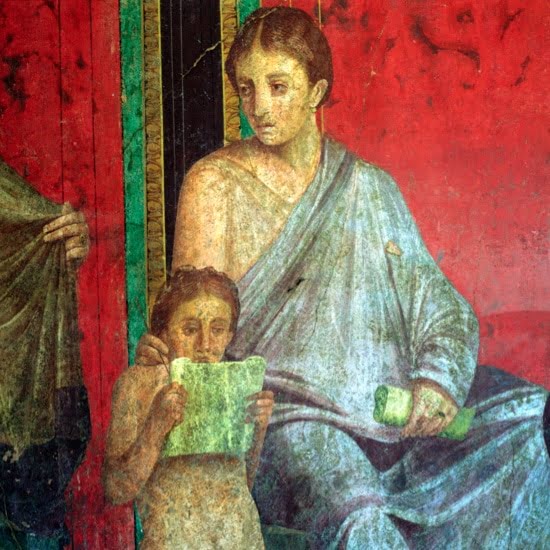
Fresco showing a German in a Roman latrine | AI visualization
A Roman spectacle began long before the first roar of the crowd, before the arena gates opened, before the animals, gladiators, and condemned prisoners were brought into view. It began behind the scenes, in corridors, holding rooms, and cells, where men were counted, searched, stripped of anything that might be used as a weapon, watched closely, and made to follow the rhythm of the coming show. Everything had its place and its appointed moment, because Roman disciplina extended far beyond military drill or the orderly running of public offices. It also governed those who were expected to die for the entertainment of the audience.
Among the men being prepared for one such spectacle was a Germanic captive mentioned by Seneca. The philosopher gives neither his name nor the city in which the incident took place. He tells us nothing about the man’s earlier life or how he had fallen into captivity. We know only that he was being prepared for a morning spectacle, most likely one involving wild animals, and that he remained under constant supervision, without a weapon, without freedom of movement, and without any right to refuse. There was, however, one basic necessity for which even the guards had to give him a brief moment of privacy.
The captive asked to use the latrine. Inside was a simple hygiene implement: a wooden stick tipped with a sponge, commonly associated with the terms xylospongium or tersorium. Such an object was used for cleaning after defecation and would have attracted no suspicion. It belonged to the ordinary equipment of a Roman toilet, alongside the stone seats, drainage channels, and water used for washing. To the guard, it was simply a household object. To the captive, it was the only thing within reach that had not been taken away.
He forced the sponge-tipped stick down his throat and suffocated himself. It was neither a quick death nor, by Roman standards, an honorable one, but he had been denied access to a sword, a rope, or even a high window. Seneca recalled the episode while reflecting on freedom in circumstances where almost every other choice had been removed. What mattered to him was the extremity of the man’s resolve: stripped of weapons and kept under constant watch, the captive turned the most ordinary object left within reach into a means of escaping the fate prepared for him.
The morning spectacle was meant to go ahead as planned. The crowd was waiting, and the Germanic captive was supposed to be brought into the arena as part of someone else’s entertainment. He never reached it. A latrine, a moment alone, and a sponge fixed to a wooden stick were enough.