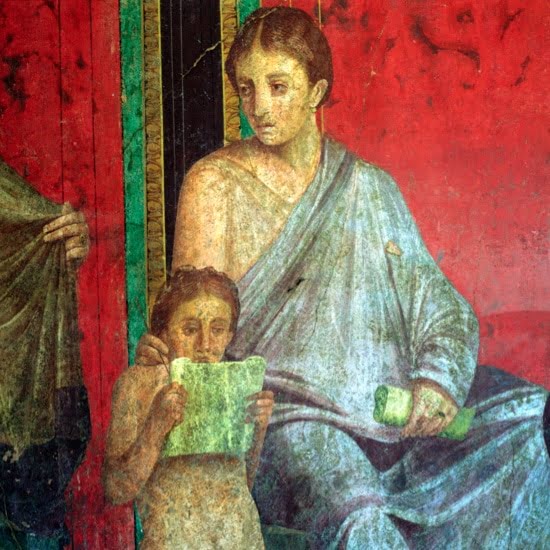
Synesius of Cyrene, Neoplatonic philosopher, bishop of Ptolemais in Cyrenaica, Father of the Church and rhetorician. Today, the figure is probably known only to a small group of specialists and lovers of ancient history, even though he left behind a large literary legacy. A student of the famous Hypatia of Alexandria. Let’s take a closer look at this extraordinary, and unfortunately now-forgotten figure of late antiquity.
Life
It is assumed that Synesius was born between 365 and 370 CE in Cyrene. The date of his death is considered to be 413/414 CE then his correspondence abruptly ends. In one of his last letters, he writes about a serious illness that plagues him, both spiritual and physical, and asks for remembrance1. According to his testimony, he was descended from the Hesychid family2.
Around 393 CE together with his brotherEuoptioshe went to Alexandria, where for 4 years he studied mathematics and philosophy under the supervision of Hypatia of Alexandria, whom he had great respect for until the end of his life3. He continued his mathematical studies in Cyrene, where he also studied rhetoric, literature and astronomy.
He completed military service, but it is not known exactly when, after which he took up running his father’s estate. In 397/3984 he was sent as a representative of Pentapolis5 to Constantinople with a request to reduce the fiscal burden. He succeeded, but the emperor accepted him only in 402, i.e. after 3 years!
In the year of his admission to the court of Constantinople, he went to Athens, which he compared to an animal sacrificed, with only its skin left as the only thing by which it could be identified6. In the same year, he came to Alexandria, where he stayed for 2 years. And again in the same year, he married a Christian woman, with whom he later had three sons, given to them by his friend Patriarch Theophilus of Alexandria.
At the beginning of 404 he returned to Cyrene, where, fed up with the incompetence of the army, he stood at the head of the armed inhabitants and successively repelled the attack of the Moorish Macetes.
Between 409 and 411 he became bishop of Ptolemais. Synesius was surprised by the decision of the inhabitants of Cyrenaica, who elected him, and Patriarch Theophilus of Alexandria was especially surprised because, as he wrote in a letter to his brother, he had certain Neoplatonic views that were openly contrary to Christian teaching. These included: belief in the eternity of the universe, the preexistence of souls, or doubts about the actual resurrection7. But that didn’t stop him from considering himself – or being considered – a Christian. Despite these ideological differences, he accepted the title of bishop, but the episcopal life weighed heavily on him. He recalled his former life on the estate with sentiment and compared it with his current difficult life as a bishop.
During Synesius’s four-year term in office, all of his sons and wife died. He opposed the prefect Andronicus, who was severely excommunicated during the Ptolemaic Synod. He also confronted priests from the sect of Eunomius of Cyzicus called the Anomeans8. He wrote a pastoral letter regarding them9. In 411, when the Asurians and Maketi nomadic peoples began to devastate the country, Synesius organized defence against them. He also defended governor Marcelin.
Analyzes by his correspondents indicate the year 413/414 as the most probable moment of his death.
Works
Synesius is the author of 2 homilies, 3 speeches, 6 treatises, 12 hymns and 157 letters. Their content proves the wide range of interests of our bishop-philosopher. He touched on various topics, from political to philosophical, religious, and scientific. Their content in English is available on the Internet10.
Speeches:
- Constitution
- Against Andronicus
- In Praise of Baldness
Treaties:
- About the kingdom
- The Egyptian story, or about Providence
- Dion, or about her life
- About dreams
- Catastasis
- About the astrolabe
Summary
As you can see, Synesius is an extraordinary figure, a great Neoplatonic philosopher, and at the same time a Christian, politician, bishop and commander. It is a living testimony to the fact that ancient culture and its achievements coexisted and intertwined with the Christian faith, in many aspects interacting harmoniously, although there were differences.
- Emilia Żybert Wstęp W: Synezjusz z Cyreny, O snach, Wrocław 2015
- Letter 57, 113
- He refers to her as his mother, sister and teacher See. Letter 14; Tadeusz Sinko, Zarys historii literatury greckiej. Tom 2, Warszawa 1959
- According to Robert SawaEncyklopedia katolicka Tom 18Lublin 2013 it was in 397, while according to Kleffner Encyklopedja kościelna, podług teologicznej encyklopedji Wetzera i Weltego Warszawa 1904 it was 397 or 398 CE.
- Pentapolis – a group of 5 interconnected cities. Here they were Apollonia, Teuchira, Ptolemaida, Berenice and Cyrene.
- T. Sinko, Zarys historii literatury greckiej Tom 2, Warszawa 1959
- Ewagriusz Scholastyk, Historia Kościoła 1:15; Także Kodeks 26 z Biblioteki Focjusza
- Anomeans - an extreme faction of Arians existing in the 4th century CE. Their end is dated to around 393, the date of the death of their second leader, Eunomius of Cyzicus.
- Letter 5
- https://www.livius.org/articles/person/synesius-of-cyrene/synesius-texts/ Two works were published in Polish: O snach i Pochwała łysiny oraz Hymn III, VI, VIII [in 2 versions] and IX . The content of the hymns can be found in a book edited by ks. prof. Marka Starowieyskiego Muza chrześcijańska. Greek poetry from the 2nd to the 15th century.
- Texts of Synesius w: https://www.livius.org/articles/person/synesius-of-cyrene/synesius-texts/
- Tadeusz Sinko, Zarys historii literatury greckiej Tom 2, Warszawa 1959
- Robert Sawa, Encyklopedia katolicka Tom 18, Lublin 2013
- Giovanni Reale, Historia filozofii starożytnej Tom 4, Lublin 1999
- Synezjusz z Cyreny, O snach, Wrocław 2015