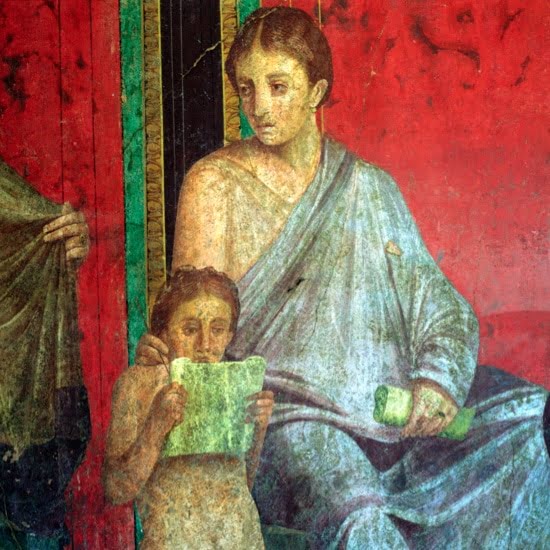
A woman's face on the Roman mosaic
Sophists were concerned with making speeches that moved crowds, although they often concerned fictional situations or events from the past. It wasn’t necessarily what the rhetorian said, but how he says it. Speaking skills were highly valued in both the Greek and Roman worlds.
During the empire, at the Greek games, especially in Delphi and Olympia, apart from the rivalry of flute players, heralds, poets, tragedians, comedians and many others, rhetorical agons were also organized. A rich epigraph on the sophists has been preserved: lists of victors, agonist programs, and honorific inscriptions.
From the 2nd century CE from Delphi, an inscription has been preserved commemorating the only known woman of the Greek world who spoke in public. It was during the archontate of a certain Elius Pythodoros, so it dates back to 119 or 123 CE. The woman’s name was Aufria, we do not know what she did, whether she was a sophist, but she was honored with Delphi citizenship for numerous and beautiful speeches given to the Hellenes, proving her education ( or: culture/education). It is not known if Aufria participated in the Games, it is rather unlikely. Perhaps she spoke on other occasions, certainly it was, as the inscription before god says, probably in the sanctuary of Apollo, it could have been, for example, hymns addressed to god. Honoring her citizenship was the highest honor that a sophist, and even more so a woman, could get, so we can assume that the Aufria must have truly deserved her speeches. Unfortunately, no other sources concerning her have survived, so if it were not for this one short inscription, we would not have known that there was such a woman, certainly unique.
- B. Puech, Orateurs et sophistes grecs dans les inscriptions dans l’époque impériale, Paris 2002
- K. Stebnicka, Druga sofistyka, Chrześcijaństwo u schyłku starożytności. Studia źródłoznawcze, t. V, red. T. Derda, E. Wipszycka, Kraków 2004, s. 13-75