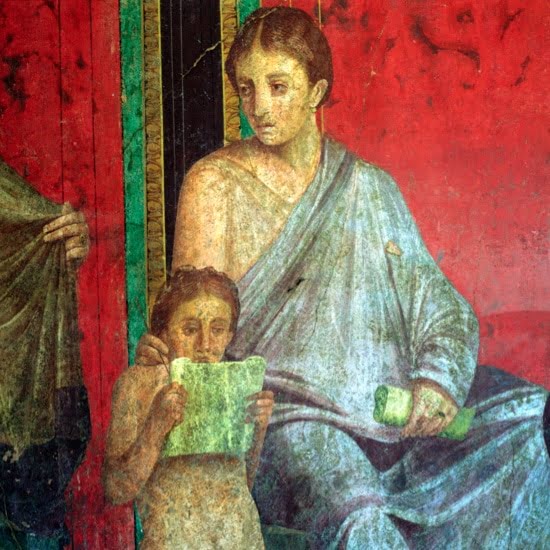
Relief showing children
In ancient Rome, infanticide was a common practice. A child’s first days in the world have always been uncertain; in antiquity, many children did not survive even a few days due to heavy childbirth, diseases and poor health. Hence, they waited to give a name to the child. At times, the child may have been deliberately rejected by the parents.
The reasons for abandonment were various: the child’s gender, deformation, it came from an unlawful relationship or bad financial situation. Most often, a child was sentenced to death simply by abandoning it. The decision on whether to accept a child into the family was made by pater familias, the head of the family. The law of XII tables already regulated the issue of “getting rid of” deformed children1.
But not always abandoning children meant death; sometimes abandoned in garbage dumps or streets, they could be taken in or simply ended up in the hands of a slave trader. In ancient Rome, children were often abandoned in a characteristic place next to a column called columna lactaria (“milk column”).
Infanticide in Roman culture was present from the very beginning. An example is the legend of Rome’s founders – brothers Romulus and Remus, who threatened the usurper’s rule in the city of Alba Longa. The twins were to be killed in infancy on the orders of Amulius. However, they miraculously survived, took revenge, and Romulus started Rome.
The first explicit opponent of killing children was the philosopher Philo of Alexandria (1st BCE – 1st century CE). In 374 CE, during the reign of Emperor Valentinian, a law was adopted prohibiting infanticide under the death penalty.
- Cicero, De Legibus, III.8
- Angela Alberto, Kleopatra. Królowa, która rzuciła wyzwanie Rzymowi i zdobyła wieczną sławę, Warszawa 2021
- Samuel X. Radbill, A history of child abuse and infanticide, [w:] Suzanne K. Steinmetz i Murray A. Straus, Violence in the Family, 1974
- Greg Woolf, Ancient civilizations: the illustrated guide to belief, mythology, and art, 2007