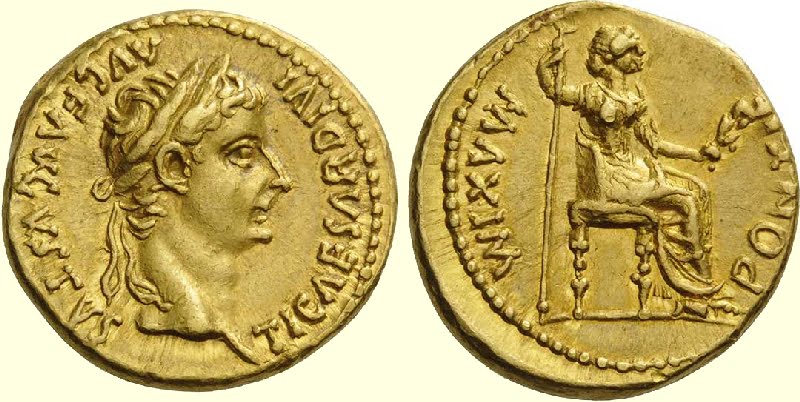
Chapters
| Name | Tiberius Claudius Nero |
|---|---|
| Ruled as | Tiberius Caesar Augustus |
| Reign | 19 August 14 – 16 March 37 CE |
| Born | 16 November 42 BCE |
| Died | 16 March 37 CE |
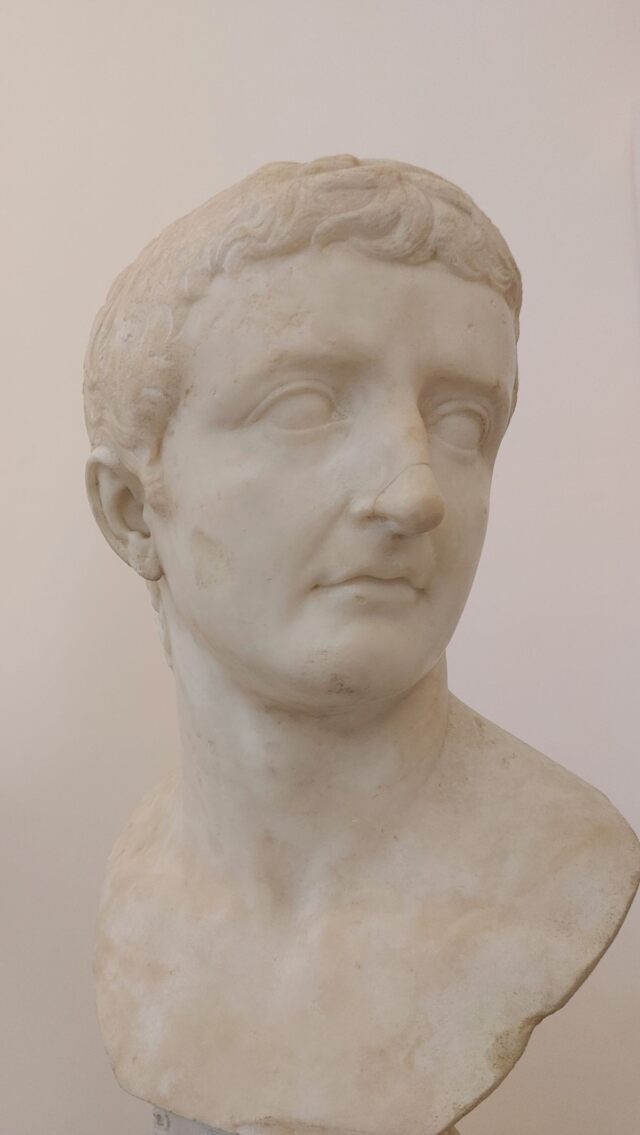

Tiberius Claudius Nero was born in 42 BCE in Rome. Tiberius was a member of the Claudius family and the second emperor in Roman history. Thanks to his adoption by Octavian Augustus he joined the Julius family. All subsequent emperors up to Nero were related to these families to varying degrees, hence the name Julio-Claudian dynasty.
Tiberius became known as an outstanding Roman general who led effective fights in Germany and on the Danube at the behest of Emperor Augustus. After the death of his adoptive father, Tiberius took over the rule. It was a time of stabilization for the lower classes and a period of terror for the aristocracy, mainly due to the praetorian prefect Sejanus, who gained more and more power in the Roman state and tried to seize power.
Background and career
The beginnings of life
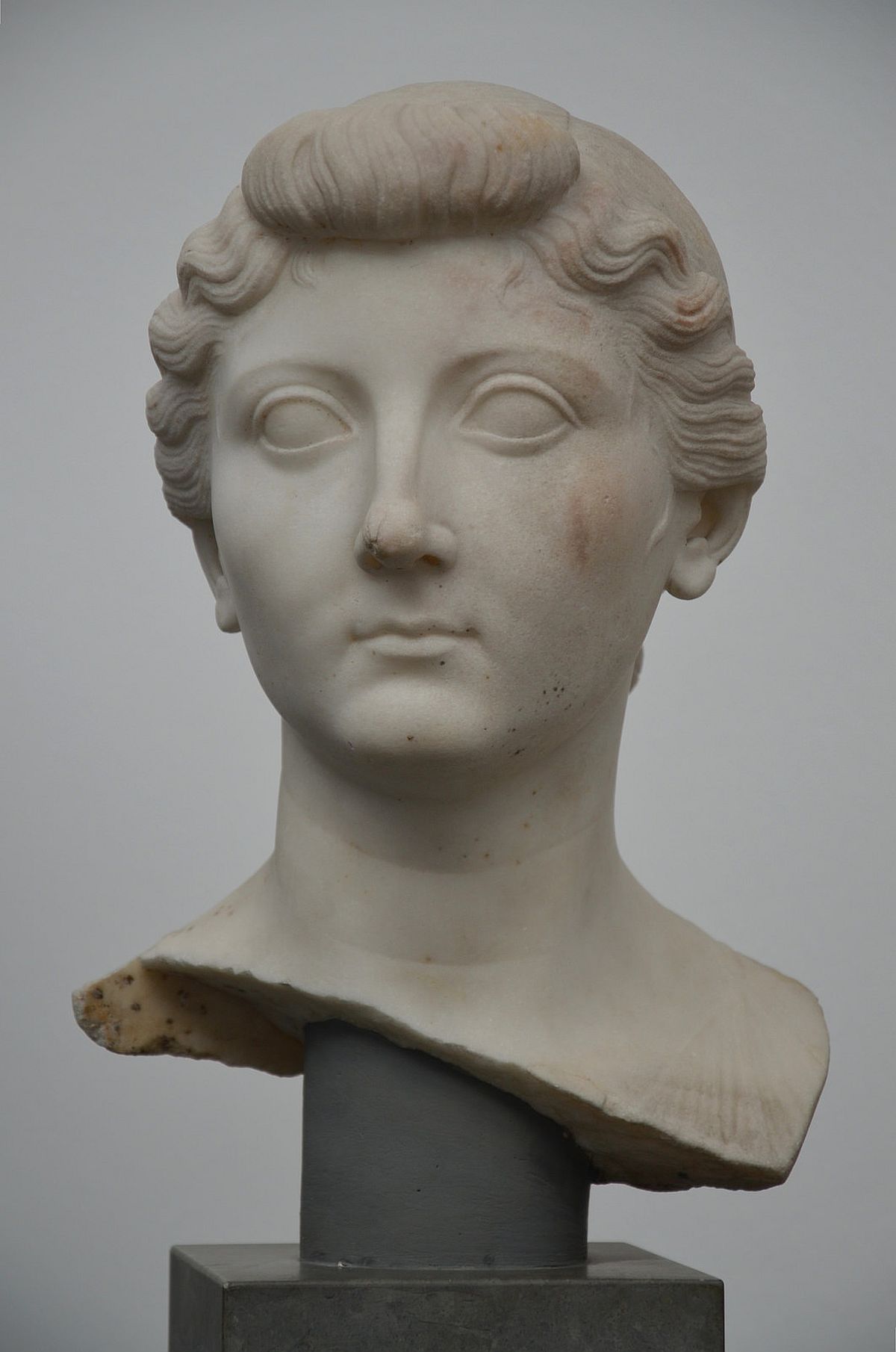
Tiberius was the son of Tiberius Claudius and Livia Drusilla. Through the adoption of his maternal grandfather, he also belonged to the plebeian gens Livia, which, according to Suetonius, was distinguished by many outstanding Romans. Suetonius describes that when Tiberius was about to be born, Livia sought divination.
She took an egg from under a setting hen, and when she had warmed it in her own hand and those of her attendants in turn, a cock with a fine crest was hatched. In his infancy the astrologer Scribonius promised him an illustrious career and even that he would one day be king, but without the crown of royalty; for at that time of course the rule of the Caesars was as yet unheard of.
– Suetonius, Tiberius 14
Thanks to Suetonius, we know that the first few years of Tiberius’ life were full of stress. His father Tiberius Claudius Nero (the optimist) was forced to take sides on the political scene and became involved with Mark Antony. As a result, he had to leave Rome in 41 BCE and was repeatedly fled by Octavian’s supporters along with Livia and his little son. Suetonius tells how they found themselves in the forest one night, when suddenly “fire all about them, and the flames so encircled the whole company that part of Livia’s robe and her hair were scorched”1.
In 40 BCE, Antony and Octavian reconciled, ending a difficult period in the family’s life. Tiberius Claudius Nero and Livia returned to Rome. Octavian met Livia by accident when she was pregnant. He fell in love and immediately divorced Scribonia, and forced Tiberius Claudius Nero to give him Livia. According to the arrangements, Tiberius and the newly born Drusus (later called the Elder) were to remain at their father’s house, who was to take care of their upbringing and education. The wedding of Octavian and Livia took place on January 17, 38 BCE, after the birth of Drusus. As reported by Cassius Dio, Tiberius Claudius Nero took part in the wedding ceremony, handing over his ex-wife personally to Octavian, as if the father of the bride did.
Political and military career
In 33 BCE Tiberius Claudius Nero died. At the funeral, Tiberius gave a speech praising his biological father. The fact that he was the elder of the brothers and officially belonged to the group of Octavian’s “family” extended a bright future for him. Moreover, Octavian’s victory in 31 BCE at Actium and the assumption of full power made Octavian look for a possible successor. The natural candidate was either Marcus Agrippa or Marcus Claudius Marcellus – the ruler’s close friends. After all, Octavian tried to ensure the appropriate career development of Tiberius and his brother, which was certainly influenced by Livia.
In 29 BCE Tiberius began his participation in public life by participating in the triumph of Augustus to commemorate the Battle of Actium. At 17 (25 BCE) he became a quaestor with the consent of Augustus. What’s more, he was assured that he would receive a pretext and then a consulate – just like his brother Drusus. Tiberius at that time was clearly interested in law and Greek rhetoric.
In 20 BCE, Tiberius went to the East on a mission to recover from Parthia legion marks lost by Crassus (53 BCE), Decidius Saxa (40 BCE), and Mark Antony (36 BCE). After a year of negotiations, Tiberius received the standards and additionally managed to ensure that Armenia would remain neutral on the border of the Empire and the Party.
Upon his return from the East, Tiberius was appointed praetor and together with his brother Drusus the Elder fought against the Alpine tribes, conquering Recia; at that time Tiberius discovered the source of the Danube. Then for a year, he was governor of the province of Gallia Comata (also called Tres Galliae). In 13 BCE Tiberius held the office of consul.
In 12 BCE, Tiberius was given special military powers in Pannonia and Germania to ensure peace and receive barbarian attacks. In 7 BCE, after returning to Rome, he received a consulate again, to start a campaign against the Marcomanni a year later.
Tiberius during the reign of Augustus, being the commander of the troops, repeatedly showed great courage in numerous campaigns.
Love, forced marriage and successor

Tiberius’s first wife was Vipsania Agrippina, daughter of Marcus Agrippa, with whom, as Suetonius suggests, he was happy. The marriage took place either on the 20th or 19th BCE. In 13 BCE their son Drusus (called the Younger) was born. But August, after Agrippa’s death in 12 BCE and the widowing of Julia’s daughter, looked for a suitable candidate for her.
[…] although she was thoroughly congenial and was a second time with child, he was forced to divorce her and to contract a hurried marriage with Julia, daughter of Augustus. This caused him no little distress of mind, for he was living happily with Agrippina, and disapproved of Julia’s character, having perceived that she had a passion for him even during the lifetime of her former husband, as was in fact the general opinion.
– Suetonius, Tiberius, 7
Augustus decided to tie Tiberius more closely to his family, as at that point he was the most likely successor to Augustus (his friend Marcellus had died 10 years earlier). In order to legitimize and link Tiberius with the Julius family, he expected the birth of an heir.
Of course, the second marriage, not out of love but out of duty, turned out to be fatal. The marriage was unsuccessful and the only child, Nero, died in infancy. Tiberius had a negative attitude towards Julia much earlier when he was still married to Vipsania. At that time, Julia was promoting him. Moreover, Julia had the opinion of a promiscuous woman who behaved absolutely against the conservative views of her father.
Departure to Rhodes
In 6 BCE Tiberius, who was de facto the second person in the state, voluntarily decided to leave Rome, abandon politics and go to the island of Rhodes. We are not sure about Tiberius’ motives, but the news certainly shocked the emperor. It is suspected that Tiberius may have perceived that Augustus would soon decide to replace him as the successor of one of his adolescent grandsons – Gaius or Lucius Caesar, the sons of Agrippa and Juliet, who would have removed him completely from politics after the death of Augustus. Another suggestion as to the reasons for Tiberius’ departure from Rome is his indignation due to Julia’s bad conduct (e.g. night trips to the Forum Romanum and numerous lovers) and the breakdown that Tiberius experienced after the forced divorce with his beloved Vipsania, with whom he could not meet more.
August, on the news of Tiberius’ decision, pleaded with him to stay in the capital, but to no avail. Tiberius stayed on the island until 2 CE. At some point, he was about to regret his decision and even asked the emperor for permission to return, but he did not receive one. In Rhodes, Tiberius learned that his wife had been convicted of debauchery and adultery, had been filed for divorce on his behalf, and had been granted it by Augustus’ will. Still, Tiberius could not return to Rome.
The situation changed in 2 CE when Lucius Caesar died. Augustus agreed to the return of Tiberius to Rome, on condition that he would not interfere in the least with the management of the state, nor influence its fate, and would become an ordinary citizen. Unexpectedly in 4 CE, the second brother, Gaius Caesar, died in Armenia, leaving August for no other choice but to bet on Tiberius. Tiberius was fully adopted; August made him his successor and ordered Tiberius to adopt Germanicus – his brother’s son, thus ensuring the continuity of the family and securing power for the family.
Suetonius also quotes a story, as he himself points out the unverified one, “that when Tiberius left the room after this confidential talk, Augustus was overheard by his chamberlains to say: “Alas for the Roman people, to be ground by jaws that crunch so slowly!””2. These words prove that Tiberius did not have the best opinion of Augustus. Tacitus, in turn, writes that Augustus did it ” he had read the pride and cruelty of his heart, and had sought to heighten his own glory by the vilest of contrasts”3.
Suetonius, again, was more indulgent about August’s decision:
[…] overcome by his wife’s entreaties he did not reject his adoption, or perhaps was even led by selfish considerations, that with such a successor he himself might one day be more regretted. 3 But after all I cannot be led to believe that an emperor of the utmost prudence and foresight acted without consideration, especially in a matter of so great moment. It is my opinion that after weighing the faults and the merits of Tiberius, he decided that the latter preponderated, especially since he took oath before the people that he was adopting Tiberius for the good of the country […]
– Suetonius, Tiberius, 21
The only possible enemy of Tiberius to take power after Augustus was Agrippa’s surviving son – Agrippa Postumus (“The Tombstone”), who – as the nickname indicates – was born after his father’s death in 12 CE. Probably thanks to Livia – promoting Tiberius in the eyes of Augustus – in 7 CE, Agrippa was banished to the island of Planazja (near Corsica).
In 10-12 CE, Tiberius oversaw the campaign in Germany after the tragic defeat in the Teutoburg Forest. He was awarded a triumph for his victories. The end of August’s life is the official recognition of Tiberius as a co-ordinator.
Emperor
On August 19, 14 CE, at the age of 76, died Octavian Augustus – the first emperor and creator of the Julio-Claudian dynasty, which will rule until 68 CE, Augustus was deified, as was Julius Caesar. Tiberius automatically assumed the office of Emperor of Rome at the age of 55.
According to Suetonius, Livia’s first decision (it is possible that Tiberius knew about it) was to murder Tiberius’ possible rival to power – Agrippa Postumus. The task was performed by a military tribune who was assigned as a bodyguard. Suetonius comments on Tiberius’s reaction to the information about the fulfilment of the order:
Tiberius replied that he had given no such order, and that the man must render an account to the senate; apparently trying to avoid odium at the time, for later his silence consigned the matter to oblivion.
– Suetonius, Tiberius, 22
On September 18, the Senate met to give Tiberius the proper powers that Augustus had. Tiberius then had to reject many titles and laws – according to Tacitus – incl. “father of the motherland” (Pater Patriae) and corona civica (wreath of oak leaves). From the accounts of ancient writers, Tiberius initially appears to us as a man terribly afraid of any conspiracies, avoiding getting involved in state affairs and wanting to have as much peace as possible. Suetonius reports that Tiberius ultimately rejected many titles, accepting only modest ones, and agreed to rule over Rome, saying, however, that his reign would continue: “Until that moment when it seems right to give my old age some respite.”
There was also confusion in the armies on the Rhine and attempts to proclaim Germanicus as emperor. Tiberius was also very cautious and, as Suetonius said, he was even ready to give up some power. Eventually, Germanicus crushed the legions’ revolt. Later Tiberius was suspected of having dug his fingers in the rather mysterious death of his well-liked nephew, for the poisoning of which Tiberius’ friend – Gnaeus Calpurnius Piso was accused.
The beginning of his reign, after letting go of fear, is a time of peace. From the source texts, Tiberius appears to us as an extremely modest person. Tiberius was a modest person who did not agree to build temples for himself and did not like flattery at himself.
He so loathed flattery that he would not allow any senator to approach his litter, either to pay his respects or on business, and when an ex-consul in apologizing to him attempted to embrace his knees, he drew back in such haste that he fell over backward. In fact, if anyone in conversation or in a set speech spoke of him in too flattering terms, he did not hesitate to interrupt him, to take him to task, and to correct his language on the spot. Being once called “Lord,” he warned the speaker not to address him again in an insulting fashion. When another spoke of his “sacred duties,” and still another said that he appeared before the senate “by the emperor’s authority,” he forced them to change their language, substituting “advice” for “authority” and “laborious” for “sacred.”
– Suetonius, Tiberius, 27
Tiberius in his rule relied more on the opinion of the Senate, leaving room for decisions. He wasn’t even nervous when the law passed against his opinion. His rule was sane; he interfered in matters only when the law was broken. He assumed the attitude of the supervisor and guardian of the state, giving his institutions freedom. In addition, he ordered to abandon large expenses for the Games and limit them to the required minimum. What’s more, Tiberius also focused on increasing security and eliminating the problem of robberies and robbers.
Sejanus comes to power

In 15 CE, Sejanus – an Equestrian descent – became the prefect of the praetorians in Rome, and succeeded his father Strabo, who in turn was appointed governor of Egypt. Sejanus, showing great ambition, immediately undertook the reform of the formation and established it as a powerful tool in the era of the principate. In 20 CE he moved all the scattered garrisons to a single barracks outside Rome. In addition, he increased the number of cohorts from nine to twelve, one of which was on permanent duty in the palace. The divisibility of the prefect’s office was abandoned – there was to be one commander of the Praetorian Guard from now on – and his powers were increased: from now on he personally appointed centurions and tribunes. Through these changes, Sejanus took full authority over a unit of approximately 12,000 men that was ready to obey any order. During the reign of Emperor Tiberius, the strength of the guard was often presented at all kinds of parades, which only emphasized the end of the republic’s facade.
Conflict of Sejanus with Drusus the Younger
After making these reforms, Sejanus became a trusted and strong advisor to the emperor himself. By 23 CE he had a significant influence on the decisions of Tiberius, who called him “Socius Laborum” (“my partner in my hardships”). During this time, Sejanus was given a praetor position, which was not normally intended for an equites. A monument was built in his honour in the Pompey Theater, and over time his supporters, performing public and managerial functions, joined the Senate. The growing power of Sejanus and his important position in the state gradually began to arouse outrage among members of the imperial family and senators. The most hostile, however, was Drusus Julius Caesar, son of Tiberius, known as Drusus the Younger.
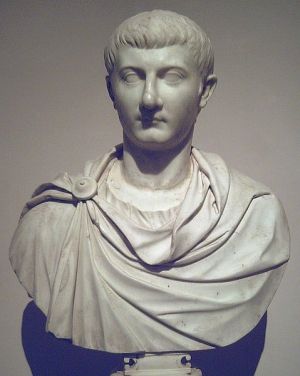
The history of hostility between Sejanus and Drusus dates back to 15 CE, when the legions stationed in Pannonia and Germania revolted imperial power. When Tiberius’ adopted son, Germanicus, calmed the revolt in Germania, Drusus the Younger was sent to Pannonia with Sejanus and two praetorian cohorts. Drusus quickly suppressed the rebellion and ordered the execution of the leaders of the rebellion. The camp was cleared of rebels by the praetorians, and the legion returned to their winter barracks. Despite his success, the hostility between Drusus and Sejanus grew significantly.
From the accession of Tiberius to the Roman throne, his son Drusus was seen as a very likely successor. He won the victory at the head of his legions in the Illyricum province in CE 18, and served as consul with his father in CE 21. In practice, however, Sejanus was still the second person in the country, who still wanted to increase his power. As early as 20 CE, Sejanus, wanting to consolidate his relationship with the royal family, betrothed his 4-year-old daughter Junilla to the son of the future Emperor Claudius – Drusus IV (Claudius Drusus). Ultimately, however, they did not get married due to the fact that a few days later Claudius Drusus died of asphyxia.
It seems that the unsuccessful attempt to connect with the imperial family-directed all of Sejanus’ attention to an attempt to eliminate a possible heir to the throne – Drusus. In 23 CE, the conflict between Sejanus and the son of Tiberius reached its peak. During the quarrel, Drusus punched the prefect, and openly lamented that someone outside the family had been invited to co-rule while the emperor’s son was still alive. By this time Tiberius had turned 60 and it was likely that his son Drusus would succeed him. Sejanus began to conspire and secretly persuaded Livilla, Drusus’ wife, to participate in the plot. With her help, Sejanus poisoned the heir to the throne, who was dying slowly in what appeared to be a natural death. Drusus died on September 13, 23 CE.
The death of his son was a huge shock for Tiberius for personal and political reasons. The emperor deliberately relinquished many public functions to Drusus in order to prepare him for the position of emperor. The devastated Tiberius left most of the administrative duties to Sejanus and began looking for a worthy successor. It seemed that the three candidates had the best chance (sons of the deceased Germanicus): Caligula and his brothers Claudius Nero Julius Caesar and Drusus III. All three men were a threat to Sejanus’s plans.
Sejanus and the pursuit of autocracy
Meanwhile, Sejanus, eager to reconnect with the Julio-Claudian dynasty, demanded to marry Livilla in CE 25. It was possible because Livilla was the widow of Drusus and Sejanus had divorced his wife Apikita two years earlier. Sejanus was ready to take the name of Julian so that he could be considered the heir to the Roman throne. Emperor Tiberius did not agree to the request of his subordinate, arguing that he would therefore exceed his powers. Sejanus decided to change his plans and decided to isolate Tiberius from Rome. He began to spread rumours of the hatred of Agrippina the Elder (widow of Germanicus) and the Senate towards him. The paranoid emperor retired to a country estate in Campania and then to the island of Capri in 26 CE, where he spent his remaining years of life (he died in 37 CE). During Tiberius’ stay outside Rome, Sejanus easily controlled all the emperor’s correspondence with the capital.
Until 29 CE, Livia (Tiberius ‘mother) controlled Sejanus’ independent actions. With her death, in Rome there was a time of sentences, confiscation of property and the elimination of Sejanus’ political opponents. The prefect eliminated the prominent senator Gaius Asinius Gallus Saloninus, an opponent of Tiberius, linked to the Agrippina the Elder faction. In turn, the widow of Germanic, along with her sons: Nero and Drusus, was forced to go to exile in 30 CE, where they all died under mysterious circumstances of starvation. Only Caligula, who had moved with Tiberius to the island of Capri, survived the persecution.
The Fall of Sejanus
In 31 CE, despite his Equestrian origins, Sejanus shared a consulate with Tiberius in the form of in absentia (“substitutions”) and became engaged to Livilla. Tiberius, who had withdrawn from Rome, still formally ruled, but the actual power was exercised by Sejanus in Rome. His birthday was celebrated in public, statues were erected and honours were given to him. Sejanus believed that, once all opposition was removed, his position was unchallenged. Sejanus finally made the decision to prepare a coup d’etat, hoping to gain undivided power for himself. Warned in time by Antonia the Younger, Tiberius with the help of Macron arrested Sejanus on October 18, 31 CE and asphyxiation after the motion of the Senate. After Sejanus’ execution, Quintus Sutorius Makron succeeded him as Praetorian Prefect.
End of reign
Tiberius spent the last years of his reign in isolation on the island of Capri, where, according to Suetonius, he would invent kinky games. Shortly before his death, he moved to Misenum.

Among the less significant issues, it should be mentioned that Tiberius did not agree to deify himself while he was alive. However, this did not prevent him from building his temple in Smyrna (Greece) or naming the city after him (Tiberias, or Tiberias in Israel). Tiberias, located on the western shore of Lake Galilee, was so named by Herod Antipas.
Construction activity
During the reign of Tiberius, a palace was built in Rome, which was located in the Palatine – its ruins are still visible. The construction of a temple dedicated to Augustus was inaugurated in the capital, and the renovation of Pompey’s theatre began – both projects ended only under the rule of Caligula.
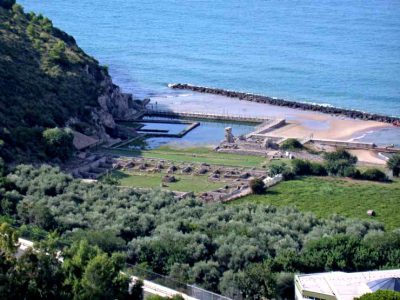
The reign of Tiberius is primarily associated with the island of Capri, on which during his reign there were 12 villas, of which the most famous and largest was Villa Jovis. In turn, in Sperlonga (a seaside Italian town) there was Tiberius’ villa with the famous grotto, which the ruler adopted for his summer banquet room. Numerous fragments of Roman sculptures were also found there.
Death
On March 16, 37 CE, Emperor Tiberius lost his breath in a villa in Misenum. According to Tacitus, everyone began to congratulate Caligula on taking the throne when it was heard that the emperor was alive. Great chaos was to reign in the villa, which Macron took advantage of (possibly at Caligula’s instigation), accelerating his death and suffocating the emperor with a pile of clothes. A similar version of events was proposed by Cassius Dio.
Tiberius left the world a few months before his 78th birthday. He was buried in Mausoleum of Augustus but was refused to be idolized after Augustus’s example. The rule of Sejanus’s reign and the subsequent negative attitude towards the Senate was held to be bad for him. In his will, he divided the power over the Empire between Caligula and Tiberius Claudius Gemellus (grandson of Tiberius, and son of Drusus the Younger). Caligula, right after taking power, omitted the provision about Gemellus.

The painting shows Emperor Tiberius, who was allegedly strangled by order of Quintus Sutorius Macron – the praetorian prefect.
The character of Tiberius and the relationship with his mother

Tacitus characterizes Tiberius as a closed person, initially submissive to his mother, later even jealous of her good reputation among some senators. The historian believes that under the influence of Sejanus (the praetorian commander, who gained the position of the emperor’s closest adviser), he turned into a cruel, inconsiderate nobody an autocrat. Here is how he characterizes Tiberius and describes the relationship with his mother:
Tiberius Nero was mature in years and tried in war, but had the old, inbred arrogance of the Claudian family, and hints of cruelty, strive as he would to repress them, kept breaking out. He had been reared from the cradle in a regnant house; consulates and triumphs had been heaped on his youthful head: even during the years when he lived at Rhodes in ostensible retirement and actual exile, he had studied nothing save anger, hypocrisy, and secret lasciviousness. Add to the tale his mother with her feminine caprice: they must be slaves, it appeared, to the distaff, and to a pair of striplings as well, who in the interval would oppress the state and in the upshot rend it asunder!”
– Tacitus, Annals, I.4
Tacitus is generally silent about the way Tiberius was brought up, but in this one sentence it is striking: “ingrained respect for the mother” could not result from anything other than teaching it by a strict but understanding mother. Although Tiberius in the later period of his reign is insensitive and even arrogant towards his mother, he did not dare to raise his hand on her. It was jealousy that was the driving force behind his first actions against his mother. And, as Tacitus informs us, he did not allow Livia to be called “the mother of the motherland”. Tacitus says:
Declaring that official compliments to women must be kept within bounds, and that he would use the same forbearance in the case of those paid to himself (in fact he was fretted by jealousy, and regarded the elevation of a woman as a degradation of himself), he declined to allow her even the grant of a lictor, and banned both an Altar of Adoption and other proposed honours of a similar nature.
– Tacitus, Annals, I.14
The same is mentioned by Suetonius: “he was greatly offended too by a decree of the senate, providing that “son of Livia””4.
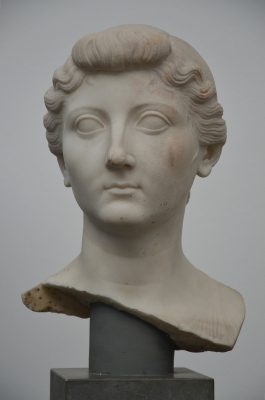
Tiberius reluctantly endured his mother’s company, as Suetonius informs us about. He also did not want to be accused of directing his actions. Her behaviour irritated him:
[…] he often warned her not to meddle with affairs of importance and unbecoming a woman, especially after he learned that at a fire near the temple of Vesta she had been present in person, and urged the people and soldiers to greater efforts, as had been her way while her husband was alive.
– Suetonius, Tiberius, 50
As Suetonius suggests, in the end, such an argument between them arose that Livia took from home Augustus ‘hidden letters about Tiberius’ bad temper and read them aloud. Since then, he had only seen his mother for a few hours, and when she fell ill, he stopped visiting her altogether. Moreover:
When she died, and after a delay of several days, during which he held out hope of his coming, had at last been buried because the condition of the corpse made it necessary, he forbade her deification, alleging that he was acting according to her own instructions. He further disregarded the provisions of her will, and within a short time caused the downfall of all her friends and intimates, even of those to whom she had on her deathbed entrusted the care of her obsequies, actually condemning one of them, and that a man of equestrian rank, to the treadmill.
– Suetonius, Tiberius, 51
Cassius Dio wrote that Tiberius he had done many wonderful things and committed only a few mistakes; but when he no longer had a formidable competitor, his behaviour shown countless good deeds and changed into the exact opposite. He tortured without hesitation to gain witnesses against his opponents, real or imaginary. According to Cassius Dio, the change in Tiberius’ way of being was greatly influenced by Lucius Aelius Sejanus, whom he was quickly promoted. Cassius also confirms Suetonius’ account of Tiberius’s attitude towards Livia’s funeral.
Despite Tiberius’ lack of love for his mother, his cruelty and indifference, all ancient historians agree on one thing. If Livia was suspected of a crime or conspiracy, Tiberius was also involved in it. If we assume that it was as a result of Livia’s actions, Augustus adopted Tiberius, as suggested by Suetonius, then she could also have participated in governing the state right after her husband’s death, which would follow from Tacitus’ message. Perhaps it was they who led to the situation that Augustus had no choice but no other candidate for a successor. It is possible that Livia and Tiberius led to the deaths of all potential candidates in different ways, but it cannot be ruled out that it was a coincidence.
When Livia died in 29 CE, Tiberius had lost any scruples. As Tacitus writes: “without changing his delightful lifestyle, he did not take part in giving his service to his mother”. He was very strict when he handed out Livia’s honours by the Senate. He did not even want to disclose her will immediately and never, after it was announced, did not fulfil what she wrote in it.
Assessment attempt
The reign of Tiberius was for ordinary people in the provinces a period of peace and good state management, but for the spheres of the Roman aristocracy, a time of increasing tyranny and terror. Tiberius was also the emperor who departed more from Octavian’s “Republic comedy” in favour of a more autocratic rule.