Chapters
When Julius Caesar was murdered, a real earthquake swept through the Roman Republic. Representatives of successive factions threw themselves at each other’s throats, engaging thousands of soldiers in their activities. There were civil wars that shaped the fate of the Roman state. It was then that the second triumvirate was created, the power-sharing agreement between Octavian, Mark Antony and Lepidus.
Bloody ides
The prelude to the events that I will describe in this work was undoubtedly memorable the ides of March 44 BCE. Literary historian Zygmunt Kubiak in his Histories of the Greeks and Romans points out that the ides in the Roman calendar marked the thirteenth day of most months, while the fifteenth day in March, May, July and October.
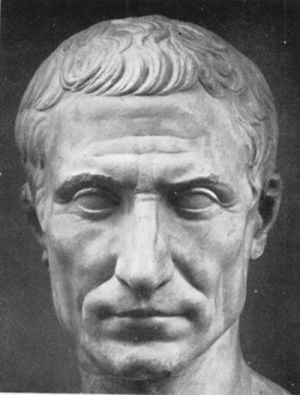
Julius Caesar had the support of the people, but his politics made many enemies for himself. The party once clustered around Pompey believed, more than ever, that the victor of Pharsalus posed a serious threat to the Roman Republic. Not for the state as such, but for its republican system. The constitutionalists had formed a conspiracy with the mission of removing the danger embodied by Caesar. It was headed by Marcus Junius Brutus and Gaius Cassius Longinus. The execution, according to the plan of the conspirators, was to take place on the days of March I, that is, as Kubiak writes, four days before Julius’ planned raid on Parthia. This war was to wash away from the Roman state the disgrace that fell upon it after the fatal defeat of Crassus at Carrhae (Carrara). According to Plutarch of Cheronea, Caesar’s wife, Calpurni, had nightmares on the night before the ida of the night. It was her husband who played the main role in them. The woman dreamed that Artemidorus, a teacher of Greek philosophy, who remained close to the Brutus party, handed Caesar the scroll and asked the dictator to read it personally. Julius used to hand over all his writings to his service. He wanted to read this scroll, but there was still something discouraging him from doing so. The chief entered the Senate with a scroll in his hand, without finally reading it.
Describing the unfortunate event, Zygmunt Kubiak refers to Lives of Famous Men Plutarch of Chaeronea and Roman History Appian of Alexandria. The day of the March IDs has finally come. Gaius Julius Caesar, together with Marcus Antony, a faithful friend and consul at the same time, headed for the senate. On the way, Gaius Trebonius, one of the members of the conspiracy, stopped Antony with some matter to him, probably urgent. Caesar, on the other hand, continued quietly. As he entered the building, the senators rose from their seats. The dictator sat down in the consul’s chair and waited for work to begin. Several people stood behind him. An expression of unconditional support? Probably not this time. Other conspirators approached him from the front. One of them, Tilius Cimber, wanted to ask Caesar for mercy for his exiled brother. Julius put off the case first, and then Cymbra’s petition was definitely rejected. Nervous Tilius jerked the Consul’s toga down sharply. This positioned in such a way that it constrained the leader’s movements. It was a signal for the conspirators to attack. They pounced on him like poisonous snakes. They drew daggers hidden under their togas and fell on the dictator. Behind Pompey’s slayer, Publius Servilius Casca swung and struck Caesar. He wanted to hit the neck, but the blade of his dagger sank into the consul’s chest. Terrified Julius yanked his toga from the hands of Tilius Cymbr and started the fight with Kaska. He got up from his chair and struggled with his attacker. But then he felt a powerful stab – the senator standing next to him stabbed him in the side. Caesar’s toga blushed with the passing blood. The conspirators slashed and stabbed, Julius saw only flashing blades, he heard the whistle of the air cut by the conspirator’s knives from all sides, he felt the skin being cut and pierced over and over again. Blood spurted left and right. The chief tried to defend himself, he struggled like a wild animal hunted by hunters, like an old wolf with Manhunt Kaczmarski. Then, however, Marcus Junius Brutus approached Caesar and struck him in the hip with a dagger. Julius, seeing that his friend had hurt him, looked at him with eyes full of pain, terror and surprise and whispered: Et tu Brute contra me? And you, Brutus, against me? The consul could not believe that even Brutus, whom he had forgiven for fighting against himself at Pharsalus, whom he considered his friend, had stabbed him. He already knew he had lost. He stopped defending himself. The conspirators finished their work. The great leader fell to the ground in front of the statue of Pompey. Rivers of blood spilling from his twenty-three wounds flowed slowly across the floor. His robes soaked the hue of the greatest Julius family. Senators-conspirators also had it on their hands. Mission accomplished, mission accomplished. He, the great Gaius Julius Caesar, the slayer of Vercingetorix, was now butchered under the statue of Pompey. Stripped of dignity, stripped of its majesty. The flame of life was extinguished in his eyes forever. Caesar gave up the ghost.
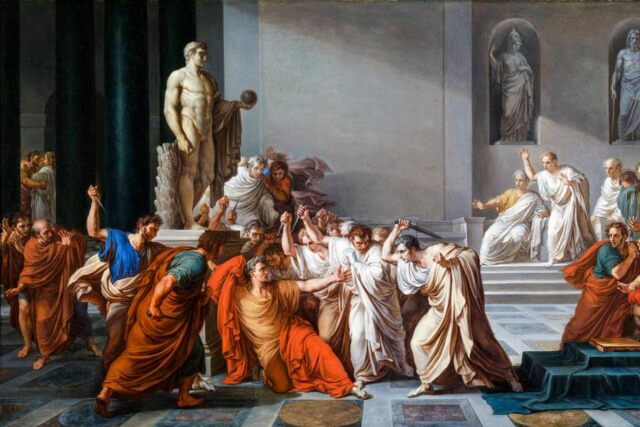
Marcus Antony survived for this, although the conspirators were arguing about his life. Cassius Longinus staunchly insisted on the murder of the second consul so that he would not threaten them in the future. But Brutus was against it. He argued his opinion that the killings of both consuls could resemble the purges carried out by Sulla during the civil war of the popular and the optimates. By the way, civil wars in the times of the second triumvirate can be called another version of the conflict between populares and optimates.
According to the conspirators, the greatest threat to the republican system of Rome has been eliminated. It would seem that the Republic was saved. No more dictatorship, there will be no single rule. However, if the conspirators thought that the murder of Caesar would bring the longed-for end of tensions, they “miscalculated” a little. The real Roman hell was just about to begin.
Turbulent beginnings of the 2nd triumvirate
When Caesar was murdered, his sister’s grandson, Gaius Octavian, was in Apollonia (southern Illiria), where he was undergoing military training before Julius planned an expedition to the countries of the East, where Roman domination was slightly worse than in other regions. Moreover, after the pogrom of Crassus’ legions, the Parthian state grew in strength. When the young Octavian found out about the brutal murder of his great relative, he immediately set off for Italy. It was an extremely risky move because he did not have enough experience, and the Senate was willing to support the conspirators in the imminent dispute.
The turmoil in the capital of the Republic was even greater when it was necessary to read and implement Caesar’s will. Marcus Antony, his surviving friend, became the guardian and executor of the murdered chief’s last will. It was possible because Marcus Emilius Lepidus, magister equituum Caesar, was stationed at the head of his troops near Rome. Antony allied with Lepidus, and the conspirators, whose actions, to their great amazement, were not applauded by the Roman people, took refuge on the Capitoline Hill. The Caesarian party finally made an agreement with the conspirators. Here’s what was decided:
- the dictatorship was abolished
- Caesar’s murderers were granted amnesty
- all of Julius’ acts were officially confirmed
- there will be no persecution for participating in any civil war
The meeting was to be chaired by Cicero himself. However, the impression of relative peace is only apparent. As Kubiak writes, in his will, Julius Caesar gave his beautiful gardens to the Eternal City. Not only that, for each of the citizens of Rome he allocated a certain amount of money, it is not known what exactly. It is not difficult to guess what effect this had. The people glorified Caesar for his final act. However, they, the conspirators, took their benefactor, a great friend, who did not forget about them even at the time of writing such a personal document as the will. Conspirators were not welcome in Rome. The people of the Republic wanted their blood. Julius Caesar had a really wonderful funeral. After him, Cassius and Brutus prudently fled Rome and headed east.
Caesar’s testament is not only gift for the city and the people. The most important act contained in the last will of the great commander was undoubtedly the recognition of Gaius Octavian, who henceforth referred to as Octavian, as his successor and heir, that is, more precisely, his son’s sonification.
Octavian was to find out about the details of Caesar’s will already in Brundisium. So he came to Rome as Gaius Julius Caesar Octavian. He inherited not only the name of Caesar but also the financial resources of his adoptive father. When he found himself in the capital, he immediately tried to gather the army around him, but, as Zygmunt Kubiak points out, he only partially succeeded. It seems that Octavian, despite being the main heir of Caesar’s heritage, would not have been able to cope with such a difficult situation, if not for his outstanding political abilities. He allied with the then influential Cicero. This was probably not too much of a problem, because, for the great speaker and politician, Octavian was a much better alternative than Marcus Antony. It is worth noting that Cicero and Antony had a sincere and uncompromising hatred for each other. Caesar’s friend held a personal grudge against the constitutionalist, because on his orders, for taking part in the Catiline plot, he was executed Antony’s stepfather. Marcus Tulius Cicero also gave vent to his negative emotions, as in his Filipikach (collection of 14 speeches) he attacked the future triumvir with particular ferocity.
Julius Caesar’s testament, while he certainly pleased Octavian very much, simply shocked Marcus Antony. It has been marginalized. The consul tried to secure his future, as the deadline for his resignation would soon pass. He appointed himself governor of Pre- and Transalpine Gaul. In 43 BCE, Aulus Hircius and Gaius Vibius Pansa became consuls.
When Marcus Antony made himself governor of Pre-Alpine and Trans-Alpine Gaul, the real ruler of the first of these provinces was Decimus Brutus, one of the conspirators. Brutus refused to give Antony power over his lands. He gathered legions faithful to him and marched north to take the rule of Decimus by force. He seized the major cities of the province and prepared to attack Brutus. He, in turn, began to withdraw towards Rome. Imagine everyone’s surprise when it turned out this manoeuvre was simulated, and the conspirator’s troops took Mutina (today’s Modena). Decimus sensed that he would soon face Antony’s troops, so he decided to prepare for the siege. He ordered the cattle to be killed and food supplies to be gathered so that, in case of necessity, they would be able to survive until the arrival of possible relief.
Soon, Mark Antony besieged Mutina. He surrounded the city with a ditch and a rampart, like Caesar at Alesia. The next days slowly passed. Eventually, Brutus was running out of food supplies. To the north, however, marched the forces of the consuls, Hirtius and Pansy, sent by the senate, as well as… Octavian. In the case of the latter, these were units faithful to Caesar, which the heir of the great leader maintained from his own money. As John Warry writes in the Armies of the Ancient World, the Senate, which was influenced and persuaded by Cicero, still regarded the conspirators as defenders of the current system and showed them special considerations. Octavian, on the other hand, set off with the consular army against Antony, because he could not accept the choice of the young man as the main heir of the great Julius.
Eventually, the consuls began to approach Mutina. Octavian accompanied Hirtius. Soon after, they encountered Antony’s cavalry. The rides of the consul and the Caesar heir soon clashed with her. The cavalry of the chief, who was apparently the public enemy number 1 in Rome, turned out to be more numerous, but fought in inconvenient terrain, as many streams flowed nearby. To help his colleague, the consul, he decided to move Pans, but his troops were ambushed by Antony’s soldiers. In turn, a cohort of Octavian’s guards walked in front of the young commander to protect him from possible danger. Returning to Pansy, his men engaged in a murderous fight with the former consul’s subordinates. Heavy fighting took place in three places, as both sides were separated by a high embankment, on which a road ran, allowing passage through the swamps. On this road, Octavian and Antony’s cohorts of guards rubbed their swords. After some time, the young Caesar’s cohort was defeated. Pansy’s veterans, in turn, retreated to the camp where the consul’s recruits were waiting. They were not supposed to join the fight due to the much greater experience and familiarity with the stress of the battle of Antony’s soldiers. However, Pansa himself fell during the struggle. Hirtius, who wanted to get involved in the fight at the time, set out from the camp near Mutina. He marched about 13 km and attacked the already tired enemy subordinates. He defeated them but refused to pursue the pursuit as night was slowly falling. The consul rightly decided that it was not worth the risk of chasing enemies fleeing through the swamp at night. Antony, on the other hand, had a different view of the matter, and he also rightly ordered his cavalry to find and bring back wounded and lost comrades. Despite repelling the enemy, Hirtius was unable to break the siege of Mutina. After the fighting resumed, it already seemed that the troops of Octavian and Hirtius would break through the weakest defended points of the embankments, but Antony then withdrew two legions and threw them to support sensitive places. It was not enough, however. Aulus Hirtius soon burst into the Caesarian leader’s field quarters but was killed there in battle. Soon after, the defeated Antony, with the clear opposition of his staff, decided to break the siege and go north towards the Alps. It was not without difficulty that he managed to break into Gaul. There he allied with Marcus Emilius Lepidus, who held the office of governor of Gaul of Narbonne (southern France). A very interesting situation happened in Mutin itself. Octavian simply could not have dreamed of better circumstances. Both consuls fell in battle, and Decimus Brutus was approved by the senate as commander of the troops that took part in the battle. But what if the soldiers decided otherwise? There were massive desertions from Brutus to Octavian. The position of the conspirator continued to grow weaker and weaker. In the end, he decided to flee and try to reach his more influential relative, Marcus, who was governor of Macedonia. However, he was captured by a leader of one of the Gallic tribes, who was an ally of Antony. This chief, without much thought, ordered Brutus to be executed.
Coming back to the fights in the vicinity of Mutina, it is worth noting how fiercely the soldiers fought. John Warry suggests, with which I fully agree, that enemy troops were treated as traitors, so it is no surprise that the legionaries were attacking each other with a murderous expression on their faces. The civil war that resulted from the murder of Julius Caesar divided Rome so deeply that those fighting on both sides killed their countrymen as if they were complete strangers. It should also be mentioned that the conflict that resulted in the Battle of Mutina actually had four sides. One was the conspirators represented by Decimus Brutus. The second was those who, admittedly, did not belong to the conspiracy, but adhered to the republican principles and supported the senate and Cicero. The third-party turned out to be Octavian, who wanted to deal with Antony. The latter fought against all of the aforementioned simultaneously.
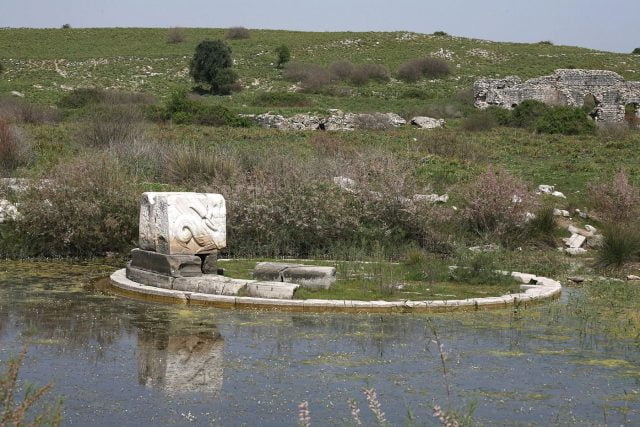
Octavian realized he had eight legions below him. Of course, as his foster father had once before Rubicon, refused to give them up. What did the young commander decide? March on Rome. The terrified senate awarded the 19-year-old the consulate. Octavian, after receiving the nomination, marched northward at the head of his troops, where he was to meet with Antony and Lepidus. The meeting took place near Mutina, more specifically, according to Appian, on a small island in the Lavinius River. The chiefs deliberated for two days and finally came to an agreement that was based on common rule and cooperation to get rid of Caesar’s murderers. In addition, Octavian resigned from the office of consul, and it was decided to create a separate office for all three, equal to the consular authority, which they would hold for five years. Moreover, the supporters of the murdered Julius divided the territory. They also agreed that they themselves would legislate in their own lands and elect lower officials. Marcus Antony received almost all of Gaul. Its part adjacent to the Pyrenees, as well as Spain, fell to Marc Emilius Lepidus. Gaius Julius Caesar, Octavian, in turn, took charge of Africa, Sicily, Sardinia and other islands in this area. Thus, in November 43 BCE, the second triumvirate in Rome’s history was established.
New order, new war
The provisions mentioned in the previous paragraph still required official confirmation. The people’s assembly, therefore, began deliberating at the Forum Romanum. There would be nothing strange about the whole situation if the Forum was not surrounded by an army of triumvirs. Soon, after the triumvirate was legally approved, it was time to think about an action plan. Brutus and Cassius took over power in the eastern provinces of the dying Republic, so the new alliance of Octavian, Antony and Lepidus had to do something about it. Especially since their combined forces had as many as 45 legions. First, however, they decided to clear their own “backyard” of enemies.
Proscriptions began soon. Originally, this term referred to the auction of the debtor’s property and goods, but later it was applied to all penalties related to the confiscation of property. Speaking of proscription, one cannot ignore the “feats” of the one who became famous for the biggest proscription action so far, that is Lucius Cornelius Sulla. The great leader and dictator of the optimates ruthlessly slaughtered his opponents. Unfortunately, the second triumvirate followed suit, only the political party changed. Now it was populares that began to carry out a bloody purge among the Roman elite. How terrible it must have been for the elderly residents who still remembered the atrocities committed by Sulla forty years ago.
A person whose name was included on the proscription list (tabulae proscriptionis) may have been killed. This was often the case because the killer of such a man was receiving a reward of two talents, which was a considerable sum indeed. Kubiak writes that the property of the murdered was sold or given to the winners. Moreover, the children and grandchildren of the proscribed person were subject to infamy. So the Triumvirs made a list. Officially, Caesar’s enemies (unofficially their own as well) will eventually be punished. 300 senators and 2,000 equites were placed on the list. The scale of the murder is just terrifying. Antony also gave vent to his hatred of Cicero for the last time. He demanded that the Catiline Conqueror open the proscription list. While Lepidus shared his opinion, Octavian did not. However, after two days of opposition, he resigned and Marcus Tullius Cicero was sentenced to death.
Upon learning of the sentence, Cicero, together with his brother Quintus, decided to flee to the coast of Italy, from where they would be able to get to Marcus Brutus in Macedonia. On the way to Astura (west coast), where the great speaker had an estate, Quintus realized that in the heat of his escape he hadn’t taken any supplies with him and that Cicero’s would not last long either. So he left his brother and returned to join him later, having enough food. However, the effect of this turned out to be deplorable. Quintus was betrayed by his servants. They handed it over to people who wanted to cross a few more names from the list of triumvirs. So Quintus and his son were killed. Cicero, however, having reached Astura, jumped on the first ship he found there and ordered to sail along the coast to Cape Circeum. There, the crew wanted to go to the high seas, so as not to waste time and reach Macedonia faster, but for some reason, the great speaker stopped them, disembarked and started walking towards Rome. Kubiak recalls that he went about a hundred furlongs, but then he hesitated again and returned to Astura. It was December 7, 43 BCE The servants of Cicero from his villa in Asturias decided to seat the worried and still hesitant speaker in a litter and carry him out to sea. However, the envoys of Antony, Centurion Herennius and the tribune Popilius came to the estate, and they also brought a few helpers. When they did not find their destination there, they questioned the servants. The latter, however, did not want to release Cicero and replied evasively that she did not know. However, one broke away and told the wet boys that they were carrying the speaker in a litter towards the sea. Wasting no time, Herennius and Popilius raced down the forest path where they would encounter the erstwhile conqueror of Catilina. How strange it seems to be the behaviour of Popilius towards the speaker who once defended him against accusations of murdering his father. Herennius was faster than the tribune and was the first to catch up with Cicero. Realizing that his stay in this world was about to end, he ordered to keep the litter. The centurion drew his sword and ended his life as a former consul. Then, as ordered by Antony, he removed his head and hands.

Let us leave the triumvirs for a moment, however, and look at how Brutus and Cassius took power in the provinces east of Italy. The first of them, having reached Greece, gathered soldiers who managed to flee from Pharsalus after Pompey’s defeat against Caesar. He also recruited the army, replenishing the troops with young Romans who studied in Athens or other cities of Hellas. The army of the conspirator was not united, the young legionaries lacked experience, but despite this, Brutus threatened the war to the then governor of Macedonia, who, due to the end of his term of office, was getting ready to leave his post. The blackmail paid off – the conspirator seized power in Alexander’s homeland. Soon after, Brutus headed northeast, where he took control of the upper part of Illyria. The Senate, which, as I mentioned earlier, supported the murderers of Caesar, was very pleased with the actions of Marcus Brutus on the eastern side of the Adriatic. Therefore, in February 43, the chamber appointed him governor of Macedonia and the Illyricum.
Cassius, on the other hand, received Syria from the Senate. His mission was to defeat Publius Cornelius Dolabella, who ruled those lands. Dolabella was appointed consul after Caesar’s death. Initially supported by constitutionalists, the situation changed when he changed sides and killed the governor of Asia Minor, Gaius Trebonius, the same one who stopped the burly Antony on the way to the Senate on the day and March of 44 CE. Cassius managed to defeat Dolabella, who later committed suicide in Laodicea (today’s Latakia, in Syria).
John Warry writes that Brutus and Cassius thought the war with Antony could be avoided. Young Octavian did not even take into account their accounts. In any case, they considered strengthening their military position and improving the financial condition as a priority goal. As their dominance in the eastern provinces had only just begun, the idea seemed to be right. Longinus was immediately struck by the island of Rhodes, which had supported Dolabella in the previous conflict. When you’re short on money, any reason is good to sack the island, and this one was just perfect. Cassius began planning an attack. It was known that he had to prepare a strong fleet because defeating the Rhodes at sea would be crucial. He established a base on the island of Mindos, off the coast of Caria (a land in southwest Asia Minor). Warry points out that Longinus did not disregard the brave sailors of Rhodes, after all, he himself studied there in the past. He carefully trained the crews of his ships – this operation was to be flawless so that no unpleasant surprises would happen. The Rhodes, meanwhile, wanted to balance the strength of powerful Roman ships with the manoeuvrability of their smaller ships. A ramming manoeuvre from the old days was to help them, and preferably ramming the sides because they were the Achilles’ heel of Rome’s heavy ships. In the end, the 33 ships of the Rhodesian fleet faced the Cassius armada near Mindos. The outnumbering of the Romans turned out to be too great and the Rhodians were surrounded. Two of their ships were sunk, two were captured while the crews were captured, and the rest fled towards Rhodes. After this victory, Longinus moved his base ashore to Asia Minor. There he loaded the troops into transports and planned a coordinated attack on Rhodes from two sides. The embarked army will carry out a landing on the island and attack the city. At the same time, Cassius, with 80 ships, will sail to attack the defenders from the sea. The brave Rhodes sailed back to face the aggressor, but the result turned out to be similar. When they lost two ships, they withdrew, and the Romans skillfully pushed them to the port and blocked them there. Longinus was a prudent commander. He ordered the fleet to also carry parts to the siege towers. When it turned out that Rhodes was completely unprepared for a siege, several people decided to open the gates. Suddenly Cassius and the escort were in the centre of the city, cleaning up. When Rhodes was completely under the control of the conspirator, he ordered the 50 most powerful inhabitants to be killed and all the gold, silver and other valuables that could fall into the hands of the Romans seized.
Dolabella is dead, Rhodes is looted. The last opponent to meddle in Rome was Cleopatra. In the end, the Egyptian queen allied with Caesar, moreover, she tried to help Dolabella. Cassius began planning a “visit” to Alexandria. Then, however, he received a message from Marcus Junius Brutus: Marcus Antony is gathering strength in Brundisium. Another war is coming.
Filippi – win or die
The hard step of the legions thunders over Europe, the inevitable foretells the end of the Republic – Jacek Kaczmarski sang in the Classical History Lesson. Although this phrase was applied by the eminent bard to the actions of Julius Caesar, I think that it is equally relevant to the wars of the Second Triumvirate. Especially as the battle was looming, which would ultimately decide the survival or fall of the Republic. The triumvirs were gathering their strength. Their idea was that Lepidus, at the head of 15 legions, would guard Italy, while Octavian and Antony with 28 legions would go to Brundisium, from where they would try to get to Greece. There they were to break the power of the conspirators once and for all.
If we are looking for the perfect case of fate’s chuckle, or rather its brazen irony, it will be difficult for us to find a better example than the story of Sextus Pompey. The son of the one who carried out the great land-sea operation and completely crushed piracy, became a corsair himself. It happened after the lost Battle of Munda, in which his brother, Gnaeus, was killed. After Caesar was murdered, the Senate appointed Sextus, now experienced in naval combat, as commander of the Republic’s fleet. The situation from the war between Caesar and Pompey the Great repeated itself. The optimists once again had a great advantage at sea.
Cassius and Brutus decided to join their forces. They moved to the northern part of the Aegean Sea, from where they had a good starting point for a march deep into Thrace. There you will be able to face the triumvirs. John Warry draws attention to the cultural diversity of the army of conspirators – in its auxilia and riding there were people from almost all corners of the known world at the time: from Iberia and Gaul, through Illyria, to Media and Party. The army of Cassius and Brutus consisted of 19 legions, many of which did not have full personnel – the republican chiefs were gathering troops from the provincial governors. In addition, their army included refugees from Pompeian units near Pharsalus, as well as the legion of Gaius Antony, brother of Marcus. Brutus defeated and killed Gaius in Macedonia. Where did the constitutionalists get the money to support so many troops? From looting the cities of Greece and Asia Minor, of course. It should be noted that both optimists spent quite a lot of time on this looting.
Soon Cleopatra VII decided to join the game. Considering the sea weakness of the triumvirate, the Egyptian ruler set out at the head of the fleet to aid Antony. As they say, paved hell is good intentions. Her ships crashed off the coast of Libya, and the queen herself, ill, barely managed to get back to Alexandria. The disaster of the Egyptian fleet allowed the constitutional maritime squadrons to concentrate on the troops of the Brundisium triumvirate.
Octavian had previously tried to undermine the republican domination at sea but to no great effect. Sextus Pompey still controlled the Roman waters. Now the triumvirs faced an extremely difficult task, namely to transfer troops to the eastern coast of the Adriatic Sea. The Caesarians, however, were not stupid, they decided that they would wait for a favourable wind and only then sail out on transport ships with unfurled sails. So they did. The smaller transport ships thus managed to escape the constitutional fleet. It was similar on the way back and on the next cruise. In the end, 28 triumvirate legions landed in Macedonia.
When the triumvirs reached the Dyrrhachium, where Caesar had once suffered defeat at the hands of Pompey, Octavian fell ill. However, when he felt a little better, he immediately joined Antony, who continued to move eastward during the treatment of the young chief. The Caesarians had only one big problem – supply. It took a lot of food to feed the 28 legions. Cleopatra’s fleet crashed, so not only were all the supplies she was carrying were gone, but also Pompey’s son took full control of the waters. Therefore, the triumvirs could not count on deliveries. It was clear that they needed to get some fertile land where they could find a lot of grain as soon as possible. Antony decided to send a detachment to secure one of the Thracian passes. This would give him control over the area to the west of the mountain pass where agriculture was very well developed. Except that Brutus and Cassius quickly realized the strategy of the triumvir and sent their ships along the coast to outflank the forces occupying an important position for Antony. Seeing a serious threat, the officer in charge of the group seizing the pass had to withdraw. The conspirators led their army through the place attacked by Caesarian soldiers and clashed on another mountain pass with enemy subordinates. Then a very interesting situation took place, namely, a certain Thracian prince, supporting the constitutionalists, showed them a difficult and dangerous circumvention of the positions occupied by Antony’s men. This manoeuvre, however, did not please the brother of the prince, who reported everything to Antony’s officer. The latter decided to quickly withdraw to Macedonian Amphipolis. Upon learning of this, Marcus Antony decided to join his subordinate and marched with the army to, to his great delight, the city controlled by his people. Cassius and Brutus, meanwhile, joined their fleet and took up positions outside Philippi, Macedonian, near the sea. They fortified there and fortified, waiting for what fate would bring. It should be noted here that while the tactic in the battle, which was soon to settle the civil war, was not very impressive (more on that later), the strategy turned out to be a very interesting element of the struggle. I would like to remind you briefly that strategy means actions aimed at bringing about a battle, i.e. moving troops, taking the most advantageous positions or securing good supply lines. Tactics are the same manoeuvres on the battlefield.
At the end of September 42 BCE, the triumvirs were running out of food supplies accumulated in Macedonia and Thrace. The fact that the sea was controlled by Sextus Pompey’s fleet did not make it any easier. Antony and Octavian understood that they had to settle the war soon. Otherwise, their troops will starve, mass desertions to a well-equipped opponent will begin, and the triumvirate will be lost. Caesar’s murderers would have triumphed, and the avengers could not have let that happen.
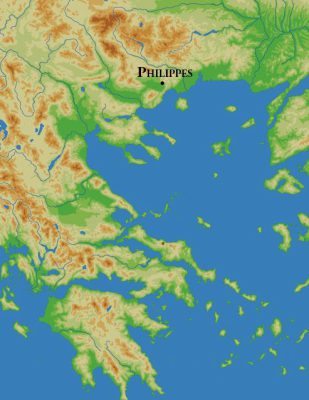
Both sides began to build various fortifications. Camp Cassius was about a Roman mile from Camp Brutus. Connecting the camps, the road was crossed by a ditch, a rampart and a straight stockade. In the middle, there was a central gate, which was the point of departure for troops from both camps. However, the Republicans did not intend to lead to a major battle – it would be completely illogical. They had great supply lines from the island of Thasos, where they had set up a base earlier, and from where it was close to the mainland and rear of the constitutional troops. A river was flowing nearby, so there was no shortage of water. Opposite Thazos was also the bay where the ships of Brutus and Cassius were gathered. In other words, there was no indication that the rulers of Rome’s eastern provinces would attack the Caesarians. There were only smaller skirmishes between the two sides. Antony knew he had to take the initiative. He decided to make preparations for a frontal attack. However, it was only a cover. In fact, he had a causeway built to cross the marshes to the rear of Cassius. The construction works were hidden from the watchful eye of the Republican soldiers by a tall reed. Finally, however, Longinus realized what was happening and decided to quickly build a second causeway, almost perpendicular to the one made by Caesarian soldiers. In addition, he ordered to strengthen it with a palisade, thanks to which he properly cut off Antony’s strategic point at his back from the reinforcements. Cassius’ idea was very good, but he did not notice that his forces had slightly dispersed. However, the triumvir noticed it and organized an immediate assault on the embankments between the camp and the marshes. The ex-consul’s troops knew what to do. They brought ladders, filled the ditch, demolished the stockade and quickly captured the point under attack. Moreover, the camp on the right was virtually unguarded, so Antony’s men took it right away. Then Brutus’ soldiers noticed that the triumvir attacking Cassius had completely exposed its wing. Without waiting for the decision of their superiors, they fell on the enemy, wreaking havoc in his rear. Soon they ran into Octavian’s legionaries, but after a fierce fight, they managed to defeat them. Soon after that, the triumvirate camp, established in that place, fell prey to the republican army (it was not the main camp). John Warry informs us that the constitutionalists did not really know what was happening on the battlefield. Clouds of dust rose everywhere, almost completely obstructing visibility. Cassius thought his and Brutus’ camps had fallen into the hands of the triumvirs. He was also unaware that his friend’s troops had captured the enemy’s camp. Warry suggests that Brutus himself may not have known this. In the end, it led to a fatal misunderstanding. Longinus was convinced he had failed and decided to take his own life. According to the author of The Army of the Ancient World, there was a certain theory among ancient historians, one might say, on the verge of conspiracies. According to her, Cassius murdered his own slave, after which he made everything appear to be suicide.
After some time, both sides, realizing that their main camps were under threat, left their opponent’s positions. The ubiquitous clouds of dust only intensified the already powerful confusion. It was practically impossible to distinguish enemy soldiers from comrades-in-arms. Brutus occupied the camp that until recently belonged to Cassius. He also took command of his army. When it seemed that the triumvirs were gaining an advantage in the strategic and tactical struggle at Philippi, there was an unexpected twist. The Caesarians, wanting to increase their numerical advantage over Brutus, decided to bring further supplements from Italy. But luck finally turned its back on them – it was almost windless that day and the constitutional fleet caught up with the triumvirate’s transport ships. The soldiers knew that they would not be able to cope with 130 enemy ships, so they combined their transporters to create a kind of platform on which they would more effectively resist the enemy. It also prevented the cut-off of individual units. The Republicans, however, fired flaming arrows at the Caesarian legionaries and forced the platform to be disconnected. A large proportion of the triumvirate’s soldiers surrendered. Others died, exhausted by drifting across the Adriatic Sea on the remains of transport ships without food or drink and in the hot sun. When news of the incident arrived at Philippi, it boosted the declining morale of Brutus’ people. The Triumvirs, on the other hand, had to accept the terrible blow they had just received at sea.
Brutus wanted to continue to fulfil his assumptions, i.e. not to be provoked to fight a battle. As I mentioned before, it would be very illogical – time was working in his favour. His legions’ officers were of a different opinion. Once, an attack against the will of the leader had paid off, so they thought that the situation would repeat itself. The triumvir soldiers, in turn, tried literally everything to make the enemy launch a careless attack on them. There were even such situations that the legionaries of the triumvirate approached the position of Brutus’ men and challenged them as vulgarly as they could. John Warry points out that although it may seem ridiculous or even primitive to us today, in the old days these were quite common activities. The Triumvirs also agreed to promise rewards to those who desert from Brutus to Octavian or Antony. The leader of the Senate party was limited to a few nightly forays into enemy outposts. Once, his army directed the river to a Caesarian camp, but all this to no great effect. Brutus remained very alert and reserved.
The situation still showed no advantage for either side. Supply remained a burning problem for the triumvirs. So they sent the legion to the Peloponnese, but the supplies there did not solve their problems. Octavian and his men had an interesting idea, however. Brutus and his troops had recently left a hill that was very close to Cassius’ former camp. Keeping this point was very difficult, especially since the range of the bows made it possible to fire at this position directly from the camp. Young Caesar then attacked this hill and placed on it, a trifle, four legions. Of course, Brutus’ soldiers began firing at the enemy almost immediately, but Octavian’s legionaries erected wicker and leather screens on which missiles fired by Republican archers landed. South of this hill, Caesar’s heir created several outposts that would enable him to outflank Brutus from the side of the marshes. However, seeing the actions of the enemy leader, he decided to build his own fortifications to protect him from being flanked.
But Brutus had a new problem. The moral of the soldiers due to inactivity continued to deteriorate, especially in the army of Cassius which had come under his orders. The leader of the Senate party finally bowed and decided to fight a major battle. He had seen an analogy between his own and Pompey’s situation six years ago. It certainly terrified him to think that the outcome of the battle might also be similar to that at Pharsalus. Marcus Junius Brutus led his army out of the camp. Victory or death. There was no other way now.
Earlier, I noted that the Philippi tactic was not very impressive. While certainly, dear Readers, you will agree that the struggle of building new dikes, crossing swamps, hiding builders in reeds or constant attempts to encircle or cut off the enemy is very interesting for us, as far as the actions on the battlefield that were to be resolved the next instalment of the civil war between the popular and the optimists, were not very inventive. Both armies faced each other. Surprisingly, the clash was not preceded by piles throwing, which was traditional for the Roman art of war. There were also no tactical manoeuvres. The troops of the triumvirs and Brutus fell at each other and began to fight fiercely against the traitors whom the soldiers considered the enemy. It was already known that in a few or a dozen hours this place would run with blood, that the ground would be bogged down by the rush flowing from thousands of bodies, that the fellow countrymen would send the country back to the afterlife. This battle was more like a battle between Greek than Roman troops. It is as if the phalanxes rushed at each other and fought until one side was broken. This is what the battle of Philippi was like, except that instead of spears, swords moved. Octavian’s legionaries decided to move on to the Brutus soldiers. They began to push them away. They pressed relentlessly forward to annihilate the legions of these damned traitors. Fury raged in the hearts of the fighters, they were almost completely lost in the heat of the fight. They just remembered to stay in style all the time, the rest with anger. They were getting the upper hand. Brutus’ legionaries began to give way to them. They easily withdrew, keeping the current formation, it was the key. The fury of the republic’s defenders began to give way to concern, the supporters of the dictatorship were stronger. Octavian’s men pressed harder and harder with each passing moment. Until finally Brutus’ chic broke. The rapid pace of the retreat in the formation was not withstood, and the soldiers ran into their comrades-in-arms. The first line mixed with the rear. Now Brutus’ subordinates had to fight for their own lives, young Caesar’s swords were getting closer. Octavian, however, did not lose his head in all the confusion. His legionaries, fulfilling orders, rushed to the central gate in the constitutional fortifications, captured it and cut off the enemy from the camp. It was an excellent move, despite the fact that the triumvirs’ men were exposed to fire from the embankments there. When Octavian blocked Brutus’ main camp, Antony flanked the enemy from the sea and the mountains. There was a slaughter. Republicans were surrounded. Caesarian gladiuses pierced other bodies, which gradually began to cover the battlefield. In the end, the conspirator’s army, still carving out and losing more soldiers every minute, decided to surrender. Marcus Junius Brutus managed to escape north, towards the mountains. He only had four legions with him. In the first impulse of proud thoughts about the victory of the republic, he wanted to force his way back into the camp under the cover of night. However, the leader’s return was blocked by Antony’s legionaries. Brutus realized his officers’ morale had been broken. He was aware of his defeat. He asked a trusted member of staff to kill him. This is how Brutus died, this is how the republic died.

Sextus, Parthians and the enmity of the triumvirs
This bloody and brutal civil war is over. Rome could finally breathe a sigh of relief – the murder of compatriots has finally stopped, at least for the time being. The troops of the conspirators were defeated. The victory of the Caesarians was complete. Now, however, it was necessary to modify the contract with which the triumvirate had been made. Its members regained the eastern lands, so the territory of the Roman state was re-divided. Octavian became the governor of most of the western provinces, including Italy. Antony, in turn, kept Gaul but also took power over the reclaimed territories in the east. He planned to conduct a campaign against the Parthians, which Julius Caesar did not have time to start. There was also the question of Lepidus, who was accused of colluding with Sextus Pompey. In the end, the triumvirs decided that Caesar’s former magister equituum would become governor of Africa. Before that could happen, however, Octavian had to deal with new problems that seemed like a hydra – if you solve one, two more will come. The veterans began demanding the land the triumvirs had promised them. This in turn sometimes required the displacement of farmers. In addition, young Caesar “took care” of his soldiers in the first place. It was then that Antony’s legionaries began to tear down. This resulted in the emergence of a new player on the political scene. His brother, Lucius, appeared as a defender of Mark Antony’s abused veterans. He secured the title of consul and openly opposed Octavian. So peace in Rome was short-lived. Lucius Antony was in Perusia when the governor of Italy decided to end his quasi-revolt. Triumvir besieged the city and starved to force it to surrender. Perusia was to be handed over to Octavian’s army, but one of the terrified inhabitants set it on fire so that it would not fall into the hands of the soldiers. Caesar’s heir, following the example of his adoptive father, decided to forgive Lucius and make him governor of Spain. In this way, he also avoided a new conflict with Marcus. Admittedly, Octavian was an incredible political talent.
However, Lucius Antony turned out to be only a temporary problem, unlike Sextus Pompey, who allowed himself more and more. He controlled all of Sicily, and his forces grew as Brutus’s soldiers fled from Philippi joined him. He also took control of the Cassius fleet, which was located in the Adriatic Sea. Overall, Sextus was capable of cutting off Italy from overseas grain supplies. The relationship between the triumvirs made him optimistic – another war was hanging in the balance. When Octavian besieged Lucius in Perusia, a furious Antony arrived in Italy. It is known where two of them fight, the third is used there. This time, however, it ended in fear. The two great men finally managed to communicate, and a certain young lady became the guarantor of this peace. In 40 BCE Octavian and Antony made a treaty at Brundisium. They regulated their relations and sealed the arrangements with marriage – Octavia, Octavian’s sister, married Antony, who had been widowed shortly before Fulvia’s death. A year later, the triumvirs also came to an understanding with Sextus Pompey. This was given to Sicily, Sardinia, Corsica and the Peloponnese. In return, he was to pass all-grain deliveries to Italy. It is not obvious where the agreement was signed. John Warry writes about Misenum, which was located near Naples. Kubiak argues that it was Puteoli. We can more or less say that it was a place in Campania. Rome, however, still suffered from a powerful political earthquake in the aftermath of the murder of Julius Caesar. The rooms were fragile, new civil wars broke out all the time. The treatise with Sextus Pompey was no exception. The settlement was soon broken and the war started again. Octavian’s fleet, however, was beaten twice by the last republican – at Kume and Massana. Future Augustus, however, had an ace up his sleeve. It was his friend, Marcus Vipsanius Agrippa. He turned out to be a very talented commander who managed to solve the problem of the lack of sea control. Meanwhile, Octavian was defeated again in the naval battle, this time at Tauormenium. Agrippa had the idea of eliminating the threat posed by Sextus. He just needed to train the fleet so that it would have mastered all the manoeuvres that he wished to teach them, he said. To this end, he ordered a canal to be dug through the narrow coast between Baiae and Puteoli. In this way, he connected Lake Lucrynskie and the Bay of Naples. The second channel connected Lake Lukryńskie with Lake Avernus. So Agrippa created a base where his fleet could train as much as they wanted, and they were absolutely fine with it. An officer fond of innovation ordered his naval forces to use a new type of harpoon. It was fired from the ship’s catapult and pulled as close as possible to the hit ship to be boarded. This solution was much more effective than the ravens that the Romans used during the Punic Wars. Sextus Pompey commanded smaller and more manoeuvrable ships, which were slowly returning to favour. So Agrippa knew that he would face an opponent who fought in a completely different way than himself. Octavian did not disappoint his friend, Marcus defeated the governor of Sicily at Mylae, exactly where the Romans first defeated the Carthage fleet. It was then that the ravens of corvus made their debut in the Roman fleet. Agrippa finished his work at Naulochus. Sextus Pompey was smashed. As the two fleets continued to struggle, Octavian, with Lepidus, who was losing power, seized the Republican’s Sicilian supply bases. The defeated Pompey escaped to Asia. There, however, he was captured and executed by Antony’s order.
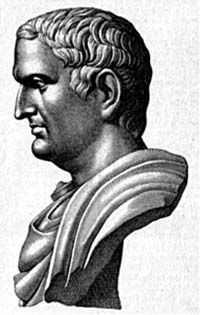
With everyone’s eyes on Octavian’s war with Sextus Pompey, the Parthians began to act in the east. Their valuable ally turned out to be Quintus Labienus, one of the conspirators whom the constitutionalists sent to the Party asking for military support. There he also learned about the defeat of his allies at Philippi. He prudently did not then return to the Roman state ruled by his enemies. He joined the Parthian prince Pacorus – with him he invaded Syria and defeated its governor. The presence of Labienus turned out to be very important, as some legionaries joined the invaders. The occupation of the eastern parts of the territory of the Roman state began. The support of the legions was extremely important to Pacorus, as the party army was customarily composed mostly of cavalry. There was, however, no good communication between the Parthians and the Roman allies. This in turn caused many dangerous situations. An officer of Antony, a certain Ventidius, stood in the way of the aggressors. A battle took place in the mountainous terrain, which ended with the crushing of the invaders. In the mountains, the Parthian horse archers were no longer as elusive as in the flat terrain, and they could not use almost any of their advantages, which they really had many. Also, the elite heavy cavalry in the form of cataphracts – riders in chain mail that also covered the horse – could not manoeuvre and did not represent much combat value. The Parthians, however, remembered the slaughter of the legions at Carrhae and thought they could repeat a similar success. They attacked the legions of Ventidius, standing in higher positions, and that would be enough of the Party’s invasion of Rome. Upon learning of the events in the east, Antony made sure only of the need to attack the Parthians. The pretext was, of course, to retrieve the legionary marks and free the captives, that is, to wipe the disgrace from Carrhae, which still stung so much Roman pride.
Marcus Antony finally attacked the Parthians. However, his expedition ended in another catastrophe. The eastern riders fought their own well-known plains again, sending hundreds of arrows at the Romans. Antony wanted to take a light ride from Armenia with him – this would be valuable support from people who have more experience in dealing with this type of troops, which constituted the bulk of the Party army. The king of Armenia, however, deserted at the last moment and Antony had to do without him. Gallic and Iberian cavalry were not used to fighting this kind of opponent. The eastern riders were often chased away, but after a while, they returned and again showered the Romans with a barrage of missiles. The legionaries were going in a square so that if necessary, they would immediately take up the fight, but it did not do much. Antony’s men eventually found a way to deal losses to the defenders, but that also failed to tip the tide in favour of the triumvir. The soldiers lay down and pretended to be dead or wounded, waiting for the enemy to show up and try to finish them off. Then they jumped up and killed off their enemies unaware of the deception. Soon after, it became clear that another expedition against the Party would end in disaster. So Antony made his way to the mountains of Armenia, where his legions were safe. Legionnaires’ marks were not recovered, prisoners of war were not recovered, what’s more, Kubiak writes that the Caesarian lost 22,000 people. In fact, the only positive thing seemed to be that the triumvir survived and the Party did not seize any of the Roman provinces.

Roman Empire
The year 36 BCE was very important in the history of the second triumvirate. Antony was defeated at the hands of the Parthians, Agrippa defeated Sextus Pompey, and Lepidus was removed from the political game altogether. As if the tensions were not enough, the third child of Antony and Cleopatra was born, with whom the chief had an affair for a long time. The role of Octavia, who tried to restrain her brother and husband’s war struggles, could not be overestimated in maintaining peace. In 37 CE in Taranto, the triumvirs faced each other at the head of armies and fleets, but Octavia managed to get the feuding men to talk. How many Roman lives did this woman save with her mediation.
Now let’s move to Alexandria. There, in 34 BCE, a ceremony took place that further increased the tension on the political scene. Marcus Antony and Cleopatra sat on golden thrones, like Osiris and Isis. They introduced to the Egyptian people Caesarion, son of Julius and the queen, as Caesar’s rightful heir. The twin’s Alexander Helios and Cleopatra Selene, as well as the then two-year-old Ptolemy Philadelphos (children of Antony and Cleopatra), received the honourable dignity of governors of the eastern provinces of Rome. These dignities were obviously fictitious, but the whole ceremony was a kind of mockery of Octavian. In Italy, people did not like the Alexandrian festival of Antony. The mistress of the Egyptian queen was accused of abandoning strict Roman customs in favour of basking in the luxuries and splendour so characteristic of these parts of the ancient world. Some of the Italians went even further, suggesting that Marcus had even given up Roman virtue. Octavian knew it was a good excuse to refuse Antony a consulate for him, even though he had promised him it earlier. The ceremony in the Egyptian capital was the nail in Antony’s coffin in terms of reputation in the Eternal City – in 35 CE he rejected Octavia, who had come to Athens with supplements for her husband. Marcus must have realized that he had already been crossed out in Italy. Even ordinary people were hostile to him by the nasty gesture of pushing away the pretty Roman woman who was undoubtedly Octavia.
Such an affront to his sister was the perfect excuse for Octavian to start an honourable war in which he would have the unconditional support of the people. However, Octavia, despite her husband’s open betrayal, continued to persuade the triumvirs to “bury the battle ax”. John Warry at this point reminds us once again of Octavian’s political genius. He said it was better to declare war on Cleopatra as an external enemy who had stripped the Roman spirit of the former statesman. It was obvious that Antony would side with his mistress, so by not attacking the Roman directly, the heir of Caesar could get rid of his co-triumvir once and for all. Octavian, therefore, issued a decree which stripped Antony of membership in the triumvirate. Everything was headed for another civil war.
The decisive battle was to be at sea, for that was what Cleopatra wanted. Octavian considered Antony to be, as Warry writes, a slave to the will of the Egyptian ruler, so he was sure that the former triumvir would support the position of mistress. Octavian Caesar also somehow did not mind such a departure, after all, he had by his side a faithful friend, Marcus Agrippa. Antony was the first to propose a duel. When the triumvir refused, he tried to convince him to fight the Battle of Pharsalus. Perhaps he wanted to decide once and for all who is, or rather who should be, Caesar’s rightful heir. Octavian also rejected this proposal. Antony gathered his forces, both sea and land, near Actium – in the Ambracian Gulf (southern Greece). What a surprise for Cleopatra’s supporters must have been when Octavian’s mighty fleet appeared on the Epirian coast. Antony was deeply concerned because he had not yet completed the crews for his ships. So he went to his head and decided to take a chance. He arranged the ships in battle order and had the oars be placed even in places where he was not manned to man. The risk paid off, Octavian withdrew.
Despite several skirmishes, Antony did not manage to repel the enemy, and Octavian’s fleet, commanded by Agrippa, who was skilled in naval battles, took a convenient position on the Ionian Islands and the Gulf of Corinth. The move was really perfect considering it was cutting Antony from the Peloponnese supplies. The former triumvir decided to persist in its own position. He only gave up the idea when there was a threat of a lap. He withdrew south, from where he wanted to break through to Egypt with his entire fleet, because there were another seven of his legions stationed there. To do this, he had to bypass the island of Leukas. Antony ordered them to go out to sea with their sails tucked in, as if suggesting that he was choosing to flee instead of fighting. He lined up three of his squadrons in two lines, along with the merchant ships. In the rear were Cleopatra’s ships, which carried much of the war’s financial back-up – a whole lot of valuables. Octavian’s armada also formed two lines. Antony, around noon, ordered his ships to go forward and extended his left wing to throw Caesar’s ships away. This would allow him to break southward and flee to Egypt. Agrippa felt that the lines of the fleet should be withdrawn a little because he wanted to pull Antony out into the open sea. Then Octavian’s friend could take full advantage of the advantage offered by a large numerical advantage. Octavian and Agrippa had 400 warships and 40,000 legionaries. Antony, on the other hand, had 230 warships and 30-50 transporters under him, with a total of 20,000 legionaries and 2,000 archers. The two fleets approached each other and began firing fire. Octavian’s soldiers did not want to get too close to avoid being boarded by Antony’s mighty ships. Agrippa, taking advantage of his numbers, stretched his lines north and south. Cleopatra’s lover had to thin out his centre to meet the enemy on the flanks. His mighty ships would have been able to handle smaller numbers in the centre, but he was losing on the wings, so his reaction was understandable. A gap appeared at about the middle of the formation. And then something happened that Antony had not foreseen. Cleopatra lost her head completely and, noticing a favourable wind, broke through the gap and began to run away. Confused, Antony abandoned his men and followed his queen. About 70-80 ships managed to join the leader. The former triumvir, apparently, valued Cleopatra more than their own troops. They fled to Egypt, and the shocking fleet he had left at the mercy of Agrippa surrendered and went over to the victorious side. It was 31 BCE.

Antony and Cleopatra travelled to Egypt but knew that they did not have much life left. In 30 CE, Octavian raided the refugee sanctuary from Action and dotted the “i”. Caesar stood at the gates of Alexandria. Antony, abandoned by officers, by soldiers, and by virtually all of them, devastated by his defeat, committed suicide. Queen Cleopatra also took her own life, although the mystery of her death still arouses the curiosity of scientists from various fields. Octavian wanted to spare the defeated queen, but she was afraid that she would be a trophy in his triumph and she managed to take her own life. After some time, Caesarion, who originally escaped from Egypt, also died, but then Octavian, convinced by someone that it was not good when there were too many Caesars, ordered him to be killed.
Another civil war is over. Octavian had no enemies anymore, he remained alone on the political scene. So he proclaimed himself Augustus and founded the Roman Empire. With absolute power at his disposal, he took over all the offices known from the republican times. When Marcus Aemilius Lepidus died, Emperor Octavian Augustus also became pontifex maximus, the high priest. The Battle of Actium resolved a lot, according to Zygmunt Kubiak we had to live in its shadow because it ultimately decided the shape of Europe at that time. The civil wars were over, no one could undermine the position of Augustus, the heir of the great Julius. He finished his work. He, the adoptive son, Octavian Caesar Augustus.