If you have found a spelling error, please, notify us by selecting that text and pressing Ctrl+Enter.

Sensational find in Gloucestershire

In the British county of Gloucestershire (south-west England), an extraordinary archaeological discovery was made, which began completely by accident – ​​with the discovery of two Roman swords by an amateur with a metal detector. This discovery became the impetus for extensive research, which revealed the existence of an extensive settlement complex of Romans from the 1st-2nd centuries CE.

Uncovered Roman cavalry sword

First intact Roman jar discovered in Ireland

Archaeologists excavating at Drumanagh Fort, north of Dublin, Ireland, have discovered an unprecedented artifact – an intact Roman jug. Previously, only fragments of Roman vessels had been found, but never a complete vessel. The finds demonstrate the intensity of the local population’s trade relations with the Romans.

First intact Roman jar discovered in Ireland

Extraordinary find in ancient Liternum

In Giugliano, Italy (near Naples), on the site of the former Roman settlement of Liternum, archaeologists have made a spectacular discovery – they have uncovered a 2,000-year-old necropolis with a unique tomb, probably belonging to a gladiator.

Extraordinary find in ancient Liternum

Amazing fresco discovered in Pompeii

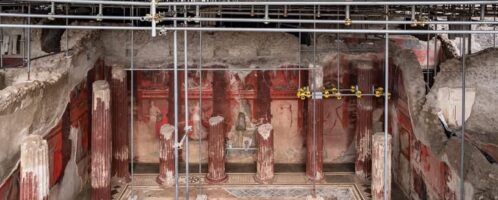
In Pompeii, in Insula 10 (Casa del Tiaso) in Region IX, archaeologists have discovered an exceptional fresco depicting rituals related to the cult of Dionysus. It is located in the large banquet hall and decorates three walls of the room, while the fourth opens onto the garden.

Amazing fresco discovered in Pompeii

Latest discovery in Pompeii: a family’s dramatic attempt to save themselves

Archaeologists have uncovered moving evidence of a family’s desperate attempt to survive the eruption of Vesuvius in 79 CE in a house named “Helle and Phrixus” after a fresco of the mythological siblings. The remains of four people, including a child, were found in a bedroom. The remains of a bed were also discovered, probably used as a door barricade to protect against falling ash and lapilli that entered through the open roof of the atrium.

The latest find in Pompeii - bed blocking the door

Spelling error report

The following text will be sent to our editors: