Chapters
Ancient writers conveyed that Roman breeding was the best mixture of knowledge and art possible for man. According to Varro, the trick was to feed as many animals as possible at the lowest possible cost. He said that the main goal of any grower should be to make the most profit possible. It is quite a modern approach to agriculture, and more than 2,000 years have passed since these words were written.
In his textbook on agriculture, Varro divided the knowledge about farming into three separate sections. In breeding, he distinguished small livestock, including goats, sheep and pigs, large livestock i.e. horses, donkeys, oxen, bulls and cows, and auxiliary livestock, without which the work of a breeder would not be possible. He included dogs and shepherds in the auxiliary inventory. The shepherd was included in the livestock because he lived with grazing animals, and his price was often less than one milk cow. However, it was indispensable for the proper operation of a farm.
Varron was the first writer to try to scientifically explain the history of agriculture and animal husbandry by man. He divided the stories of mankind into three periods, which he called the gatherer age, the breeding age, and the farming age. In the first era, man lived with the animals in the forest and was not much different from them. He ate what the gods, or nature, gave him. In the age of breeders, from the animals around him, man chose the most useful ones, tamed them and began to use products derived from them to feed himself and his family. In the agricultural era, people began to use the land itself for food. This division introduced by him is actually valid in human consciousness until today.
Another Roman writer, Columella, noted that the goals of the farmer and the breeder are inherently divergent, and conflicts constantly break out between them. Only a very good farmer can be both a farmer and a breeder. A farmer would like to allocate all the land to pasture for his animals, while the farmer tries to plough the same land and sow grain. Columella believed that a good landlord was able to divide his estate in such a way as to benefit both from farming and cultivating the land. Well, in his time, farms were vast, completely different from the scattered scraps of land that now constitute the majority of farms in Poland. However, Columella made a big discovery. He noticed that animal and human excreta even on the tiniest scrap of land would make it fertile and suitable for cultivation over time. In northern Europe (i.e. in Poland among others), a similar discovery was made only 1300 years later and its result was gigantic progress that had been made in the lives of Europeans from the end of the 15th century. His observation that cattle breeding means wealth, based on the similarity of three Latin words: pecus – cattle, pecunia – money and pecullum – wealth, is up to date, perhaps only slightly to a different extent.
The ancient Romans raised cattle in large numbers because it was a very profitable enterprise and necessary for the proper functioning of their economy. Thanks to this breeding, milk and its derivatives (mainly cheese), meat, skins and the necessary draft animals were obtained. It should be noted that the homeland of the best cheeses are the regions of Europe where rational cattle breeding has been conducted for over 2,000 years, i.e. Italy, France and partly Spain. All these countries were part of the Roman Empire for over 500 years.

All wheeled transport in the areas of the Roman Empire was based on wolf sledges. The horse was most often used as a war animal (cavalry and war chariots) as a pack animal and as a mount. It was rarely used for the harness because the Romans could not invent a suitable harness that would use all its possibilities. The statues showing the Roman harness indicate that it was a harness, but one fatal solution was used in it. The horse’s neck was girdled with a leather collar that tightened around his larynx as he pulled an oversized wagon. This type of harness only worked for a light chariot, where the horse was galloping a short distance. Horse statues from Roman times show the truth: a tight leather noose around the neck suffocated the animal, resulting in bared teeth, bulging eyes and a sort of terror and fear in its silhouette. The usual hard hack was not invented until after the fall of the Roman Empire.
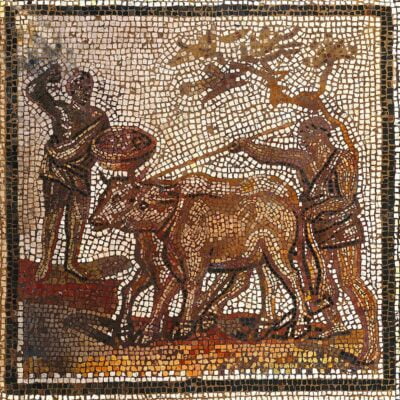
Oxen were necessary for the hardest fieldwork, especially ploughing. It was a very laborious job. Roman ploughs did not overturn the furrows but only moved the soil sideways. For this reason, to obtain the proper loosening of the soil, it was ploughed twice: once along the field and then across the already ploughed area. For this reason, three pairs of oxen were needed to support one peasant family (and they were quite numerous). Translating this into modern requirements – three medium-sized tractors would be needed to work the land on one decent peasant farm. In addition to six steers, a typical Roman peasant farm at the beginning of our era had to include a breeding bull and a dozen cows. It was a model self-sufficient farm that did not produce too many products for sale. In Poland, it was the model that was mentioned in official state documents at the end of the communist era. 2,000 years have passed, and there has been hardly any change in the perception of agriculture since the beginning of the Roman Empire.
In the 1st century CE however, major changes took place in Roman agriculture. There was a fairly quick consolidation of lands in the hands of a small group of great Roman owners. Farms that we would call specialized today were established. One of the most popular specializations was cattle breeding. Such a farm is described by the Roman encyclopedist Pliny. He says that the farm had a minimum of 60 cows and two breeding bulls. The cows gave birth to an average of 1 calf per year (sometimes there were twins, but this was rarer than in humans). The inquisitive Pliny calculated that among women, twins are born once in 100, and in cows, once in 250. He made little mistakes in his calculations. Nowadays, gynaecologists say that twin pregnancies occur in humans once in every 80 deliveries, and vets say that such pregnancies in cattle are three times less frequent than in humans. The calves were kept on the farm for two years, and then they were intended for slaughter or for further breeding. It follows that the herd described by Pliny on a specialized livestock farm consisted of about 150 head of cattle. It is a number that resembles modern livestock farms in an order of magnitude. At that time, the best breeding bulls were those that were 4 years old, and the heifer should become pregnant for the first time when it is 2 years old. Pliny reports that 10-year-old bulls were removed from breeding, because the breeding abilities were significantly reduced, and the weight could lead to injuries or even death of two young heifers. He also calculated the life expectancy of the cows. He noticed that they died of natural causes after the age of 29. According to him, bulls lived a few years shorter, but if they were castrated in their youth, they could live up to 30 years as oxen.
Roman breeders had a fairly good understanding of the physiology of cattle. They knew the length of pregnancy in a cow (Pliny described it as similar to that of a woman, while Cato, who lived more than 100 years earlier, said that it lasted a little less than 10 months). They very accurately determined the mating time of cows and the period of time needed for the animal to reach sexual maturity. All Roman writers emphasize that the one-year-old bull and the one-year-old heifer are capable of producing offspring, but the calves born of such compounds are usually sickly and very weak, therefore they are not suitable for further breeding. The same thing happens when the cow and the bull are mated too closely. Roman breeders very strongly adhered to the principle that the bull and the cow should not be related in a straight line, because a calf born of such a relationship brought misfortune to breeding. This was translated as a punishment from the gods, although it had perfectly rational reasons. The contemporary Roman guides recommended that one-year-old calves of different sexes should be separated from each other during estrus, and heifers should be kept in well-fenced pens or barns.
In large specialized farms, breeding was carried out in semi-free conditions. The animals stayed in the pasture most of the year and were not fed there. They were herded to the barns only for the winter period. According to the breeders’ recommendations, the barns had to be covered and closed. They should be warm in winter. In Italy, cattle were then fed with chopped straw, tree leaves, grape and olive pomace silage, and a small amount of hay. We are currently used to haymaking 3-4 times a year. However, the Romans rarely mowed the grass, mainly in autumn, so they did not have large supplies of hay. Intensive breeding meant that the animals consumed practically the grass for 9 or even 10 months a year, so there was nothing to mow. So in winter, the cattle crowded in the barns had to be content with straw, the silage produced after pressing olives and grapes, and the leaves that were harvested for their needs throughout the autumn.

Cattle belonging to a dozen or so breeds were bred in Italy. The most accurate native breed was considered by Roman breeders to be Campanian cattle. Campanian cattle were small, mostly white. Campanian oxen were considered to be not very strong, but very resistant to the hardships of work. They were also very obedient, unlike the Umbrian steers, which were large, very strong, not very harmoniously built, and very wayward. The Umbrian cattle were red or spotted white and red. The Etruscan cattle from today’s Tuscany also had similar characteristics. The cows of this breed were red or white red, but the bulls had a very harmonious build and were slightly smaller than their Umbrian relatives. The Etruscan oxen were considered exceptionally strong. Oxen from the Apennine race showed less strength. However, they were of extraordinary beauty and of a special colour. The cattle of this breed were uniformly black.
In addition to the native Italian breeds, imported breeds were also bred. Especially in Italy, cattle of the Gallic breed, imported from the territories of what is now northern France (ancient Alpine Gaul), were highly valued. Oxen of this breed were especially appreciated as the most useful for heavy field work. Wealthy breeders also imported more exotic cattle breeds to Italy. Cattle imported from India were considered the most expensive. Pliny writes that the bulls brought from this exotic land in Italy were considered the largest in the world and were compared only with wild aurochs and bison living in the barbaric part of Europe. The inhabitants of Italy are considered the most beautiful breed of cattle the breed bred in Epirus, i.e. in Asia Minor. An interesting fact is that Roman breeders considered uniformly coloured breeds as wholesome breeders, while spotted cattle were considered to be little hybrids.
Cato, a farmer and breeder by birth and passion, described in great detail the diseases of cattle and the methods of their treatment. Some of the ways of dealing with animal ailments seem quite modern, others are somewhat on the verge of knowledge and magic. For weakness and lack of appetite, Cato recommended that sick animals be given steamed lupine and cypress for three days, and a raw egg with grated garlic and onion should be poured down the throat every day. Sick animals had to be fed with salt and chalk dissolved in a mixture of wine and olive oil. If this measure failed, the food was supplemented with leeks soaked in wine, rue, white vetch and lentils. So they were natural substances that strengthen appetite and appetite, as well as bactericidal and supplying micronutrients.
Diseases
Cattle herds have often been decimated by various plagues. Their origin for the Romans was a great unknown. In addition to the supernatural factor (the anger of the gods), plagues could arise according to Cato in the most prosaic way. He immediately saw the source of most of the cattle being eaten the cattle of chicken droppings or of mouse and rat droppings. Sometimes, according to him, plagues passed from pigs to cows, so he believed that poultry, pigs and cattle should be kept separate. Knowing the origins of most infectious animal diseases today, Cato’s recommendations must be considered completely rational. Also, the ways of dealing with the plague that he describes in his writings seem to come from the pen of a modern veterinarian or animal scientist. He recommended that infected animals be immediately separated from the rest of the herd and treated with a drink made of wine in which St. Nicholas’ Day, leek root, wheat flour, incense, cinnamon and mistletoe were cooked. According to him, the drink did not cure the infected animal, but it often helped. When the animal died, it was immediately deeply buried or burned. It was forbidden to gut him and eat his meat, even if there was hunger in the neighbourhood.
The remedy for indigestion in cattle, according to Cato, was warm water and boiled cabbage leaves. After administering this mixture, the sick cow had to be chased away with a quick step for a mile (i.e. about 1600 meters), and if the flatulence persisted, it had to be treated by piercing her belly and draining the excess gas with a special tool similar to a large medical needle, i.e. in the shape of a sharpened tube. Such tools were found in the first centuries CE. Rural veterinarians used them even 80 years ago.
Dysentery, which is the most severe form of diarrhoea, was recommended by Cato to be treated by administering dry wine mixed with grated old cheese, gala nuts and cypress apples for 4 days. He recommended treating milder forms of diarrhoea with a few days’ diets and easily digestible food. Sometimes the lack of appetite could be caused by growths on the tongue. Such growths had to be cut and the wound rubbed with salt and garlic (poor cow who met this treatment, because this treatment was repeated until the growth disappeared).
Cato recommended that the animal be disinfected with urine. It is a fairly effective method, recommended several dozen years ago by modern veterinary medicine. Old and festering wounds had to be burned with a hot iron, washed with warm water and rubbed with butter or goat fat. All sorts of ulcers had to be cut and pus squeezed out, and then the wound burned. He recommended various types of ointments for such wounds. Some of them had tar as their basic base, while others were dominated by olive oil. However, there was always alum in these ointments, which is a strong bactericide. Cato distinguished between three types of colds in cattle. In all cases, sick animals had to be isolated from the herd and kept in a warm barn. In the case of cow fever, the sick animal had to be fed a one-day diet, then blood was drawn to the animal, and then for 5 days it was fed with cabbage cooked in olive oil and a fish sauce called garum. By the way, giving garum as medicine was a great sacrifice on the part of the Roman. It was an expensive sauce obtained from tiny fish that were fermented on a special metal sieve on a sunny day. As a result of natural decomposition, liquid dripped into the container located below the strainer, which was boiled in metal pots coated from the inside with lead for several days, until a thick, very sauce with a specific, strong smell was obtained. This sauce was used as an addition to meats and cakes. In fact, the cuisine of a rich Roman could not do without it. There was a fairly high concentration of lead in this sauce, which prevented the further decomposition of the speciality obtained in this way. A side effect of the use of garum by wealthy Romans was widespread sterility among them. Today, this syndrome is sometimes called lead fumes and affects people who have had frequent contact with lead fumes.
A cow that had cooled down had to be watered only with warm water. Cough and bronchitis were treated similarly, but instead of boiled cabbage, diseased cattle received barley flour and chopped grass mixed with broad beans and lentils. Portions of wine were added to the warm water and the sick animal had to stay in the barn until it recovered.
In case of eye disease, the sick animal had to be compressed with honey, wheat flour and ammonia salt. The top of the dressing should then be smeared with tar and oil so that the bees and wasps do not irritate the diseased area. A large number of cattle diseases described by Cato were associated with various types of accidents during fieldwork and pasture. The most common cases were hoof laceration, dislocation or painful rubbing of the neck with a yoke, various types of lameness (bruises and dislocations of joints), leg fractures, horn fractures, and viper bites and ingestion of leeches. A wounded or lacerated hoof was immediately covered with lint (that is, an especially torn cloth) soaked in tar mixed with grated garlic. Then you had to put the bubbles on the leg and put the hoof in a special shoe made of juniper. The sick animal had to be placed immediately in the cowshed, where it had to stay until it was completely healed. With all kinds of lameness, you had to rub the sore spots with oil mixed with salt and vinegar. Then a warm compress consisting of flax, millet and honey was placed.
The wound of the ox’s neck, rubbed by the yoke, was treated by bleeding blood from the ear and applying a grandmother compress to the sick place. Of course, the sick animal could not work until it was completely healed. The broken corner had to be bandaged with a cloth soaked in olive oil mixed with salt and vinegar. The dressing had to be changed every day, and after three days it was changed by adding pig fat, tar and pine bark powder to the ointment. When an animal was bitten by a viper, the wound had to be cut open as soon as possible and the blood was squeezed out. After that, the wound had to be covered with an ointment made of grated clover, burdock root and salt. This procedure had to be repeated several times so that the smallest possible amount of venom remained in the blood. Cattle swallowing leeches at a watering hole very often occurred then. The cure for this pain was warm water mixed with vinegar and olive oil. It had to be applied to a sick cow until the symptoms disappeared and the leech was expelled in the faeces.
The veterinary procedures described above often required the animal to be immobilized in a special cage. In the farm described by Pliny, which focused on cattle breeding, there was also such a device. It was a wooden cage in which the animal’s head was immobilized in special stocks, there were handles on the floor to immobilize the legs, and in one of the walls were fastened ropes with which the animal was tied. It was one of the numerous devices without which the Roman could not imagine rational cattle breeding.
Holidays

Cattle were also an important part of the religious worship of the Romans. Breeders often sacrificed their rich arts to the gods, and thanks to this, large numbers of the poor Roman people could eat meat for free, praising both the donor and the god to whom the gift was dedicated. It must be remembered that the sacrificed animal was killed, its insides and some fat were burned on the sacrificial pyre, and the rest of the carcass was divided among the people present at the ceremony. The more sacrifices to the gods were made, the more abundant the table of the participant in the religious ceremony became. The ban on participating in religious worship and eating meat offered to pagan idols, promoted by Christians from the very beginning, very often made them enemies among the poorest part of free Roman citizens. Those who were not at the ceremony were not given the meat of sacrifice, and when they got it, they could not eat it, as a result of which they often did not have to put it into the pot. The greatest holiday of all Roman breeders was Parilia. Hundreds of cattle, pigs, goats and sheep were offered then. Feasts, the main course of which was sacrificial meat, lasted for several days. Traditional Roman cults began to disappear in cities as early as the end of the 2nd century CE. Eastern beliefs spread rapidly. Mithraism and Christianity were among the most important. While in Mithraism there was also a form of animal sacrifice in the form of a bull, in Christianity the very idea of sacrifices made to the gods on the altar was a contradiction to the essence of faith. After all, the one true and existing God accepted the sacrifice of his own son only one time and henceforth offering others was an offence to the very essence of the deity who is both the recipient of the sacrifice and the sacrifice itself.
The economic crisis that engulfed the Roman Empire at the end of the 3rd century CE contributed to the decline of large-scale farms. Animal breeding in the form described by Columella and Pliny was collapsing, and veterinary knowledge was disappearing. Barbarian tribes that in 406 CE were finally interrupted by the Rhine and Danube limes brought with them almost complete destruction of the achievements of the ancient Roman civilization. Large farms and herds of purebred cattle have disappeared. There were several or a dozen heads of cattle on small peasant farms. Larger herds began to appear again with monasteries, and later in magnate latifundia. However, it was already the golden period of the Middle Ages, i.e. several hundred years had passed since the fall of Rome.