Chapters
The history of the world is full of meetings – and sometimes even clashes – between completely different civilizations. The most famous examples of such interactions are the colonization and conquest of the so-called New World, i.e. both Americas by Europeans, starting from the very end of the 15th century, invasions of nomadic Mongols from the 13th century, reaching as far as Central Europe and the Balkans, or the long expeditions of the Vikings approximately 1000 CE, which took them as far as North America, where they encountered natives – skraelings.
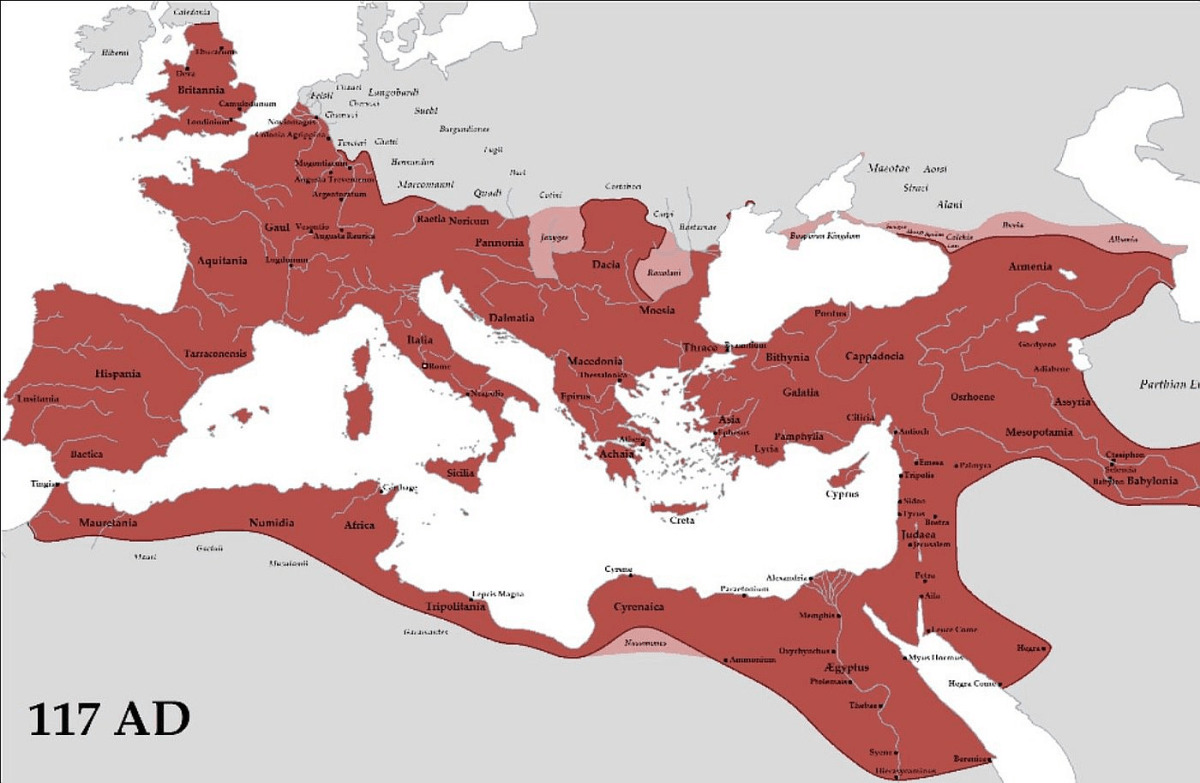
The greatest warriors of the ancient world – the Romans – also fought wars with exotic opponents, such as Nubians, Berbers, Arabs, Picts and finally Huns. On the other hand, however, intercultural contacts had a peaceful face: it is enough to recall the stories of many generations of merchants and travelers traversing Eurasia from antiquity to the modern era along various routes, which in the 19th century became known under the collective name of the Silk Road. Contrary to popular opinion, the most important routes of this trade system in ancient times led through the waters of the Indian Ocean: spices and other luxury items (such as the famous figurine) reached the Roman Empire from India through the cosmopolitan port in Alexandria, Egypt. goddess Lakshmi found in the ruins of Pompeii), from here also masses of silver flowed in the opposite direction, which had an impact on the course of the so-called crisis of the third century. In this article, however, we will go even further, to China, to see how inhabitants of such distant places as the Middle Kingdom and the Roman Empire contacted each other, what they thought about each other, as well as when and in what circumstances there could have been a direct meeting between them.
[ramka_z_zdjeciem img=”134975″ alt=”Ivory figurine of the Hindu goddess Lakshmi discovered in Pompeii” cloud=”Wikipedia” imgw=”250″ float=”right”]Ivory figurine of the Hindu goddess discovered in Pompeii Lakshmi, 1st century CE[/ramka_ze_zdjeciem]
China and Rome – powers at the edge of Eurasia
Despite the enormous distance and obstacles in the form of steppes and wastelands separating Roma from the Middle Kingdom, the history of both empires is similar in some respects. Both flourished at a similar time, in the 3rd century BCE: Rome, still a republic, in the years 241-238 BCE, after its victory in the First Punic War against Carthage and the annexation of Sardinia, Corsica and most of Sicily, which were its first non-Italian possessions. , China, however, shortly later, in 221 BCE, after the semi-barbarian Qin state subjugated the country of Qi, the last of several kingdoms into which the Middle Kingdom had been divided since the 8th century BCE, and which stood in the way of Qin expansion in the 3rd century BCE However, both emerging powers did not stop there and later experienced years of their greatest glory.
[photo_frame img=”134967″ alt=”The Empire of the Western Han Dynasty (206/202 BCE-9 CE) at its greatest extent,” cloud=”Wikipedia” imgw=”250″ float=”right”]The Empire of the Western Han Dynasty ( 206/202 BCE-9 CE) at its greatest extent, around 60 BCE[/ramka_ze_zdjeciem]
When, in the second half of the 2nd century BCE, the armed forces of Emperor Wu (Chinese: Wu-di) of the Western Han dynasty (206/202 BCE-9 CE), reigning in the years 141-87 BCE, reached the borders of Hellenistic Bactria located in Central Asia ( 256-ca. 120 BCE), the Romans were still far to the west, uncertainly setting foot in Asia Minor. And although over the course of the century they added to their achievements, among others: Gaul, Seleucid Syria and Ptolemaic Egypt, the position of the Hans decreased rapidly. Moreover, in the dying Roman republic of the 1st century BCE, it was marked by three great internal conflicts. However, with the advent of the new era, the power of China and Rome became essentially unchallenged again: in the Far Eastern Empire the old ruling family regained power, now ruling as the Eastern Han dynasty (25-220 CE), while in the Eternal City the principate reigned (27 BCE -284 CE).
Both extremely distant powers had one more thing in common: the struggle with various peoples who were considered barbarians by the inhabitants of both Qin and Han China, as well as the republic and then the Roman Empire. In principle, every alien deserved this name, but in practice, both the Romans and the Chinese used different measures for different, more or less developed cultures. For the Sons of the She-wolf, the barbarians were primarily the Celts, whom they called Gauls, Germans, Iberians, Picts and Huns in Europe, as well as the Isaurians and Arabs in Asia or the Blemmias and Garamantes in Africa. The Chinese, in turn, competed with the Mongoloid Xiongnu, Xianbei and Rouran people living in the Great Steppe (and later also with the Kitans, Tanguts, Jurjans and Mongols), as well as with the proto-Vietnamese Yue people and the Tibeto-Burmese Nanzhao people from the subtropical zone.

Roman garrison in China?
Between the Roman Empire and Han Dynasty China stretched a powerful state whose inhabitants could not be classified as ordinary, inferior barbarians, mainly due to the strength of the weapons of its warriors and the Persian-Hellenistic cultural heritage prevailing there. We are talking here about the Parthian Arsakid Empire (247 BCE-224 CE). It was the Indo-Iranian Parthians (originally called Parnas) who ruled over the critical part of the Silk Road, running through the Middle East and much of Central Asia. This happened as a result of the slow but inevitable collapse of the Hellenistic Seleucid Empire (312-63 BCE) in the 2nd and 1st centuries BCE. Originally nomadic, the Parthians were famous for their cavalry, especially their mounted archers and heavily armored cataphracts. The power of the Arsakid weapon made itself known to the Romans already in 53 BCE at Carrhae (Latin Carrhae, today Harran), when the approximately 40,000-strong forces of one of the triumvirs, Marcus Licinius Crassus (115-53 BCE), were massacred by “only “10 thousand mounted Parthian warriors under the command of an (otherwise enigmatic) aristocrat named Surena (d. 53/52 BCE), and the Roman commander himself died.
The first legend (or rather myth) in the field of direct Roman-Chinese contacts is associated with the disastrous expedition of Crassus in 53 BCE: after the Carrrean defeat, some of the legionaries survived, mostly being captured by Parthians. The then Arsakid ruler, Orodes II (57-37 BCE), was said to have placed some of the approximately 10,000 Roman prisoners in garrisons on the eastern borders of their country, as far as possible from the hometowns of the captives, where they were to guard the border of Parthia against the Xiongnu migrating west. Actually, nothing certain is known about the further fate of the prisoners from Crassus’ legions, but in the 1940s, the American sinologist Homer H. Dubs hypothesized that some of them escaped from the border fortresses deep in Asia, joining the nomadic Xiongnu, from with which they were to fight. When, around 36 BCE, the nomads were defeated by Chinese troops operating in the area of the Talas River (today Kazakhstan), the Romans who survived the next pogrom, numbering a hundred or so, were to be in the service of the Han dynasty, guarding the western edges of the Great Wall and the so-called Gansu corridor[przypisy id=”1”]. Unfortunately, Dubs’ arguments, although well received by some circles (both in the West and in China itself), are not the best justified and official historiography strongly rejects them.
The West and Rome through the eyes of the ancient Chinese
Although Homer H. Dubs’s vision of the Roman guardians of the western border of Han China is not based on any solid foundations, it cannot be denied that in the following centuries the connections between the western part of Eurasia and the Far East became more and more clear. Already the first Chinese historian Sima Qian (ca. 145/135-86 BCE) in his Records of a Historian (Chinese: Shiji) mentions countries located on (Far from the Chinese perspective) West:
Anxi [the Parthian state] is located several thousand li west of Da Yuezhi [Bactria]. […] The towns and settlements resemble those in Dayuan [Fergana]. […] Silver [coins] are used as money, on which they put the image of the king, […] In books and registers they write from left to right, on the leather. To the west [of Anxi] Tiaozhi [Characene] is located, to the north Yancai [the territory of the Alanian tribes] and Likan [the Seleucid state]. Tiaozhi lies several thousand li west of Anxi, on the Xihai [Western Sea] [i.e. Persian Gulf – K.B.]. […] At first, when the Han envoys reached Anxi, the king of Anxi ordered a general and 20,000 cavalry to welcome them on the eastern border. […] When the Han envoys were returning to China, [king of Anxi] sent his messengers with them to see how great the Han lands were, and to make gifts of ostrich eggs and Likan magicians to the Han [emperor]. […] The emperor was very happy[przypisy id=”2″].
In turn, one of the first, although still short, mentions of Rome, known to the Chinese as Da Qin (Chinese: Great Qin), comes from the so-called Jade tablet of river maps(Chinese: Hetu yuban), a divination text from the beginning of the 1st century CE, which has not been preserved to this day, known only fragmentarily from another work – The Forest of Pearls from the 7th century CE from the garden of Dharma(Chinese: Fayuan zhulin)[przypisy id=”3″]. In the following decades, the knowledge of the inhabitants of the Middle Kingdom about the “Far West” gradually increased: the author of the lost Notes of the Three Qin (Chinese: San Qin ji) from the Han dynasty, the text of which partially preserved in the 10th-centuryImperial Review of the Taipingperiod (Chinese:Taiping yulan), it reads as follows:
[…] west of Dunhuang lies Da Qin [Roman Empire], separated by the sea. [If] your heart is free from care and you encounter a fair wind, you will cross [the sea] in less than twenty days. […][przypisy id=”4″]
The reader may think (and rightly so) that this information is not much, but one should remember that the Romans knew even less about the Far East than the inhabitants of China knew about the Roman Empire. It is true that authors such as Strabo (64/63-ca. 24 BCE) and Horace (65-27 BCE) were aware that very far to the east of their homeland (although it is not known where exactly) there were people known for the production of silk. The Sers, however, data about the latter were so sparse and so doubtful at that time that they were often confused with the inhabitants of India.

The Messages of Gan Ying and Andun
Another conclusion that comes to mind after quoting the above quotes is quite obvious: despite the relatively extensive knowledge of the inhabitants of the Middle Kingdom about the lands of western Eurasia, the disproportion between the probable reports about the Parthian kingdom and the Roman Empire is astonishing. The only more ambitious attempt to enter the territory of the Roman Empire by a representative of the Chinese authorities took place in 97 CE, when a certain Gan Ying, a special envoy of Ban Chao (32-102 CE), the chief administrator of the so-called Western Territories (i.e. the conquered lands in the Kashgar Valley and its surroundings), was delegated to establish contact with the authorities (even local ones) of Da Qin. Unfortunately, the Han envoy got stuck on the Persian Gulf, in the Arsakid kingdom of Characene, vassal to the Arsakids, not realizing the relative proximity of the Roman border, so the expedition, which had great hopes, ended in failure. Was Gan Ying so incompetent that after crossing the deserts, steppes and mountains of Central Asia and reaching Parthia, he got lost on his way to Rome? This assumption does not sound very convincing, so the reason for this state of affairs must have been different: the Parthians, of course, did not intend to make the Chinese envoy aware that it was relatively easy and quick to get from Babylonia to the Roman part of Mesopotamia, and from there further into the interior. >Da Qin[przypisy id=”5″]. In the Book of the Later Han (Chinese: Hou Han Shu), a 5th-century chronicle of the rule of the rulers of the Eastern Han dynasty by Fan Ye (398-446 CE), we read that:
The king of this country [i.e. Rome – K.B.] always wanted to send envoys to the Han, but Anxi (Parthia), wishing to control the trade in multi-coloured Chinese silks, blocked the rout to prevent (the Romans) getting through [to China][przypisy id=”6″]< /p>
The action of the Anxi monarchs was undoubtedly intentional, because, being between two world empires, they wanted to prevent their mutual trade or (worse) diplomatic relations from tightening, it was the Parthians – although indirectly, thanks to the activities of the Indo-Iranian Sogdians subordinated to them – they were the true guardians of the Silk Road. However, despite the efforts of the Arsakids, Chinese sources report a mysterious event from 166 CE – the visit of an envoy from a certain Andun to the court of Emperor Huan (146-168 CE) in Luoyang[przypisy id=”7″]. Fan Ye, the author of the above-mentioned Hou Han Shu, reports the meeting of the Han monarch with the visitors from Da Qinas follows:
In the ninth yanxi year [166 CE], during the reign of Emperor Huan, the king of Da Qin (the Roman Empire), Andun (Marcus Aurelius Antoninus), sent envoys from beyond the frontiers through Rinan (Commandery on the central Vietnamese coast), to offer elephant tusks, rhinoceros horn, and turtle shell. This was the very first time there was [direct] communication [between the two countries] [i.e. Rome and China – K.B.][przypisy id=”8″]
The above fragment of theBook of the Later Hanis extremely difficult to interpret. Emperor Marcus Aurelius (161-180 CE) is most often considered to be the one mentioned in the Book of the Later Hans, but the real problems of interpretation mount for historians in the issue of the authenticity of the Roman message from 166 – there are many who believe that it was in fact a cunning Parthian staging. R. Schulz, author of the study entitled Adventurers in distant lands. Great pioneering journeys and ancient knowledge about the world (Warsaw 2020) also does not rule out that Andun’s alleged envoys were actually Greek merchants from the eastern part of the Roman Empire who – pretending to be imperial envoys – wanted to curry favor with the Chinese Son of Heaven, while avoiding Indian and Malay intermediation in trade with the Han. Either way, an official Roman mission to China most likely did not take place at that time. However, Western merchants reached the Middle Kingdom with goods and money – artifacts of Roman provenance are not as rare in the Far East as one might expect. The Chinese also particularly appreciated the skills of Syrian jugglers and jugglers, while the Romans – especially silk, which was probably their most prestigious luxury item.
Roman-Chinese contacts in late antiquity
What did the expeditions of Roman merchants to the Far East during the Principate look like? Approx. 100 CE, a certain Alexandros, a Greek from the eastern part of the Empire, arrived at the mysterious port of Kattigara. To this day, researchers do not agree on its location: some boldly place it in south- eastern China (e.g. near Guangzhou or Hangzhou), but others cautiously choose the area of the Gulf of Tonkin, the Gulf of Thailand or Singapore[przypisy id=”10 “]. Unfortunately, resolving this dispute is basically impossible. Texts of Chinese provenance record the presence of Roman merchants in the vicinity of the Indochinese Peninsula and the southeastern coast of China only in the 3rd century CE, after the fall of the Eastern Han (220 CE): in the so-called The Book of Liang (Chinese: Liang Shu) from the 7th century contains information about a certain Qin Lun, who in 226 CE reached the then Chinese Tonkin (today northern Vietnam) , from where it was transported to the imperial court in Nanking, where the founder of the Eastern Wu dynasty (222-280 CE), Sun Quan, known by the imperial name Zhongmou (222-252 CE), ruled. Does this Qin Lun’s name actually literally mean “Lun ofQin“? In such a case, as R. Schulz postulates, the merchant could be a Roman named Leon[przypisy id=”11”]. In turn, in 284 CE, another Roman delegation supposedly visited Luoyang, at the court of Emperor Wu (266-290 CE) of the Western Jin dynasty (266-316 CE).

In the following centuries, both the Middle Kingdom and the Roman Empire saw times of confusion. The Roman Empire was finally divided in two in 395 CE between the sons of Theodosius I the Great (379-395): the elder Arcadius (383/395-408) went to the East, while the younger Honorius (393/395-423) took over the rule in the West. Since then, only the Eastern Roman Empire (395-1453) with its capital in Constantinople retained political significance, which over time the Chinese (to distinguish it from the earlier, undivided Empire – Da Qin) began to call it Fulin < /em>(Chinese: Byzantium). Politically divided China was reunited by the Sui (581-618) and Tang (618-690, 705-907) dynasties at the turn of the 6th and 7th centuries, just when Eastern Rome was falling into a deep crisis. This did not prevent Emperor Yang (604-618) from making plans to send an embassy to Constantinople, which was struggling with the invasion of Sassanid Persia (224-651). And although this intention failed, in the years 643, 667, 701 and 719, delegations from Fulin[przypisy id=”12″] arrived at the Tang court in Chang’an. The Tang and Basileus of the Heraclian (610-711) and Isaurian (717-802) dynasties were brought together by the Arab expansion of the 7th and 8th centuries, but after their defeat in a battle fought against the troops of the newly established Abbasid Caliphate (750-1258) on the Talas River in 751 and the bloodily suppressed An Lushan Uprising of 755-763, the rulers of the Middle Kingdom again focused their attention on the Far East. Direct Sino-Byzantine contacts were only renewed over 300 years later, at the end of the 11th century.