Roman legion conjures up images of a perfectly synchronized formation marching in lockstep. Yet, did legionaries truly move to a rhythm resembling the modern parade step? Historical sources and analyses of the distances covered by the troops suggest a more complex picture: the army of the time was trained primarily for efficient, rapid marching while carrying heavy gear, with pace and distance determined by the type of march and local conditions. What, then, was the legionaries’ actual speed, how far could they march in a day, and how did they maintain the rhythm of a long march?
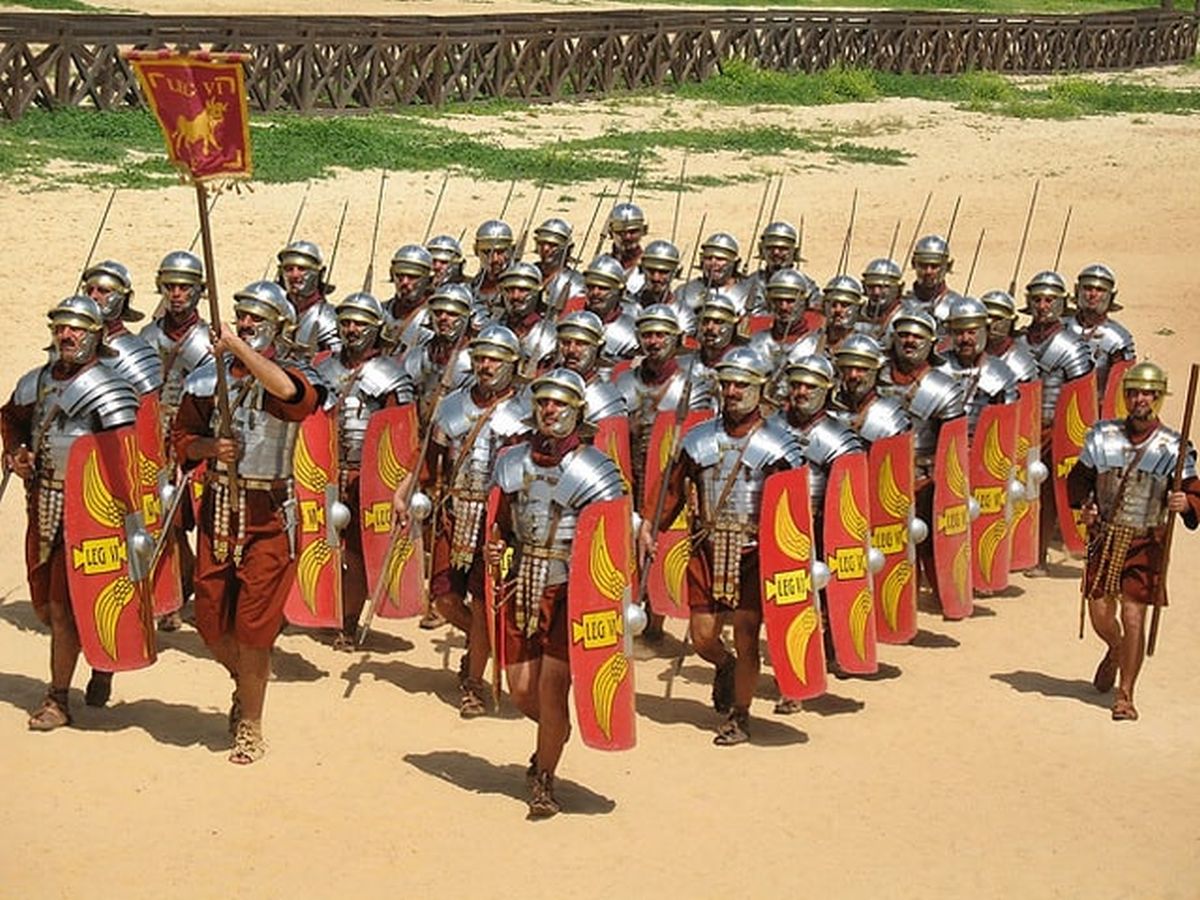
Popular culture (especially films and video games) portrays the Roman legion as an impressive machine whose components—the legionaries—move in perfect, synchronized unison. Rank after rank: left, right, left… Sinister, dexter, sinister…
But what do we actually know?
While not a scholarly source, Rudyard Kipling’s book “Puck of Pook’s Hill” (published in 1906) offers a relevant perspective through one of its characters, Parnesius, who says:
“I had previously served only in the auxiliary cohorts, which hurry along on the march like cobblers heading to a fair. The legionary’s step is entirely different: long, slow, and steady—a pace maintained from morning till night. ‘The soldier’s pace – the mark of the man,’ as the saying goes. Twenty-four miles at a stretch: neither more nor less. Head and spear held high, shield on the back, armor unfastened a hand’s breadth – that is how we marched across Britain with our eagles” (https://wolnelektury.pl/katalog/lektura/kipling-puk-z-pukowej-gorki.html; translation from Polish). The English mile – also known as the statute mile – is approximately 1.609 km; thus, according to Kipling, a legionnaire covered roughly 38.6 km in eight hours. This yields an estimated pace of 4.8 km per hour – though the actual speed was likely higher, as soldiers did not take breaks during the march.
Alternatively, one might consider the Roman mile (mille passus), defined as a thousand double paces (passus), which equals 1.478 km. This results in a distance of approximately 35.5 km and a speed of 4.43 km per hour.
I will return to these figures later.
Roman legions marched in a formation known as a column (agmen), carrying their gear and equipment – a practice crucial to their combat effectiveness.
Did the Romans march until they reached their destination?
A Roman marching day typically spanned from sunrise until around noon. It is commonly stated—and easily verified online – that they likely covered between 30,000 and 40,000 paces during this time. Since the “pace” is not a standardized, universal unit of distance, I am assuming here that the reference is to the Roman pace. However, the units used at the time were the passus (a double pace, measuring 1.478 m) and the *gradus* (a single pace: 0.739 m).
Consider the proposed line of reasoning.
The passus should be ruled out. Under that assumption, 30,000–40,000 paces would equate to 44.34–59.12 km. It is doubtful that a legionary—burdened by his gear—could maintain a (constant!) pace exceeding 6–8 km per hour. I must emphasize: calculations must account for breaks. This is a point understood by anyone who has tried it; military reenactors and soldiers, in particular, have strongly agreed with me on this.
If we base the calculation on the *gradus*, the figures become more realistic: a legionary covers 22.17–29.56 km, which—without breaks—yields a base speed of 3.16–4.22 km per hour. This aligns with the Roman army’s standard march (*iter iustum*), which lasted about four hours and covered a distance of 15–20 km (though it is also stated that an iter iustum simply involved covering about 30 km per day). When necessary, legionaries could cover approximately 30 km in five hours; this was known as a forced march, or iter magnum. At a standard marching pace, the Romans moved at about 4.5 km/h, whereas during an *iter magnum* they reached a speed of 6 km/h. It turns out Kipling didn’t write nonsense after all.
I believe that the authors of various widely available studies all too often fall prey to myths or rely on generalizations.
The step associated with the legions is, in fact, the parade step (a specific manner of foot placement characteristic of that maneuver); the name itself suggests it is ill-suited to the realities of an actual campaign.
A “march step” or “ordinary step” variant was employed—defined as movement performed in a steady, energetic manner.
In the Polish military, a march begins from the position of attention with the left foot (a centurion would shout “sin”). It is performed using either the parade step or the ordinary step, whereas marching in place is done only with the ordinary step. Setting aside posture and arm movements, a soldier starting a march with the parade step lifts the foot to a height of about 10 cm and places it down springily, with a slight stamp. The stride length is 60-80 cm (the ordinary step is shorter, at 60–70 cm), and the marching tempo is 112-116 steps per minute (unchanged for the ordinary step). Crucially, “Marching with the ordinary step allows for covering greater distances on foot. During this type of march, only the necessary muscle groups are engaged”1.
Arm movement is free and synchronized with the rhythm of the march.
Reenactors customarily begin the march with the left foot. That is simply the accepted convention. Times change, yet human anatomy and metabolism can—over the span of centuries—be safely considered constant. In other words, a soldier is a soldier, whether traversing the Roman Empire two millennia ago or trekking across the flat, semi-arid plateau of modern-day Iraq. The marching cadence of French military units is currently around 120 steps per minute—unless the Foreign Legion is involved; the official march of this formation is Le Boudin, which is sung exclusively while standing at attention. The Legion’s parade marches are performed at a slow pace (88 steps per minute), perhaps for a prosaic reason: it is difficult to move quickly – let alone run – through desert sand. Exceptio probat regulam.
Let me return to Rome.
A legion’s marching column spanned a length of 3-4 kilometers.
Recruits (*tirones*) began their basic training by learning to march.
According to Vegetius2 (4th century CE) – author of the only surviving Roman military manual, the treatise Epitoma rei militaris – the Roman army employed two types of marches, differing in pace and, consequently, in the distance covered. The foundation of training was the march at the so-called… …at a regular pace – militaris gradus – covering approximately 29.5 km (twenty Roman miles)3, and at a forced, faster pace – plenus gradus – covering approximately 36 km (twenty-four Roman miles)4. Covering these distances was expected to take five (summer) hours; I assume that the need for rest was factored into both scenarios. If the pace increased, the march would transition into a run – maneuver for which no standardized regulations existed.
Note, reader, that within this brief text, three different march durations have already appeared: five hours (though I have also encountered sources citing six), seven hours, and eight hours.
A three-hour discrepancy represents a significant margin of variation, yet authors consistently overlook the aspect of rest in their analyses. Vegetius, too, makes no mention of halts; while these were almost certainly necessary, they were likely quite brief.
A complicating factor in these calculations is that the length of Roman hours varied according to the season—which likely accounts for the discrepancies.
It also appears that Vegetius lacked firsthand military experience, and the accuracy of his assertions regarding the late Roman army is questioned by modern military historians.
The demands once placed on legionaries can be compared to the test marches conducted by modern armed forces that enforce strict standards for weighted marches (marches with a load)5. In summary, Roman legionaries were trained to march rapidly while carrying heavy equipment – and usually over long distances, too.
Finally, there is an intriguing question: how was the marching pace maintained?
The drum – an instrument commonly associated with the military—was virtually absent from Mediterranean culture in antiquity; it was considered a foreign, exotic instrument.
In the Roman military, the tuba (trumpet) and the signal horn played the primary roles.
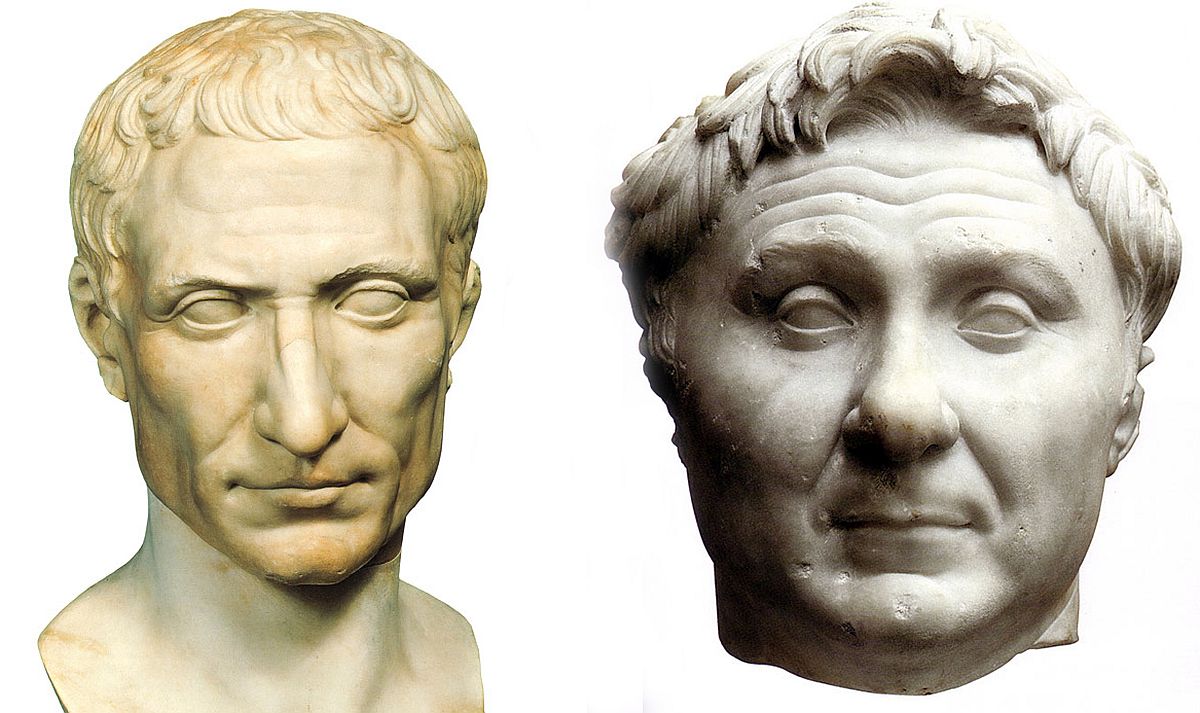
Admittedly, we do not know whether the legionaries marched to the sound of specific instruments or while singing. I find the image of the *miles gregarius* (the ordinary legionary) marching with a song on his lips more compelling—especially given that Suetonius (d. 130 AD), in his biography of Caesar, mentions that veterans sang (mockingly) during Caesar’s quadruple triumph in 46 BCE.
How spectacular is the scene from the film “Ben-Hur” (2016) depicting the legion marching into Jerusalem to the chant of “Legio, Aeterna, Victrix!” (“Legion, eternal, victorious!”). Unfortunately, this epic marching song was created for the American production; it employs a style of singing known, among others, in the US Army, where the rank and file respond to an officer’s call6.
The idea of chanting also strikes me as convincing because the instruments known to have been used by the Roman military are ill-suited for keeping time.
We know that they did manage to maintain the tempo somehow.