Functioning in the Eastern Roman Empire since at least the 5th century CE, the so-called Scrinium Barbarorum could be described as a bureau for barbarian affairs. Active both inside and outside Empire’s borders, it dealt with both foreign policy concerning barbarian tribes and the oversight of the population of barbarian origin living within the Empire.
The exact date of Scrinium’s establishment is unfortunately unknown. Notitia Dignitatum, a document describing imperial offices, tells us that the bureau already existed in the 5th century CE. According to this source, the head of Scrinium Barbarorum was the magister officiorum (Eng. “Master of Offices”). He belonged to the innermost circle of imperial officials, working closely with the emperor. It is likely that the bureau came into being during the reign of Emperor Caracalla (ruled 211-217 CE), in whose era Rome was challenged by mass migrations of barbarian peoples from the East. In 212 CE Caracalla issued the Constitutio Antoniniana, an edict granting Roman citizenship to all free inhabitants (including barbarians) of the Empire.
On a day-to-day basis, the bureau was run by four subadiuvae, that is, secretaries, delegated to supervise activities within the four principal administrative units (dioceses) of the Empire: Thrace, Pontus, Asia and the East (also called Oriens). The tasks of the Scrinium may have included, among other things, mediating in negotiations and providing interpreters, documenting diplomatic contacts, and supervising barbarians visiting the Empire. The bureau may also have served as an intelligence agency, a view put forward by, among others, the historian M. Antonucci (The Legacy of Byzantium, 1993); however, there is no unambiguous evidence confirming this claim.

The role of an intelligence agency most likely fell to the Agentes in rebus (Eng. “Messengers”), couriers in the service of the state, who, thanks to their mobility and worldliness, also served as the ears and eyes of imperial power. The Scrinium was rather concerned with gathering and documenting information obtained openly, through contacts with representatives of barbarian peoples via diplomacy or during supervision.
Both Scrinium and Agentes in rebus were successors of the military intelligence, courier and police service known as the frumentarii. Established during the reign of the Flavian dynasty (1st century CE), this organisation carried out all tasks assigned by the emperors: from gathering intel to political assasinations. Missions carried out by frumenatrii, often aimed at terrorizing the Empire’s population, led to the dissolution of this universally hated organisation in 312 CE, during the reign of Emperor Diocletian.
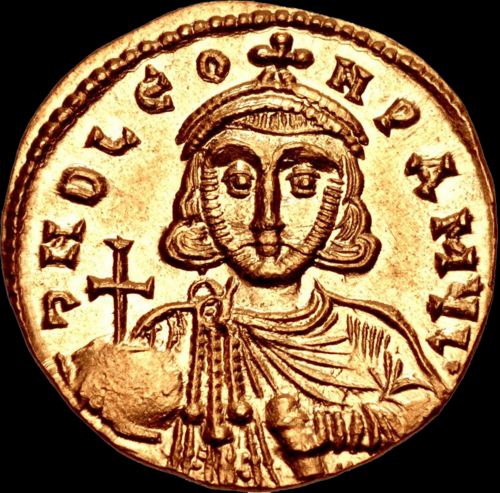
It seems that both Agentes in rebus and the representatives of the Scrinium were seen in a more positive light than their predecessor; nevertheless, both agencies ceased to exist or undervent reforms in the 8th century CE, during the reign of Leo III the Isaurian (ruled 717-741 CE). Reforms of these agencies were a part of a larger effort aimed at transforming both the imperial adminsitration and the army, still recovering from the ruin caused by the dynastic crisis of the turn of the 7th and 8th centuries, whose structures were archaic and ill-suited for the problems the Empire faced during his reign.