Well-preserved Roman leather boot
Well-preserved Roman leather shoe that was discovered in London and dates from 75-125 CE. The artifact is in the Museum of London.
If you have found a spelling error, please, notify us by selecting that text and pressing Ctrl+Enter.
Artifacts is a collection of curiosities dedicated to objects left behind by the ancient Romans. This category features lesser-known facts and interesting information about archaeological finds, such as tools, weapons, coins, inscriptions, and everyday objects, which provide a deeper understanding of life in the Roman Empire.
Well-preserved Roman leather shoe that was discovered in London and dates from 75-125 CE. The artifact is in the Museum of London.
Roman painting showing a scene from mythology. In the fresco we see Hippolytus and his stepmother Phaedra, who confesses her affection for him. Phaedra tried to seduce Hippolytos; but when he rejected her advances, she hanged herself accusing Hippolytus of trying to seduce her. Hippolytus was therefore exiled. In the painting, Hippolytus is preparing to hunt.
Roman mosaic showing a chessboard in the shape of a circle. In the corners of the object we can see decorations in the form of ducks. The object is dated to the 1st BCE – 1st century CE. The artifact was discovered in Pompeii, in the so-called Mosaic House with Doves. The object is in the National Archaeological Museum of Naples.
Roman mosaic showing struggle of Theseus with Minotaur in the labyrinth. At the back of the stage, we see women watching the fight in horror. The object dates back to the 1st century BCE. The artifact is in the National Archaeological Museum in Naples.
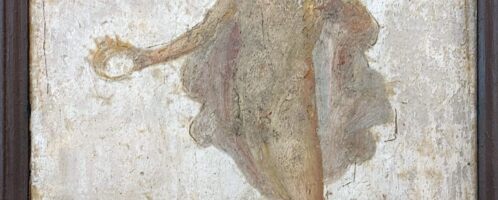
Roman fresco showing Narcissus looking at his reflection in the water. There is also a cherub in the painting. Object dated to the 1st century CE; discovered in Pompeii. The artifact is in the National Archaeological Museum in Naples.
Plaster casts of Pompeian bodies. The objects are located in the Archaeological Park of Pompeii.
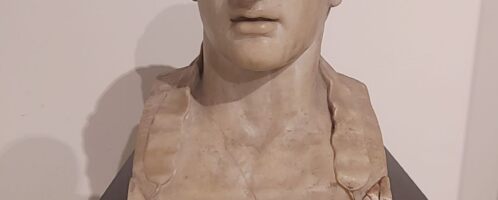
Unidentified man on Roman marble statue. The object is dated to the reign of Emperor Tiberius (14-37 CE). The artifact is in the National Archaeological Museum in Naples.
Roman sculpture that depicts the mythological Atlas holding the celestial vault on his shoulders. According to mythology, the titan Atlas was condemned for participating in a conspiracy against the power of Zeus. The “Farnesian Atlas” is a Roman marble copy of a Hellenistic original; dated to the 2nd century CE
Roman fresco depicting a parody of Aeneas’ flight from Troy; the painting adorned one of the houses in Pompeii. The scene depicts Aeneas carrying his father Anchises on his shoulder and leading his son Ascanius by the hand.
Roman women’s leather sandals made in Gaul around 1900 years ago. The object was discovered at Vindolanda Fort in northern Britain.