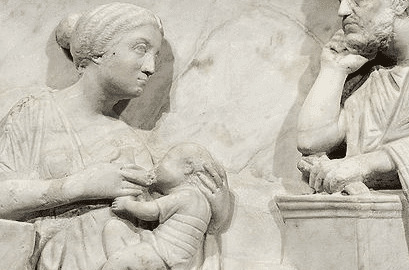
The rich Roman matrons did not breastfeed their children. For these purposes, slaves or freedmen were usually used.
Soranus – Greek philosopher and doctor from the 2nd century CE – in his work De arte obsterica morbisque mulierum he confirmed this practice as beneficial, due to the fact that the mother after birth was too exhausted to feed the child. Moreover, a Greek slave woman, feeding her child with her milk, could give him the ability to learn Greek. In turn, when the infant reaches the age of 6 months, it was necessary to start feeding them with bread softened in wine.
Interestingly, Roman medics and philosophers had a different opinion and thought that mother’s milk should be delivered to the child. In their opinion, breastfeeding mother could transfer the defective features of a slave to a child. Roman men, in turn, considered a wife who did not feed her offspring as lazy and vain, who only cared for her figure.