
If you have found a spelling error, please, notify us by selecting that text and pressing Ctrl+Enter.
Articles (Other)
Other Topics is a category that collects articles related to ancient Rome and the ancient world that don’t fit into the website’s main thematic sections. Here, you’ll find a variety of texts on historical curiosities, source interpretation, pop culture, scientific research, and other related topics that complement knowledge about the Roman Empire. This is a space for unusual topics and content that expands the understanding of the ancient world.
Sikait (Emerald Mountain) – only known emerald mine in the Roman Empire
Emeralds were the most popular gemstones of ancient Rome. All kinds of jewelry were decorated with them, as well as everyday objects, such as safety pins or hairpins.

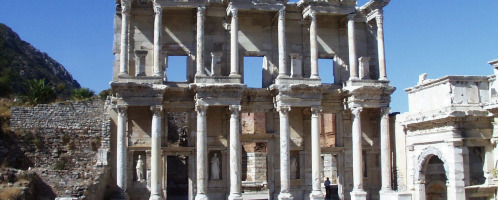
Public libraries in Roman world
The word “libraries” (Gr. βιβλιοθήκη, derived from the Greek words βιβλίον and θήκη, successively translated as book and reservoir) functions in Polish as a name for a large collection of books, both private, being the work of an independent collector, and public, in the form of a state institution with free access to the collection, which is regulated by the rules set for a given institution. This 20th-century definition significantly differs from how libraries functioned and were understood during the existence of ancient Rome.
Origins and development of victory theology in ancient Rome
War is one of the most radical actions that a human society can take. Among ancient societies, this type of behaviour was most often perceived in a religious and magical context. Humans appeased the gods before the conflict began, and subsequent victories or defeats were attributed to their direct intervention. Ancient Greek and Roman societies functioned no differently.

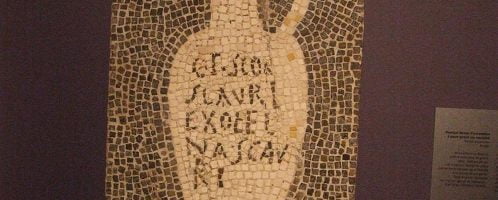
Advertising in ancient Rome
In the modern world, advertising accompanies us at every step. It may concern all manifestations of human activity: trade, politics, art, etc. The desire to promote one’s own products or a person seems to be inscribed in human nature. It was no different in ancient Rome. However, the means of disseminating advertising were very different from those we know today.
Reconstruction of Roman legionary in movies on biblical themes
One of the most famous events in human history is undoubtedly the crucifixion of Jesus Christ in the early 30s of the 1st century CE. For this reason, along with the development of cinematography, many works were created to show the life of Christ: his birth, teaching, death and resurrection. Most of these works show Roman soldiers, specifically – legionarys, who most of the time appear only as a background.

Traces of presence of ancient Romans in Ukraine
In Ukraine, we can find remains of the presence of ancient Romans, as well as evidence of intimate trade contacts with peoples inhabiting the Ukrainian steppes – Sarmatians or Scythians. One of the most abundant Roman finds is the Crimean Peninsula.

Three resurrections of Nero
On June 9, 68 CE in Rome, Nero, the last emperor of the Julio-Claudian dynasty, committed suicide. Nero was a figure hated by Christians and the Roman aristocracy. However, the ruler was perceived differently among the lower social classes; its popularity was so great that three pretenders appeared throughout history.

Secrets of Pompeian fresco
September in Campania was far from what we had imagined. Together with a Polish couple, permanently living in the cool, rainy Scottish Highland, we naively expected room temperature, perfect for long hiking trips. Instead, the Campaign greeted us with over thirty degrees of heat and humidity of ninety per cent. In a word, horror.

Monetary propaganda of Emperor Domitian
Reign of Domitian (81–96) is an interesting and at the same time controversial period in the history of the Roman Empire. Writers from senatorial circles described the emperor as cruel and authoritarian.
