

Chapters
For centuries, Roman buildings have exemplified the durability of ancient engineering. Many concrete structures have preserved fragments of the material dating back nearly 2,000 years. These include harbors, breakwaters, foundations, domes, and other structures constructed throughout the Roman Empire.
It has long been known that one of the most important ingredients of Roman concrete was pozzolana – a material of volcanic origin that, when mixed with lime and water, created a durable binder. However, research conducted in recent years indicates that the method of preparing the mixture also played a significant role.
The characteristic white lumps of lime present in many samples of Roman mortar have attracted particular attention from scientists. Initially, these lumps were attributed to incomplete mixing of the ingredients. Now it is known that they may have played an important role in the material’s structure.
What was Roman concrete made of?
Roman concrete, known as opus caementicium, was made from several basic ingredients. Lime and the aforementioned pozzolana played an important role, creating compounds responsible for binding the material. The Romans used local raw materials, but pozzolana from the Bay of Naples was particularly prized. Depending on the type of structure, different types of aggregate were also used. In the case of large structures, these could be fragments of rock, brick, or volcanic materials.
This mixture was used to construct walls, foundations, and domes. However, Roman concrete did not have an identical recipe – its composition varied depending on the location, period, and purpose of the structure.
Mysterious white lumps of lime
One of the characteristic features of Roman concrete is small, light-colored fragments, which scientists refer to as lime lumps. For a long time, it was assumed that their presence might indicate improper mortar preparation. However, modern analyses have shown that these lumps may be remnants of a different preparation method. Research conducted by a team of scientists has indicated that the Romans may have used quicklime directly during the preparation of the mixture. This process is known as “hot mixing.”
Quicklime is calcium oxide, which reacts violently with water upon contact, releasing a significant amount of heat. In the case of mortar preparation, this reaction could have caused high temperatures in the mixture. As a result, calcium-rich lumps remained in the hardened material.
In 2025, excavations in Pompeii provided particularly important evidence. In one area of the city, a preserved construction site was discovered, buried during the eruption of Mount Vesuvius in 79 CE. This was a unique situation, as archaeologists were able to examine not only the finished wall but also the materials gathered on-site before construction was completed. Among the materials discovered were fragments of quicklime mixed with dry pozzolana. This provides a significant argument in favor of the hot-mix technique used by Roman builders.
How could Roman concrete repair itself?
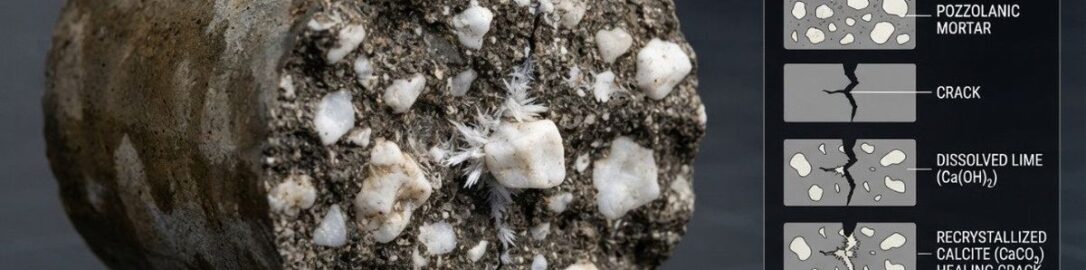
One of the most interesting findings from the research is the self-healing ability of small cracks. This mechanism is related to the presence of calcium-rich nodules. When a small crack forms in the material, water can penetrate. Contact with water can dissolve some of the limestone components and release calcium ions.
Then, calcium can migrate with the water within the material’s structure. Under the right conditions, minerals, including calcium carbonate, can be re-formed, which can fill small gaps. Some calcium can also participate in further reactions with pozzolana.
This doesn’t mean that Roman concrete was completely immune to damage. This process primarily affects small cracks and specific chemical conditions. However, researchers confirmed the possibility of such a mechanism in laboratory experiments. Mixtures they prepared, containing lime lumps, demonstrated the ability to seal cracks when deliberately damaged by water.
Why did the concrete of Roman ports survive so long?
Roman structures in contact with seawater are a special case. Modern concrete can be exposed to a range of degradation processes related to water, salts, and freeze-thaw cycles. Meanwhile, some Roman port structures survived for many centuries. However, it is impossible to pinpoint a single recipe responsible for the durability of all Roman structures.
In the case of marine concrete, the pozzolana reaction and subsequent mineral processes occurring in the concrete structure were among the factors. Studies of Roman marine concretes revealed minerals such as tobermorite and phillipsite, associated with long-term reactions occurring within the material. Therefore, the durability of Roman concrete should be considered the result of the entire set of material properties, not a single component.
Roman concrete still holds many secrets
Despite advances in research, scientists do not yet know all the details about Roman concrete technology. The Romans used various raw materials and recipes, and the method of preparing the material could have varied depending on the type of structure. Not all Roman concretes exhibit the same properties either.
However, the Pompeii research is an important addition to previous analyses. For the first time, scientists have obtained such a direct archaeological picture of the process of preparing building materials in Roman times.
Thanks to the combination of archaeology, chemistry, ge