

Chapters
In 79 CE Mount Vesuvius (Vesuvio), unexpectedly resumed its eruption activity, covering the area with a hurricane of ashes, lapels, poisonous gases and eruptive materials. At that time, streams of lava mixed with mud were flowing down the slopes of the volcano, destroying everything on its way.
The explosion was so sudden and unexpected that it completely surprised more than three thousand inhabitants of Pompeii. The eruption was preceded by a series of earthquakes also in the Danube region. After the eruption Pompeii, Herculaneum and Stabiae was covered a layer of ashes more than six metres high, which mortally throttling the city preserved the testimonies of the life of its inhabitants, immobilized forever in the moment of the tragedy. The consequences of the outbreak of Vesuvius were fear and death in the flourishing regions of Campania. Ashes reached even such distant areas as Egypt or Syria. Ash clouds also reached Rome, obscuring the sun for several days and causing panic. Many other cities were also destroyed.
The explosion took place several months after the take over the power by emperor Titus (24 June 79 CE), older son of ex-emperor Vespasian.
Such a serious catastrophe was the greatest possible shock to the ancient Romans, even when compared to earthquakes. For Emperor Titus it was a sign from the gods of their wrath, for the earlier suppression of the uprisings in Judea. The ruler took appropriate measures (games, giving aid) to alleviate the inhabitants of the affected areas. To make matters worse, the following year Rome was hit by an epidemic of plague and another large fire in the city. All these events could have been the cause of Titus’; premature death in September 81 CE. Titus died when he was only 42 years old.

Before explosion in 79 CE
According to Roman writers, the slope of Vesuvius was developed by the inhabitants of the region (except for the peak where the surface was rocky). There were vineyards and gardens. As researchers suggest, in ancient times the mountain could only have had one peak, as evidenced by e.g. the fresco showing Bachus and Vesuvius found in a Pompeian house Casa del Centenario.
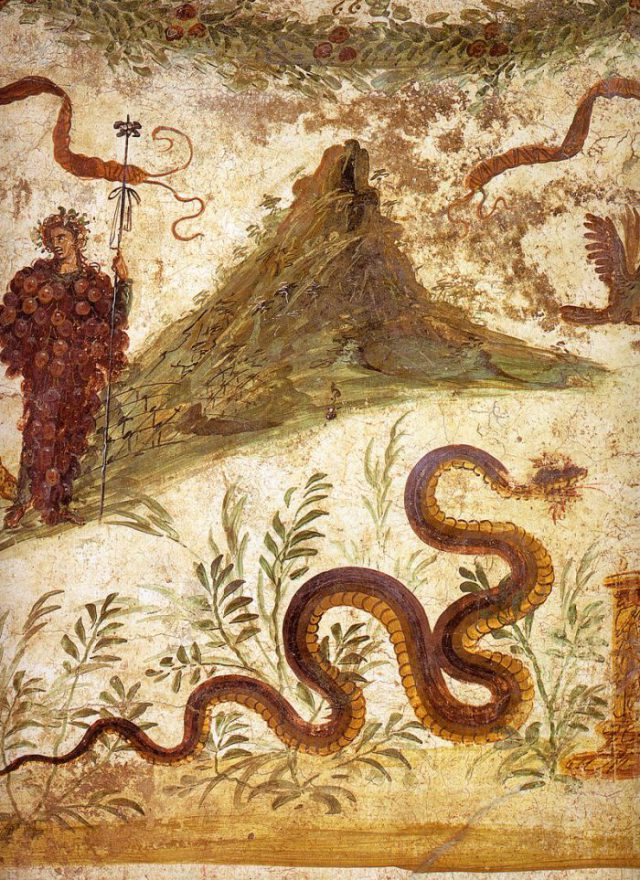
The question that comes to everyone. Were the ancient Romans not aware of the eruptive nature of the mountain, and did it not arouse any suspicion? As it turns out, several ancient authors mentioned Vesuvius, suggesting that the mountain could actually be dangerous.
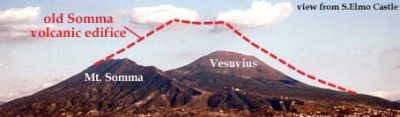


Greek historian Strabon in his work “Geography” (V, 4) wrote that dust-covered rocks can prove “craters filled with fire”. What is more, the fertility of the slope of the mountain can result from eruptional activity – just like in the case of Mount Etna.
Vitruvius for a variety, in his work R