
Battle of the Teutoburg Forest
(probably 9-11 September 9 CE)
Battle of the Teutoburg Forest (9 CE) was a huge defeat of the Roman army in Germany. All three Roman legions and all other troops fell in the fight.
If you have found a spelling error, please, notify us by selecting that text and pressing Ctrl+Enter.
Ancient Rome, a state engaged in intense territorial expansion, fought countless wars over the centuries. Well-trained and equipped Roman troops, led by outstanding strategists, were capable of defeating even much larger opposing armies. However, there were also painful defeats, such as the defeat at Cannae and the catastrophe in the Teutoburg Forest.
Rome confirmed its military might as early as the beginning of the 2nd century BCE, defeating the Macedonian army at Cynoscephalae in Thessaly in 197 BCE. Seven years later, at Magnesia in Asia Minor, Roman legions defeated the Seleucid forces – one of the greatest powers of the Hellenistic world – proving themselves to be the superior army in the region. The crisis of Roman military power began to become apparent in the 3rd century CE; As a consequence, the process of “Germanization” of the army and the decline in its combat value contributed to the decline of both the army and the Roman state itself.
(probably 9-11 September 9 CE)
Battle of the Teutoburg Forest (9 CE) was a huge defeat of the Roman army in Germany. All three Roman legions and all other troops fell in the fight.

(2 September 31 BCE)
Battle of Actium (31 BCE) was a decisive battle in the civil war between Octavian and Antonius and the Egyptian Queen Cleopatra who supported him.

(45 BCE)
Battle of Munda (45 BCE) was the last episode of the war between the Romans. Eventually, Caesar's absolute domination in Roman politics was established and the anti-Caesarian opposition virtually disappeared.
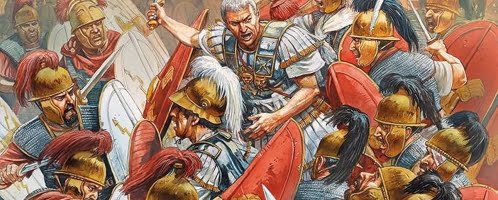
(3 and 23 October 42 BCE)
Battle of Philippi were actually two clashes in 42 BCE in eastern Macedonia, won by the combined forces of Mark Antony and Gaius Octavian, against Cassius Longinus and Marcus Brutus. The battle ended the lives of Caesar's murderers and temporarily stabilized the situation in a country torn by civil war.
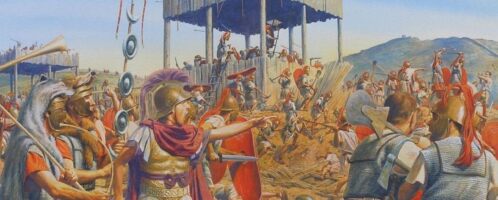
(46 BCE)
Battle of Ruspina and Thapsus (46 BCE) were the next stages of the civil war, having a key impact on the further history of the Roman Republic. The Battle of Ruspina almost did not end with Caesar's undoing, and the battle of Thapsus ultimately brought doom to many Pompeian officers and leaders (including Cato the Younger).

(47 BCE)
Battle of Zela (47 BCE) took place during the struggle of the Romans with the king of Pontus Pharnakes II. Ultimately, Caesar achieved a significant victory, and the entire campaign lasted 5 days.

(9 August 48 BCE)
Battle of Pharsalus (48 BCE) took place between Caesar and Pompey's army. The battle decided about Caesar's victory in the civil war.

(48 BCE)
Even the greatest of strategy geniuses needs a handful of luck to win. Gaius Julius Caesar, who is still considered one of the greatest generals in history, was not invincible. At one point in the civil war against Pompey, Caesar was only saved from defeat by a miraculous coincidence. How is it possible that this "god of war" came within a hair's breadth of tragedy? What decision saved him at the last minute?

(49 BCE)
In 49 BCE Julius Caesar besieged the armies of Pompey and himself at Brundisium, in the south of Italy. Gnaeus Pompey needed his ships to be able to evacuate to the Balkan Peninsula.

(52 BCE)
Battle of Gergovia (52 BCE) took place between the Roman army led by Julius Caesar and the insurgent Gallic army led by Vercingetorix.
