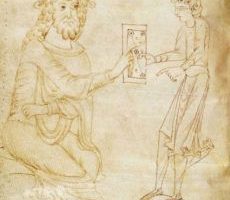
Numa Pompilius
(753 - 673 BCE)
Numa Pompilius was the second legendary king of Rome. Sabine, a religious legislator, softened customs, passed numerous laws, and an organizer of religious life.
If you have found a spelling error, please, notify us by selecting that text and pressing Ctrl+Enter.
The history of ancient Rome saw the emergence of many outstanding figures who left a lasting mark on the history of the world. Some of them are remembered by posterity as cruel tyrants, such as Caligula, Nero, and Caracalla. Others became renowned as reformers and builders of the Roman state’s power, including Augustus, Claudius, Marcus Aurelius, Diocletian, and Constantine the Great. It is also impossible to ignore the Roman generals, who often saved the state from collapse.
History also includes outstanding figures of Roman culture – writers, philosophers, and artists whose work had a profound impact on the development of European civilization. In this section, I present profiles of individuals who achieved great deeds or whose actions left a lasting mark on the pages of history.
(753 - 673 BCE)
Numa Pompilius was the second legendary king of Rome. Sabine, a religious legislator, softened customs, passed numerous laws, and an organizer of religious life.

(? - 642 BCE)
Tullus Hostilius was the third king of Rome. He reigned in the years 673-642 BCE. Tullus was a belligerent ruler.

(c. 677 - 617 BCE)
Ancus Marcius was traditionally the fourth king of Rome. Roman historians handed over Ancus as one of the best rulers of Rome.
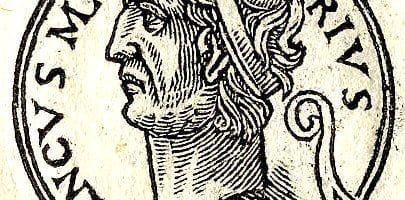
(? - 534 BCE)
Servius Tullius was the sixth king of Rome according to Roman tradition. He was the successor of Tarquinius the Elder and ruled from 578-534 BCE. He was of Etruscan origins, like his predecessor. His daughter Tullia the Elder was the wife of Tarquinius the Proud, the last king of Rome.

(? - 578 BCE)
Tarquinius the Elder was the fifth king of Rome. He reigned in the years 616-578 BCE According to Livy, he was of Etruscan origin.

(6th century - 496 BCE)
Tarquinius the Proud was, according to the accepted tradition, the seventh and last Roman king. His tyrannical rule eventually overthrew the monarchy.

(519 - 430 BCE)
Lucius Quincius Cincinnatus was a Roman consul and dictator from the mid-5th century BCE. Cincinnatus has been invoked many times as a model of civic virtue.
(? - 485 BCE)
Spurius Cassius Vecellinus is the first person of the oldest period of the Roman Republic, the existence of which is certified in sources.

(5th century BCE)
Aulus Postumius Tubertus was a Roman commander in the war with Aequi and Volsci in the 5th century BCE.