
Chapters
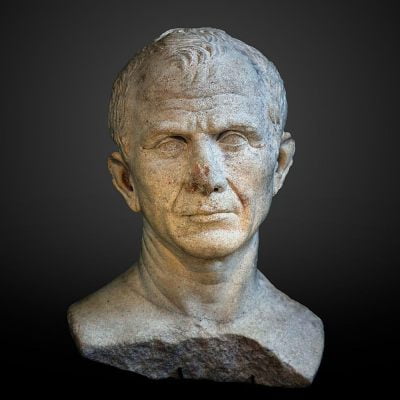
Gaius Julius Caesar was born on 12 July 100 BCE (according to Mommsen and Dio, he was born on 13 July and gained his fame thanks to the governorship in Gaul).
Son of Gaius Julius Caesar the Elder, whose political career was not impressive and Aurelia Cotta. He got his father’s name.
One of the members of the populares, is related to Cinna and Marius. After their death, he held successively the offices of quaestor, aedile, praetor, consul and dictator. He gained fame thanks to his exile in Gaul and thanks to the help of his soldiers he managed to overcome the opposition, focused on the Senate and Pompey, and then, after many years of fighting, take over the full power in Rome. Murdered during the Ides of March by senators led by Marcus Brutus and Gaius Cassius. Before his death, he adopted Gaius Octavian in his last will, designating him as his heir.
Adolescence
We do not know much about Caesar’s childhood because ancient historians were not interested in the lives of children who were not idealized like adults. Various legends were disseminated about his childhood. One of them says that Caesar was to be born thanks to a Cesarean section (hence the name), but it is rather a modern invention because in the past such a procedure was performed only in the case of a woman’s death during childbirth, while Caesar’s mother, Aurelia Cotta died in 54 BCE. His father was Gaius Julius Caesar the Elder, after whom he inherited the names.
Caesar was the nephew of Julia – wife of Marius, leader of the Populares in Rome. This party, which forced changes in the State, was in a disadvantageous position since in 82 BCE Sulla was a dictator in Rome, the leader of the conservative party – the Optimates.
The struggle between these parties also touched Caesar. At the age of sixteen, in 84 BCE, he received – thanks to Marius – the first political and religious office – the title of the priest of the god Jupiter (flamen Dialis). However, just in 82 BCE, he lost it because he had refused to follow the order of Sulla, who imposed a divorce on him with Cornelia. She was the daughter of Lucius Cornelius Cinna, the second leader of the Populares after Gaius Marius. Caesar also lost Cornelia’s dowry, but Sulla guaranteed him inviolability.
Caesar, however, did not believe Sulla, who had previously broken his promise and he fled in a hurry to the mountains. There he hid among swamps and forests. The inconvenience of these hiding places caused him a serious illness. When he was transported on a stretcher to another place, he was captured by Sulla’s army. A large ransom paid to the soldiers allowed Caesar to save his life and freedom. His acquaintances in Rome, the relatives of Aurelia, and even the Vestal Virgins, but above all, liked by Sulla, Aurelius Cotta, pleaded for Caesar to enable him to return safely to Rome. Caesar, however, had no intention of returning to Rome – he knew that in such an inconvenient political situation in which he found himself, his political career was doomed to failure. He also knew that as a politician, he had to show up in the army and fight beforehand.

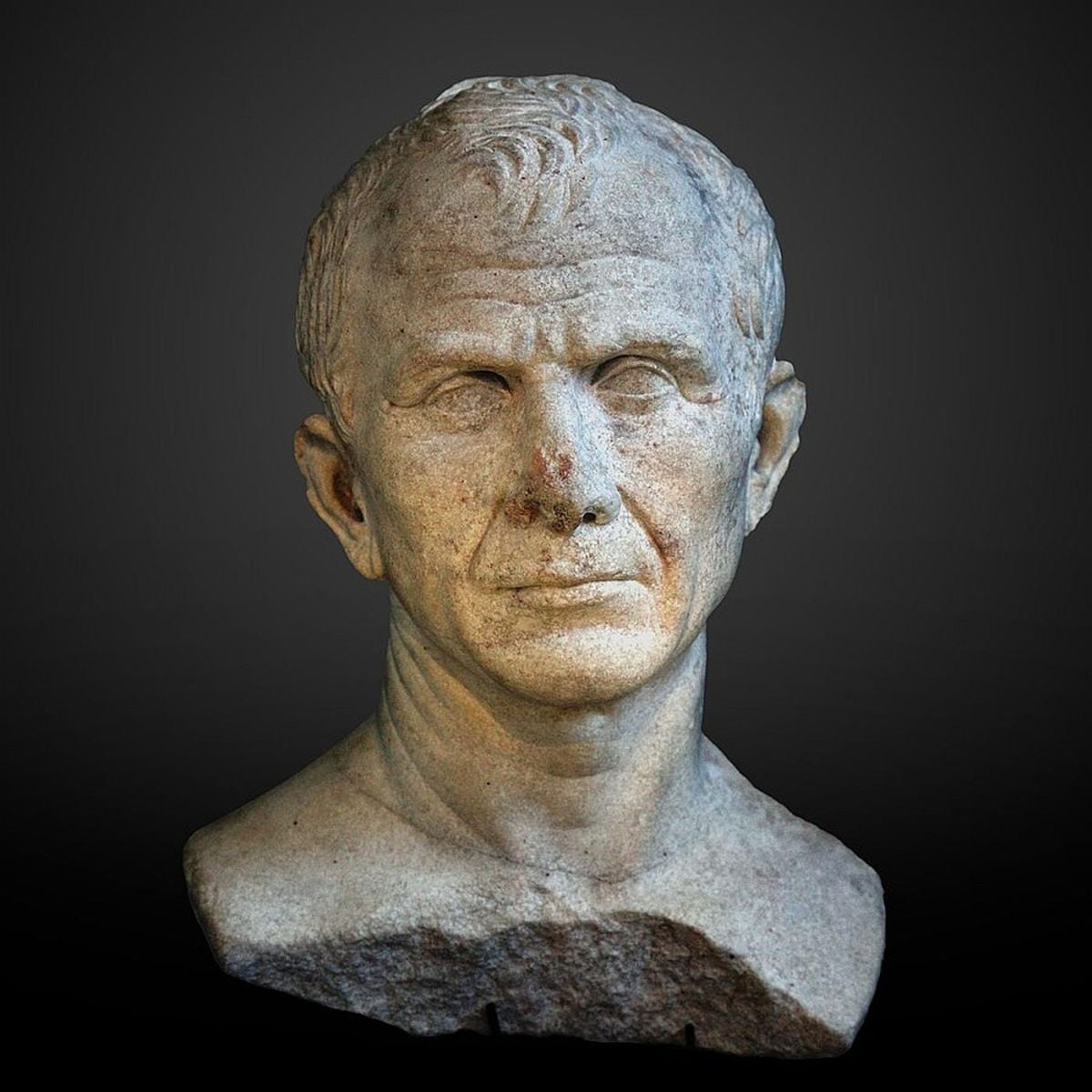
In the year 80 BCE Caesar went to north-west Asia Minor, where he assisted Marcus Minucius Termus in the siege of the city Mytilene on the island of Lesbos, where he was entrusted with the mission of bringing ships from the king of Bithynia Nicomedes IV. He did this mission very well, he even managed to make friends with the king, which later became a stigma in his political career in Rome. It has been suggested many times (probably rightly) that they became lovers. It is difficult, however, to infer Caesar’s bisexuals. This episode stemmed rather from the decadent style of Nicomedes’ court, which probably captivated the young Roman.
After the mission, Caesar returned to Bithynia under the pretext of conducting court cases. Rumours about Caesar’s alleged connection became stronger when, before his death, Nicomedes enrolled his kingdom in Rome. In 74 BCE the Roman Senate transformed Bithynia into a Roman province.
In the war campaign itself, Caesar showed his fortitude in conquering the city, for which he was awarded the so-called corona civica, which was awarded to those who saved the battle of Roman citizens. Since then, the senators had to get up when the young Caesar entered the Senate.
After the military mission, he did not return to Rome, where Sulla still ruled. He moved to the fleet of Publics Servilius Vatia Isauricus in Cilicia, whereas an officer he campaigned against numerous pirates who had their seats in the mountainous regions of this land.
Sulla’s death in 79 BCE started a new period of struggles. Caesar realized that it was too early to take power from the Optimates. They were still the dominant political party, gathering in their circle the majority of important leaders. Caesar decided to gain popularity with his very good rhetorical skills and management. To this end, he sued Gnaeus Dolabella in 77 BCE, a former consul, for abuse and extortion committed while in power in the province of Macedonia. This person was chosen not by accident – as an adherent of the deceased Sull