If you have found a spelling error, please, notify us by selecting that text and pressing Ctrl+Enter.
Curiosities of ancient Rome (Society)
Society is a collection of curiosities dedicated to the daily life, customs, and social structure of ancient Rome. This category includes lesser-known facts and interesting information about interpersonal relationships, family, social status, work, and the functioning of various social strata of the Roman Empire.
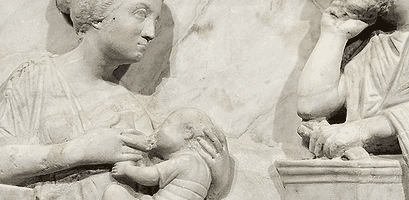
Breastfeeding in Roman times
The rich Roman matrons did not breastfeed their children. For these purposes, slaves or freedmen were usually used.

Brushing teeth in Roman times was routine
Brushing teeth in Roman times was an inseparable element of personal hygiene. However, modern people would not use the substances used by the Romans. They believed, for example, that hard ingredients allowed teeth to maintain strength – for this purpose, crushed bones and oyster shells from which the mixture was made.

Subligaculum – Roman underwear
Subligaculum was underwear, worn e.g. under a toga, which was formed by a linen loincloth. Both men and women wrapped in a belt of material around the waist to cover intimate places.

Did Romans wear rings as sign of love?
In the Roman world, there was no distinction between the wedding ring and the engagement ring. Roman on the occasion of the wedding was donating a ring to his chosen woman. However, this was not proof of love, but rather a subordination of a woman and recognition of her as property. In this way, the future husband clearly stated that the woman he married belongs only to him. It is brutal, but this is what the paternalistic Roman society looked like.


How did ancient Romans dress in cold climate?
There is a widespread – mistaken – belief that the ancient Romans always wore sandals and dressed in tunics to withstand the warm climate in the Mediterranean. It must be remembered, however, that Roman legions conquered also Gaul, Germania or Britain. There, temperatures, like today, were lower and in the winter heavy snow was falling. The Romans, wanting to survive in such conditions, had to protect the body against hypothermia.

Status of Roman woman
Woman in ancient Rome certainly had much more free life than in Greece. For example, during the classical period (up to 323 BCE), Greek women not only did not have civil rights, but they were also under the rule of a man. First, fathers, later husbands, from whom they were completely dependent. The whole life of an Athenian woman was limited to focusing on the home and children; on weekdays the woman was locked in her room, and only during the holidays she could leave hit. The relative improvement of the Greek woman’s status took place in the Hellenic period (323-30 BCE).