Did the Romans know the world was a round blue sphere before the rest of the world?
There is strong evidence that the ancient Greeks and Romans knew the world was a round globe before the rest of the world learned of it.
If you have found a spelling error, please, notify us by selecting that text and pressing Ctrl+Enter.
Unknown Facts are curiosities revealing little-known, surprising, or rarely discussed information from the world of ancient Rome and antiquity. This category includes unusual details, curiosities, and facts that offer a less obvious perspective on the Roman Empire.
There is strong evidence that the ancient Greeks and Romans knew the world was a round globe before the rest of the world learned of it.
I don’t know about you, but I’m fascinated by discovering the continuity of the fate of the city and its individual parts. From the perspective of a short human existence, the evolution of urban space – its reconstructions, transformations and changes in functions – seems almost imperceptible. Sometimes it is only when we return to a place after many years that we say “what has changed here!” But when you look at the city from the perspective of hundreds of years, the changes the city is undergoing are much more visible.

Did you know that in ancient Rome, the most sought-after cosmetic was… the sweat of gladiators? Rich ladies, in jars containing the sweat of warriors, searched for charm believing it to be the secret to eternal youth and attractiveness.

Whenever I look at the ruins of ancient Rome, I wonder: how could these magnificent buildings be allowed to perish? Why have they not survived to our times? What a pity you can’t see them today…

Further interesting discoveries are being made in the Rhineland (western Germany), which is rich in brown coal. In ancient times, the borders of the Roman Empire reached here. Roman cities included: Cologne, Aachen, Bonn and Jülich.

Will we ever find the image of Julius Caesar? The question may seem strange, but have we ever wondered how we can be sure that the busts of the most famous Roman are actually the image of Caesar?

Greek influence had a huge impact on Roman culture. In one interesting example, we can see this in the field of art.

When we think of chariot races in ancient Rome, the first thing that comes to mind is Circus Maximus. But the “Great Circus” was not the only racetrack existing in ancient Rome. Many of you probably remember that Emperor Caligula also started building his hippodrome in the Vatican (the work was finally completed by Nero). A memento of him is the obelisk currently standing on pl. St. Peter. Recently, I also wrote about the Maxentius Hippodrome on the Appian Way.

In the popular consciousness, there are only two facts in the conversion of the Roman Empire to Christianity: first, the persecution of Christians (especially during the reign of Nero in the 1st century CE and Diocletian in the early 4th century), and then the adoption of Christianity by Constantine the Great, who made the whole the empire had converted to a new faith. The triumph of Christianity seems as sudden as it is obvious and historically just.

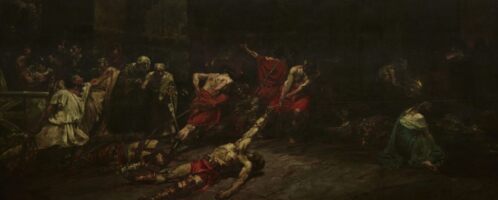
In front of the entrance to the arena of Roman amphitheatres, there was a special space – the so-called spolarium. In this place, the corpses of fallen gladiators were kept, which were deprived of weapons and armament. The weapons and equipment of the fallen were given to the slave owner or to the local armory (armamentarium).