
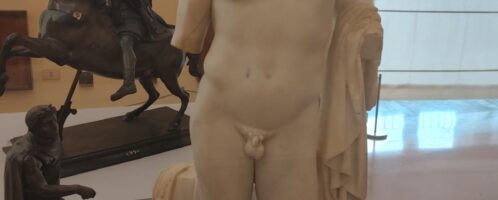
Roman sculpture depicting Alexander the Great or another Hellenic ruler
Roman sculpture depicting Alexander the Great or another Hellenic ruler. The artifact is located in the National Archaeological Museum of Naples.
If you have found a spelling error, please, notify us by selecting that text and pressing Ctrl+Enter.
Artifacts is a collection of curiosities dedicated to objects left behind by the ancient Romans. This category features lesser-known facts and interesting information about archaeological finds, such as tools, weapons, coins, inscriptions, and everyday objects, which provide a deeper understanding of life in the Roman Empire.
Roman sculpture depicting Alexander the Great or another Hellenic ruler. The artifact is located in the National Archaeological Museum of Naples.
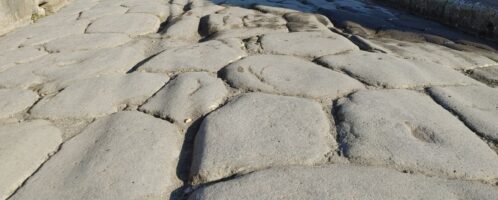
Roman street in Pompeii, with still well-preserved cobblestones. The construction of Roman roads was a true masterpiece of Roman engineering. The road-building technique was taken over by the Etruscans and initially closely imitated. Over time, new technologies began to be adopted.
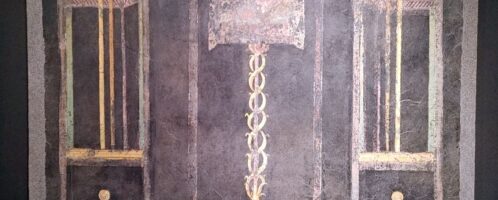
Fragment of a Roman fresco with black inscriptions. The painting was found on the left wall of the corridor leading to the ludus gladiatorius. As it turns out, the text had pleasant content: “To Popidius Rufus, unsurpassed organizer of gladiator games, to the protectors of the colonists, with well wishes”. The artifact is located in the National Archaeological Museum of Naples.

Castellum Aquae in Pompeii was a water dispenser that supplied water to the entire city. The building was located at the highest point of Pompeii (42 meters) and was connected to the Serino aqueduct.

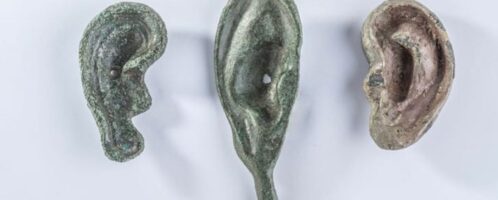
In central Italy, near the village of San Casciano dei Bagni, unusual finds were discovered in the area of a former Etruscan pool fed by hot springs. Among the discovered artifacts are bronze ears that ancient Romans put on – according to researchers – to ask the gods to hear their prayers. The finds also include sculptures showing body parts, e.g. phallus, womb, breasts, leg or arm.
Roman fresco from a bedroom in a country estate in Gragnano (south of Italy). The object dates back to the 1st century CE.
Roman decoration in the shape of a black man, made of bronze. The object is on display in a museum in Herculaneum (Italy).

Roman fresco showing a half-naked woman. Object discovered in the 1st century CE, in Pompeii. The artifact is located in the National Archaeological Museum of Naples.

Relief showing a vegetable seller (including cabbage, garlic and asparagus) from Ostia. Roman relief dates back to the 2nd century CE. The artifact is in the Archaeological Museum in Ostia (Italy).

Pompeian fresco depicting Theseus after killing the Minotaur. The fresco is not large. In the past, it was the central panel of a larger painting. It was like a painting hung in the middle of the wall and the attention of the person entering the room was supposed to focus on it.
