
Unidentified man on Roman statue
Unidentified man on Roman marble statue. The object is dated to the reign of Emperor Tiberius (14-37 CE). The artifact is in the National Archaeological Museum in Naples.
If you have found a spelling error, please, notify us by selecting that text and pressing Ctrl+Enter.
Artifacts is a collection of curiosities dedicated to objects left behind by the ancient Romans. This category features lesser-known facts and interesting information about archaeological finds, such as tools, weapons, coins, inscriptions, and everyday objects, which provide a deeper understanding of life in the Roman Empire.
Unidentified man on Roman marble statue. The object is dated to the reign of Emperor Tiberius (14-37 CE). The artifact is in the National Archaeological Museum in Naples.

Roman sculpture that depicts the mythological Atlas holding the celestial vault on his shoulders. According to mythology, the titan Atlas was condemned for participating in a conspiracy against the power of Zeus. The “Farnesian Atlas” is a Roman marble copy of a Hellenistic original; dated to the 2nd century CE

Roman fresco depicting a parody of Aeneas’ flight from Troy; the painting adorned one of the houses in Pompeii. The scene depicts Aeneas carrying his father Anchises on his shoulder and leading his son Ascanius by the hand.

Roman women’s leather sandals made in Gaul around 1900 years ago. The object was discovered at Vindolanda Fort in northern Britain.

Roman wall painting depicting a feast of pygmies, a fight with a hippopotamus and sexual acts. The object is dated to the 1st century CE and was discovered in the Doctor’s House in Pompeii. The artifact is in the National Archaeological Museum in Naples.

Roman statuette made of ivory depicting a tragic actor. The figure probably shows the actor in a tragic female role, in a mask, costume and wig. Object dated to the 1st century CE.

A well-preserved mummy from Roman times, discovered in cemeteries in the oasis of Fayum (Egypt). Object dated to the 1st century CE, showing a young man.

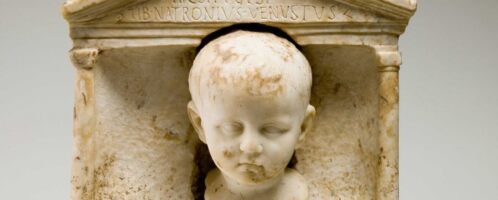
Roman tombstone with the image of a small child’s head. On the stone there is an inscription: “Here lies Tiberius Natronius Venustus. He lived 4 years, 4 months, and 10 days”. The object was discovered in the ancient necropolis of Santa Rosa near the Vatican.
Marble sculpture of Amor with theatrical mask. Object dated to the 1st century CE; discovered in Pompeii and located in the local museum.

Damaged Roman statue identified as Rhea Sylvia – the mythological mother of Romulus and Remus. The object is made of marble and dates back to the 1st century BCE. The artifact is on display in the Roman theater museum in Cartagena (southern Spain).
