
If you have found a spelling error, please, notify us by selecting that text and pressing Ctrl+Enter.
Curiosities of ancient Rome (Artifact)
Artifacts is a collection of curiosities dedicated to objects left behind by the ancient Romans. This category features lesser-known facts and interesting information about archaeological finds, such as tools, weapons, coins, inscriptions, and everyday objects, which provide a deeper understanding of life in the Roman Empire.
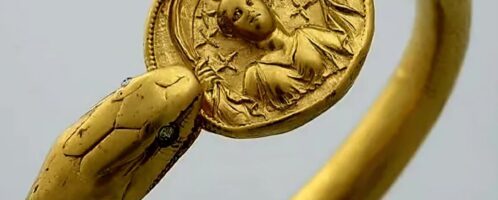
Face of Roman child from 1,800 years ago
In 1878, during archaeological work in Paris, a Roman sarcophagus containing the burial of a small child was discovered. The find comes from the area of ancient Lutetia, a Roman city that developed on the site of present-day Paris. Preserved within the grave was a remarkable imprint of the face of the child, who was between six and twelve months old at the time of death.
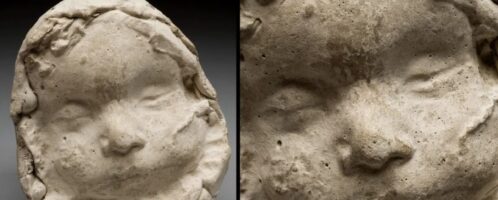
Roman bronze medallion with Perseus and Andromeda discovered in India
A small bronze disk depicting Perseus freeing Andromeda is an interesting example of a Roman artifact found outside the Roman Empire. The artifact dates to the 1st century CE and was discovered during archaeological excavations in Brahmapuri, India.
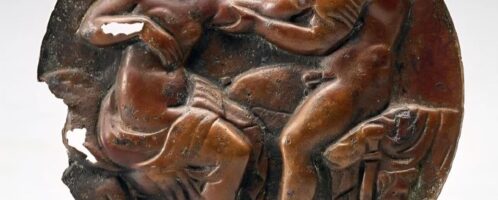
Marble sculpture of woman’s head
During archaeological excavations in ancient Corinth, a marble sculpture depicting a woman’s head was discovered. The monument dates back to the 2nd century CE, a period when the city was one of the most important centers of the Roman province of Achaea. The object is on display at the Archaeological Museum of Ancient Corinth.

Unusual Roman skeleton from Castel Malnome
Archaeologists exploring the necropolis of Castel Malnome, near Ostia, have discovered the remains of a man that shed new light on the attitudes of the inhabitants of the Roman Empire towards people with severe disabilities.

Hercules depicted on herm
Hercules depicted on a herm discovered during archaeological excavations at the ancient theater in Corinth. The sculpture depicts one of the most famous heroes of Greek mythology, whose cult was also widespread in the Roman world. Currently on display at the Archaeological Museum of Corinth in Greece, the monument represents a valuable testament to the art and heritage of ancient Corinth.

Rare evidence of Roman crucifixion – calcaneus with preserved nail
During archaeological excavations in eastern England in 2017, an extremely rare find was discovered: the heel bone of a man with an iron nail still embedded in it. The remains, designated Skeleton 4926, date from the 3rd-4th century CE and represent some of the best-preserved physical evidence of crucifixion ever discovered.

Roman amphorae in hotel lobby
The lobby of the Amphora Hotel in Split, Croatia, houses an interesting exhibition of ancient Roman amphorae, referencing the maritime and commercial history of the Adriatic and the world of the Roman Empire.

Murmillo gladiator helmet used in series “Spartacus”
Murmillo-type gladiator helmet used in the TV series “Spartacus.” Characteristic of this class of gladiator was a massive helmet with a large crest and full face shield. This example features additional decorations in the form of seahorses and lions, inspired by motifs known from ancient Roman art.
