
If you have found a spelling error, please, notify us by selecting that text and pressing Ctrl+Enter.
Curiosities of ancient Rome (Artifact)
Artifacts is a collection of curiosities dedicated to objects left behind by the ancient Romans. This category features lesser-known facts and interesting information about archaeological finds, such as tools, weapons, coins, inscriptions, and everyday objects, which provide a deeper understanding of life in the Roman Empire.
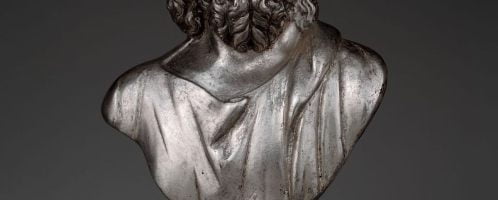
Roman bust of god Serapis
Roman bust of the god Serapis. The object was made of silver; dated to the 2nd century CE.
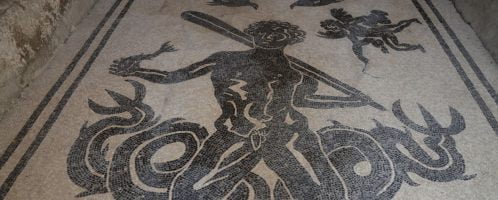
Roman mosaic showing sea scene
Roman mosaic depicting a sea scene from a female dressing room (apodyterium) in the thermal baths at Herculaneum. The scene shows the sea god Triton, holding the wheel and a fish, surrounded by dolphins, an octopus and possibly Cupid.
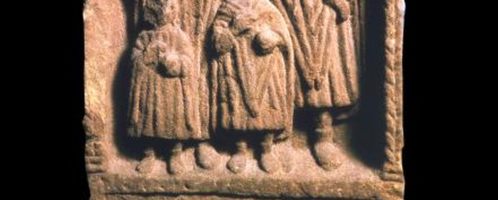
Roman tombstone of Flavia Augustina and her two sons
Roman tombstone of Flavia Augustina and her two sons, commissioned by her husband and father, Gaius Aeresius Saenus – a veteran of the legion VI Victrix. The woman died at the age of 39, and the children were barely two. The relief shows us two parents holding scrolls and in front of them their sons with balls.
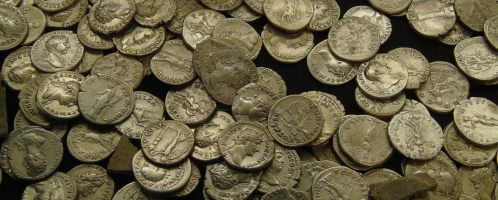
Roman treasure from Wales
Roman coins found in one place in Llanvaches (Wales). The treasury consisted of 599 silver denarii, which were hidden in the middle of the 2nd century CE.
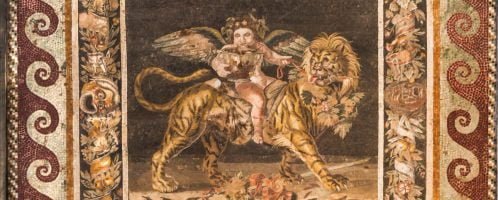
Dionysus on tiger
Roman mosaic showing a young Bacchus (Dionysus) savoring wine while riding a tiger. Object found in Faun’s house in Pompeii; now it is in the National Archaeological Museum of Naples. The strange appearance of the animal may be due to the fact that the artist saw the animal only once or it is only his image.
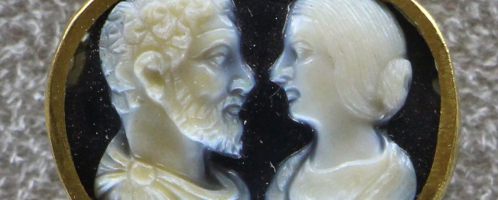
Faustina the Younger and Marcus Aurelius in relief
Roman relief in a precious stone showing Faustina the Younger and Marcus Aurelius. It is located in the National Archaeological Museum of Florence. Dated to the 2nd century CE.
Roman mosaic showing philosophers at Plato’s Academy
Roman mosaic showing the philosophers at the Plato Academy of Athens listening to a lecture by Plato, sitting in the center, pointing at the globe with a stick. Behind the men is a sundial. The object adorned the villa of Titus Siminius Stephanus in Pompeii and dates back to the 1st BCE – 1st century CE.
