If you have found a spelling error, please, notify us by selecting that text and pressing Ctrl+Enter.

Curiosities of ancient Rome

The world of the ancient Romans was rich in extraordinary, and sometimes even surprising, facts. We draw our knowledge of Roman daily life, customs, and mentality primarily from works left by ancient writers and historians. It is thanks to them that we discover information that is astonishing today – sometimes even hard to believe. Below are some interesting facts that reveal a lesser-known and less obvious side of the Roman world.

I encourage you to submit your own suggestions and to report any corrections or inaccuracies.

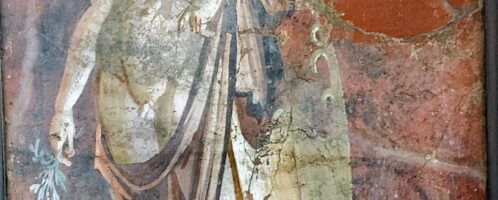
Roman fresco showing standing Apollo

Roman fresco showing standing Apollo with omphalos next to it – a stone covered with a net (symbol of the center of the universe). The object dates back to the 1st century BCE; discovered in Pompeii. The artifact is located in the National Archaeological Museum of Naples.
Roman fresco showing standing Apollo

How private agreement between three men ruined republic…

In 43 BCE a private agreement between three men sealed the fate of the Roman republic. Even before the death of Julius Caesar, the Roman republic was dying out – torn apart by the ambitions of successive great leaders and the civil wars they caused. But after the Ides of March, her agony accelerated rapidly. But formally it still continued – consuls and other officials were still elected, and the Senate continued its sessions. People’s assemblies were then convened…

Second triumvirate

Inner garden in a Roman house

Inner garden (hortus) in a Roman house (so-called Casa della Nave Europa) in Pompeii. The preserved columns that surrounded the greenery and created the peristyle (internal courtyard) are visible.

Inner garden in a Roman house

Roman sculpture of Venus with dolphin

Roman sculpture of Venus with a dolphin, which is the symbolic animal of the goddess and a reminder of her birth in the sea. The object dates back to the 2nd century CE; a copy of a Greek original from the 2nd-1st century BCE. The artifact is located in the National Archaeological Museum of Naples.

Roman sculpture of Venus with dolphin

Roman relief showing three scenes

Roman relief showing three scenes. In the middle part of the work we see the god Silenus (nature deity) surrounded by young Satyrs; in the left and right parts there are people taking part in the cult. The object dates back to the 1st century CE; the artifact is located in the National Archaeological Museum of Naples.

Roman relief showing three scenes

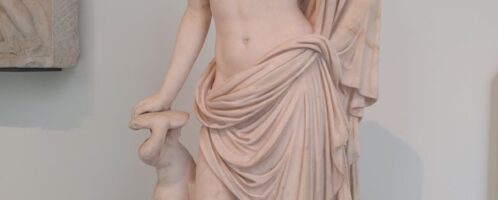
Sculpture of Venus Felix

Sculpture of Venus Felix (“Happy”), goddess of love. The object dates back to the 2nd century CE, which is a Greek copy from the 2nd-1st century BCE. The artifact is located in the National Archaeological Museum of Naples.
Sculpture of Venus Felix

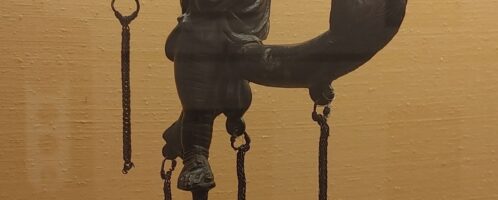
Roman wind chimes

Roman wind chimes (tintinnabulum) in the shape of a figure with a large phallus. They were usually hung in the threshold of a shop or peristyle (inner courtyard of a house), where the wind made them buzz. The phallus was a symbol protecting against misfortune. The artifact is located in the National Archaeological Museum of Naples.
Roman wind chimes

Spelling error report

The following text will be sent to our editors: