If you have found a spelling error, please, notify us by selecting that text and pressing Ctrl+Enter.

Curiosities of ancient Rome

The world of the ancient Romans was rich in extraordinary, and sometimes even surprising, facts. We draw our knowledge of Roman daily life, customs, and mentality primarily from works left by ancient writers and historians. It is thanks to them that we discover information that is astonishing today – sometimes even hard to believe. Below are some interesting facts that reveal a lesser-known and less obvious side of the Roman world.

I encourage you to submit your own suggestions and to report any corrections or inaccuracies.

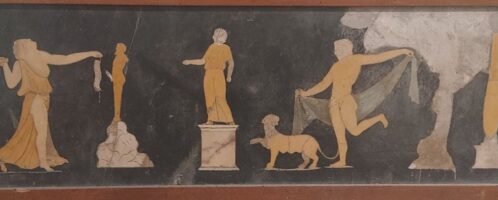
Roman fresco showing Dionysian scene

Roman fresco showing a Dionysian scene. The painting shows the dancing Maenad, the companion of Bacchus (Dionysus), near a statue of Priapus, a leopard and a satyr. The object was discovered in Casa dei Capitelli in Pompeii. Dated to the 1st century CE. The artifact is located in the National Archaeological Museum of Naples.
Roman fresco showing Dionysian scene

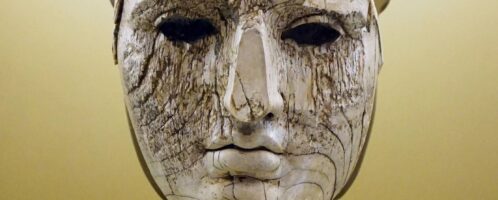
Divine face from a horror movie

Look at that face… Disturbing, isn’t it? If it weren’t for the fact that it is an exhibit from the Vatican Museums, it could be considered a mask from some horror movie.

Divine face from a horror movie

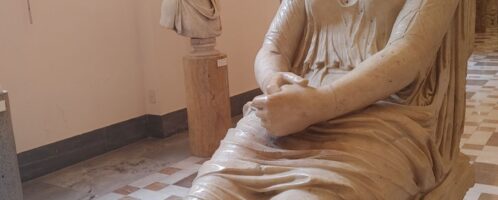
Sculpture of Agrippina the Younger

Sculpture of Agrippina the Younger, Empress of Rome, mother of Nero, from the second half of the 1st century CE. The artifact is located in the National Archaeological Museum of Naples.

Sculpture of Agrippina the Younger

Woman on Roman wall fresco

On the wall of one of the Roman houses in Pompeii you can see a beautiful fresco showing a young woman. The clear colors have still been preserved to this day.

Woman on a Roman wall fresco

Pan with basket of fruit

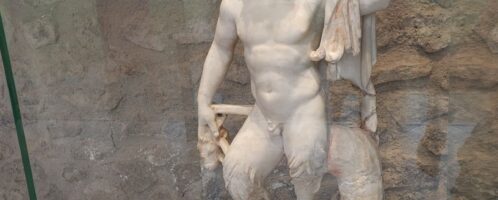
Pan with a basket of fruit. The marble sculpture dates back to the 1st century CE. The object was found and is now located in Pompeii.

Pan with basket of fruit

Rape, erotic foursome and souvenir of marital love

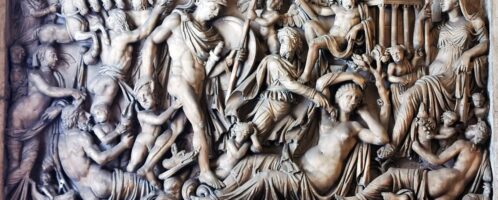
According to the canonical version of the founding myth of Rome, Rhea Silvia was the daughter of Numitor, king of the city of Alba Longa (“proto-Rome”). Numitor was dethroned by his brother Amulius. Amulius sentenced Rhea Silvia to eternal virginity. The god Mars found Rhea Silvia sleeping in a grove dedicated to him. According to legend, he raped her. The result of this event were the twins: Romulus and Remus.

Mars and Rhea Silvia front of the sargophag from Palazzo Mattei in Rome

Apollo and Daphne

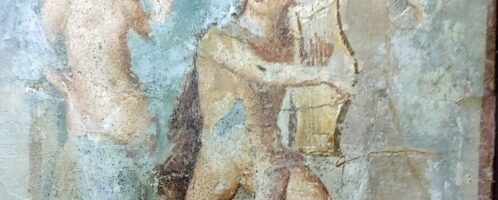
Roman fresco showing the god of art, Apollo, playing the lyre and in love with Daphne. The object dates back to the 1st century CE. Discovered in Pompeii; the artifact is in the National Archaeological Museum of Naples.
Apollo and Daphne

Spelling error report

The following text will be sent to our editors: