Roman vessel in shape of bear
Roman vessel in shape of bear. Dating back to the 3rd or 4th century CE, it was likely filled with oil or perfume. The artifact is located at The Metropolitan Museum of Art in the United States.
If you have found a spelling error, please, notify us by selecting that text and pressing Ctrl+Enter.
The world of the ancient Romans was rich in extraordinary, and sometimes even surprising, facts. We draw our knowledge of Roman daily life, customs, and mentality primarily from works left by ancient writers and historians. It is thanks to them that we discover information that is astonishing today – sometimes even hard to believe. Below are some interesting facts that reveal a lesser-known and less obvious side of the Roman world.
I encourage you to submit your own suggestions and to report any corrections or inaccuracies.
Roman vessel in shape of bear. Dating back to the 3rd or 4th century CE, it was likely filled with oil or perfume. The artifact is located at The Metropolitan Museum of Art in the United States.

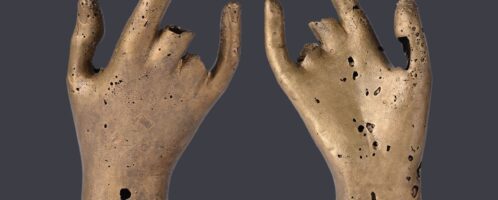
Bronze hand of Jupiter Dolichenus, an enigmatic deity whose cult spread from Syria throughout the Roman Empire. The object is 22.5 cm long and was likely part of a statue of the deity. The artifact was discovered in Ćuprija, Serbia; it is currently housed at the Jagodina Museum in Serbia.
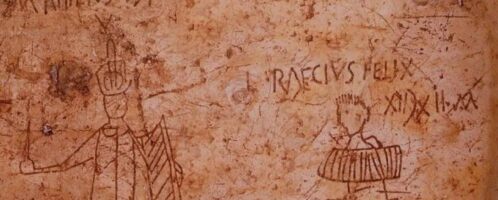
On the walls of ancient Pompeii, Herculaneum, and other Roman cities, archaeologists have discovered thousands of inscriptions that offer a glimpse into the daily lives of the empire’s inhabitants. These are the so-called graffiti – short notes, political slogans, love confessions, and even insults. Unlike monumental inscriptions dedicated to emperors, these drawings and writings let us hear the authentic, often humorous voice of ordinary Romans.
In one of Rome’s most powerful periods, when its borders stretched from Britain to Syria, when Julius Caesar spoke in the Forum, and when legions marched along roads leading to the Euphrates, there was a disease that no conqueror could defeat. There was no effective knowledge or miracle cure at the time, only experience and instinct, yet every Roman knew its name, although it was not pronounced as we do today.
Several large sculptures were among a treasure trove of artifacts recovered by divers from the waters near Alexandria, Egypt.

The image of the ancient Roman in the popular imagination – perpetuated by cinema, literature, and popular culture – is often a half-naked figure reclining in a luxurious triclinium, surrounded by wine, fruit, roasted meat, and slaves fanning him during an endless feast. Another popular motif is the alleged “vomiting during the feast” in order to continue eating. This image, while effective, is far more exaggerated and false.
The image of the Roman feast as a debauched orgy of eating and drinking comes largely from satirical literature. Authors such as Petronius and Martial often portrayed feasts as places of excess, hypocrisy, and social snobbery; this was done with the intention of criticizing social norms, not reporting on everyday life.
A prime example is “Trimalchio’s Feast” (excerpt from Petronius’s “Satyricon”), in which the titular character – a freedman and “nouveau riche” – hosts a spectacular dinner full of culinary extravagance. However, Trimalchio does not represent a typical Roman; rather, he is a social caricature.
Many Roman historians (e.g., Tacitus, Suetonius) condemned the debauchery of emperors and elites. For example, Nero, Vitellius, and Domitian were accused of excessive eating and drinking.
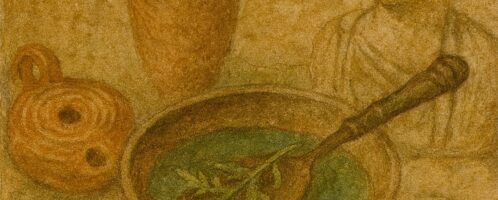
The daily diet of a typical Roman was very modest. Most Roman citizens – both free citizens and slaves – did not have access to lavish feasts. Their diet consisted primarily of:
Archaeological studies of feces from latrines, kitchen scraps, and paleobotanical analyses (e.g., from Pompeii and Ostia) confirm the dominance of plant products and grains in the diet of the average Roman citizen.
Formal feasts (cena) organized by wealthier social classes, such as senators and equites, were social events and took place on special occasions rather than daily. They had not only social but also political significance – they served to strengthen alliances, demonstrate social standing, and dispense patronage.
Participating in a feast required a special dining room (triclinium) and kitchen, which in itself was a sign of wealth. One of the most widespread myths is the existence of the “vomitorium” as a special room for inducing vomiting during the feast. The “vomitorium” was a passageway in theaters and amphitheaters through which crowds of spectators “exited” (e.g., in the Colosseum).
While some Romans may have induced vomiting in private (e.g., Seneca mentions it in “Epistulae Morales”), it was more of a medical or extreme practice than a part of the feast.

In Varna, Bulgaria, in 2024, a tourist noticed an unusual table at a beach bar. It turned out to be a 1,700-year-old Roman sarcophagus (measuring 90 cm x 235 cm x 75 cm) that was being used as a table.

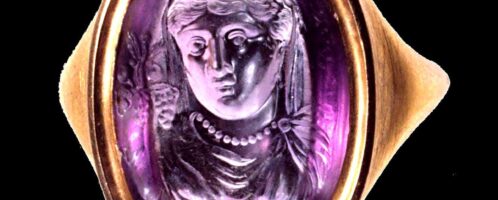
Roman ring embossed with the image of the goddess Fortuna. The object is dated to 1st BCE – 1st century CE.
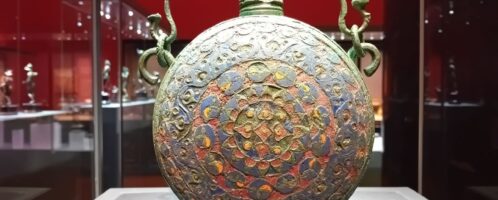
Roman metal vessel with remnants of enameled decoration. The object was found in a grave in Pinguentum (present-day Buzet, Croatia), but was made in Britain or Gaul in the 2nd century CE. The artifact is located at the Kunsthistorisches Museum in Vienna.
An extraordinary ancient artifact has been discovered off the coast of Sicily, near the Aegadian Islands: the bronze prow of a Roman warship, known as a rostrum. This rare find directly links us to the naval battle off the Aegadian Islands (241 BCE), which marked the end of the First Punic War (264-241 BCE). Such relics offer a glimpse into ancient naval warfare and the might of the fleets of the time.