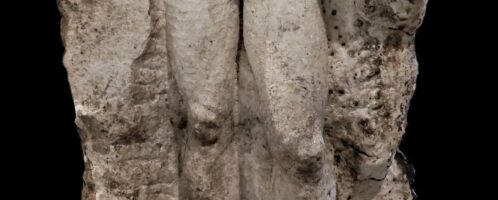
Unfinished Roman sculpture
Unfinished Roman sculpture from the 2nd century CE. The object depicts a naked male figure. For unknown reasons, the sculptor did not finish his work. The artifact was discovered in Veria, Macedonia.
If you have found a spelling error, please, notify us by selecting that text and pressing Ctrl+Enter.
The world of the ancient Romans was rich in extraordinary, and sometimes even surprising, facts. We draw our knowledge of Roman daily life, customs, and mentality primarily from works left by ancient writers and historians. It is thanks to them that we discover information that is astonishing today – sometimes even hard to believe. Below are some interesting facts that reveal a lesser-known and less obvious side of the Roman world.
I encourage you to submit your own suggestions and to report any corrections or inaccuracies.
Unfinished Roman sculpture from the 2nd century CE. The object depicts a naked male figure. For unknown reasons, the sculptor did not finish his work. The artifact was discovered in Veria, Macedonia.
Roman sculpture showing Apollo seated with a lyre. The object was made of porphyry. Dated to the 2nd century CE. The artifact is located in the National Archaeological Museum of Naples.

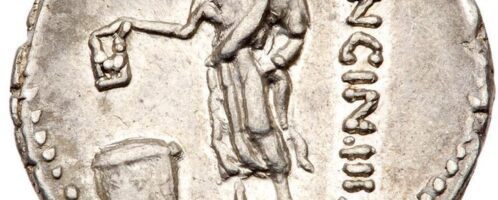
Roman coin showing a citizen casting a vote in an election. The denarius is dated to 60 BCE. According to lex gabinia tablaria, established in 139 BCE, citizens voted using tablets that were placed in ballot boxes.
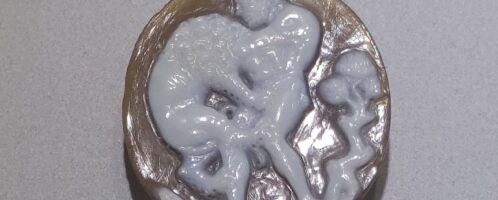
Cameo showing Hercules fighting the Lion of Nemea. His skin was so hard that no blade could pierce him and he could only be killed by suffocation. According to mythology, killing a lion and bringing its skin was the first of Hercules’ twelve labors. The artifact is located in the National Archaeological Museum of Naples.
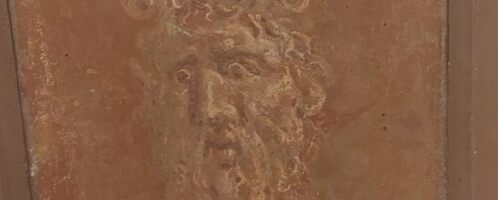
Roman fresco showing the mask of Zeus Ammon, a Greco-Egyptian deity combining the features of the Egyptian god Amun and the Greek Zeus. His image was often depicted with ram’s horns. The object was discovered in Stabiae in Ariadne’s villa. Dated to the 1st century CE. The artifact is located in the National Archaeological Museum of Naples.
During the Republic, consuls were the highest state officials elected by a popular assembly called centurial committees (comitia centuriata). The election of consuls was the most important day in the Roman political calendar. When the empire later came, the office of consul became an honorary title, and centurial commissions died out. How did this happen?
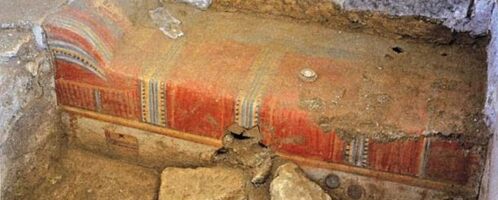
Terracotta sarcophagus from Roman times in the shape of a bed. The object was painted in bright colors; on the sarcophagus we see a woman resting under a cover, with her head on a pillow. The artifact was discovered in Corinth.
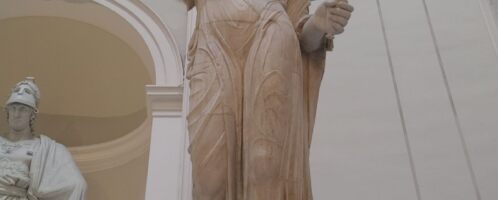
Roman sculpture depicting Aphrodite from the 1st century CE. The object is a copy of a Greek original from the 5th century BCE. The artifact is located in the National Archaeological Museum of Naples.
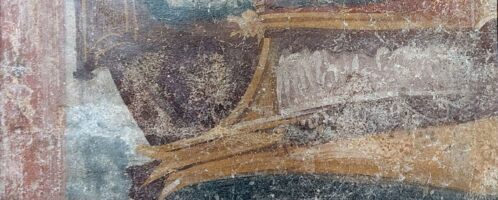
Fragment of a Roman fresco showing the bow of a ship. The painted eyes decorating the front of the ship attract attention. The object dates back to the 1st century BCE; discovered in Pompeii. The artifact is located in the National Archaeological Museum of Naples.
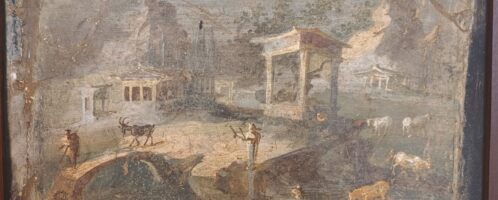
Roman fresco showing a landscape. Object discovered in Herculaneum; was temporarily on display at the National Archaeological Museum in Naples. Dated to 1st BCE – 1st century CE.