If you have found a spelling error, please, notify us by selecting that text and pressing Ctrl+Enter.

Curiosities of ancient Rome

The world of the ancient Romans was rich in extraordinary, and sometimes even surprising, facts. We draw our knowledge of Roman daily life, customs, and mentality primarily from works left by ancient writers and historians. It is thanks to them that we discover information that is astonishing today – sometimes even hard to believe. Below are some interesting facts that reveal a lesser-known and less obvious side of the Roman world.

I encourage you to submit your own suggestions and to report any corrections or inaccuracies.

History of Rome according to Livy

I am reading “From the Founding of the City” by the ancient historian Titus Livius, and although I am only slowly absorbing the first books of his work, today I would like to share some reflections with you.

Various decorative and architectural elements from Etruscan and Roman temples

Roman sculpture showing goddess of wisdom Athena

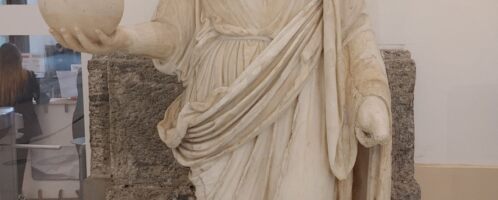
Roman replica of a Greek sculpture depicting the goddess of wisdom Athena. The object is dated to the 1st century CE. The original, referred to as the Farnese Athena, was created in the 5th century BCE in the school of Phidias.

Roman sculpture showing goddess of wisdom Athena

Ancient well

An ancient marble well discovered in Italy. The artifact is in the National Archaeological Museum in Naples.

Ancient well

Hippolytus and his stepmother Phaedra

Roman painting showing a scene from mythology. In the fresco we see Hippolytus and his stepmother Phaedra, who confesses her affection for him. Phaedra tried to seduce Hippolytos; but when he rejected her advances, she hanged herself accusing Hippolytus of trying to seduce her. Hippolytus was therefore exiled. In the painting, Hippolytus is preparing to hunt.

Hippolytus and his stepmother Phaedra

Roman mosaic showing chessboard

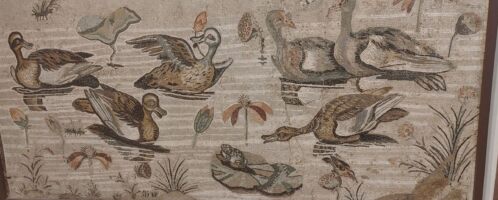
Roman mosaic showing a chessboard in the shape of a circle. In the corners of the object we can see decorations in the form of ducks. The object is dated to the 1st BCE – 1st century CE. The artifact was discovered in Pompeii, in the so-called Mosaic House with Doves. The object is in the National Archaeological Museum of Naples.

Roman mosaic showing chessboard

Roman mosaic showing struggle of Theseus with Minotaur

Roman mosaic showing struggle of Theseus with Minotaur in the labyrinth. At the back of the stage, we see women watching the fight in horror. The object dates back to the 1st century BCE. The artifact is in the National Archaeological Museum in Naples.

Roman mosaic showing struggle of Theseus with Minotaur

Spelling error report

The following text will be sent to our editors: