Shops of ancient Romans
What is a store and what is done in it probably everyone knows. It may come as a surprise to some that shops already existed in ancient Rome.
If you have found a spelling error, please, notify us by selecting that text and pressing Ctrl+Enter.
The world of the ancient Romans was rich in extraordinary, and sometimes even surprising, facts. We draw our knowledge of Roman daily life, customs, and mentality primarily from works left by ancient writers and historians. It is thanks to them that we discover information that is astonishing today – sometimes even hard to believe. Below are some interesting facts that reveal a lesser-known and less obvious side of the Roman world.
I encourage you to submit your own suggestions and to report any corrections or inaccuracies.
What is a store and what is done in it probably everyone knows. It may come as a surprise to some that shops already existed in ancient Rome.

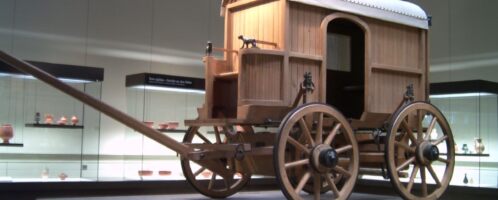
It may come as a surprise to many that the Romans ran cart rentals, but it’s true!1
Roman fresco showing a priest of the Egyptian goddess Isis reading from papyrus. The object was discovered in the temple of Isis in Pompeii; dated to the 1st century CE.

Galen was a Roman physician of Greek descent who lived in the 2nd century CE. He was considered in his time to be a great expert in human anatomy and a physician. Interestingly, he also dealt with mental health disorders.

Roman grave of a dog from the 1st century CE. The way the animal was buried proves that it was an important member of the family. A vessel was found in the grave, and the head was placed on a piece of skin. The object was discovered in Cologne (Germany). It is now in the Römisch-Germanisches Museum Köln.

Roman mosaic showing parrots pulling a two-wheeled chariot. The scene refers to the famous triumphal procession of Dionysus (Bacchus) and may symbolize wealth and prosperity. Object dated to the 3rd century CE; is in the Römisch-Germanisches Museum in Cologne (Germany).

Have you ever wondered when marking dates according to the time that has passed since the death of Jesus appeared? As it turns out, the matter is not as obvious as it might seem. It turns out that for a long time, several systems competed with each other and at first it was not at all certain that it was the date of Christ’s birth that would become the determinant for marking dates.

Roman fresco showing Amor riding a crab. Object discovered in the House of the Vettii in Pompeii.

Hyena on a Roman mosaic. Object dated to the 2nd century CE; discovered in Tunisia.

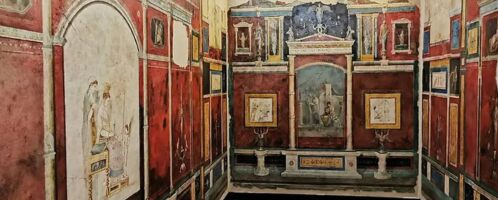
In 1880, during the construction of the Tiber embankments near Villa Farnesina in Trastevere, a very interesting discovery was made: large fragments of a luxurious residence from the reign of Emperor Augustus were excavated. It is a fascinating building: breaking with the typical architectural layout of the Roman “domus” (and with its canonical sequence of rooms: vestibule-atrium-tablinum-peristyle), reminiscent of the more refined suburban villas of Roman patricians. Its location on the very bank of the Tiber must have been captivating.