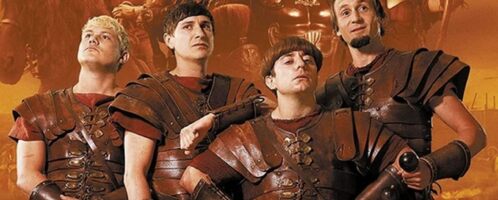
“Plebs” – comedy series set in times of ancient Rome
“Plebs” is the only comedy series set in the times of ancient Rome. It shows the everyday life of ordinary people in a funny way.
If you have found a spelling error, please, notify us by selecting that text and pressing Ctrl+Enter.
The world of the ancient Romans was rich in extraordinary, and sometimes even surprising, facts. We draw our knowledge of Roman daily life, customs, and mentality primarily from works left by ancient writers and historians. It is thanks to them that we discover information that is astonishing today – sometimes even hard to believe. Below are some interesting facts that reveal a lesser-known and less obvious side of the Roman world.
I encourage you to submit your own suggestions and to report any corrections or inaccuracies.
“Plebs” is the only comedy series set in the times of ancient Rome. It shows the everyday life of ordinary people in a funny way.
There is no doubt that Rome is a big city. It was already big in antiquity and just like today’s cities are divided into districts, so Rome was divided into the so-called. regions. During the times of Octavian Augustus, the Eternal City had 14 of them. Each of them had a separate administration to facilitate the management of the entire city. This was not easy, because under Emperor Constantine I the Great, Rome had 322 important intersections and 423 streets.

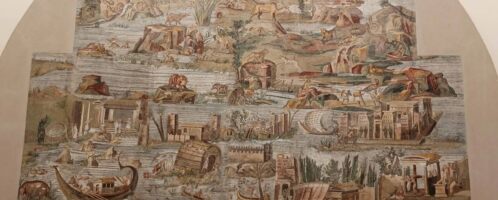
Near Rome, in the city of Palestrina, there is a small archaeological museum located where the temple of Fortuna Primigenia, famous throughout Italy, once stood. In its highest room, the so-called ‘the Barberini mosaic’, which is the best proof that museums in smaller towns can also hide real treasures and that they are worth visiting.
Roman sculpture of a barbarian. Object dated to the 2nd century CE. The artifact is in the National Archaeological Museum in Naples.

Marble statue of the goddess Isis. The object was discovered in Pompeii. The artifact is in the National Archaeological Museum in Naples.

Roman fresco showing an old man. Object dated to the 1st century CE; discovered in Stabia in Villa Arianna.

The circumstances of the death of the third emperor of Rome are seemingly clear. Caligula was assassinated on January 24, 41, after reigning for less than four years. The very fact of the murder of the emperor is beyond doubt, although some details remain obscure.

Damaged sculpture of Hercules. Object dated to the 2nd-3rd century CE; it is now in the Archaeological Museum of Murcia (southern Spain).

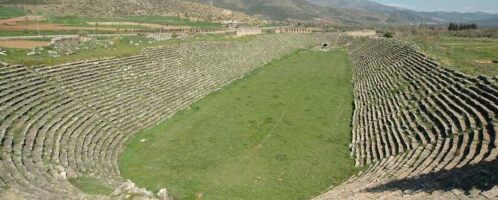
An ancient stadium in Aphrodisias (southwestern Turkey), which has been preserved in very good condition. The facility could accommodate about 30,000 spectators and was built at the end of the 1st century CE.
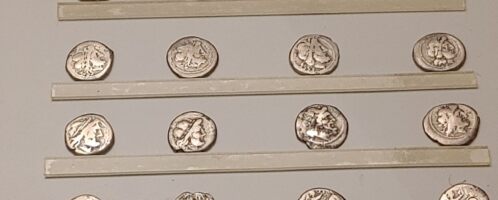
Roman victoriati dated to the 2nd-1st century BCE. Coins discovered in Murcia. They are currently on display at the Archaeological Museum of Murcia.