
Chapters
Lawrence Alma-Tadema was a 19th-century Dutch painter, most of his works concerned the ancient world. Thanks to his outstanding paintings, we can better imagine the amazing world of the ancients.
Lawrence Alma-Tadema was born Lourens Tadema on January 8, 1836 in Dronrijp near Leeuwarden, in the north of the Netherlands. The surname Tadema is an old Frisian patronymic meaning “son of Tade”; the same is true of the names Lourens and Alma which come from my grandfather.
Lourens was the sixth child of the notary Pieter Tademy (1797–1840), and the third child of Hinke Dirks Brouwer (approx. . 1800–1863). The father had three children from a previous marriage. Pieter and Hinke’s first child died young, and the second Atje (c. 1834-1876) was the future painter’s older sister, whom Lourens felt very fond of.
In 1838, the Tadema family moved to the nearby town of Leeuwarden, where his father was supposed to earn better money. Unexpectedly, after two years, Pieter died, leaving his wife five children to raise. The mother, having artistic abilities, decided that the children should learn drawing. To that end, she hired a local drawing master to teach the elder Lourens sew-on brothers.
His parents wanted Lourens to become a lawyer and enrolled him in Leeuwarden Middle School. However, in 1851, 15-year-old Lourens fell ill unexpectedly. According to the doctors, the disease was incurable and, according to their assumptions, the child was supposed to live for several years. This event changed Lourens’ life. His desperate mother let him do what he liked. Lawrence chose painting. Contrary to the doctors’ predictions, he completely recovered and decided to devote himself to art.
Education
In 1852, Lawrence went to Antwerp, Belgium to study painting at the Royal Academy there. There he studied early Dutch and Flemish painting under Gustaf Wappers. During his four years of college, Lawrence won several notable awards and competitions.
Before he left school in 1855, he became an assistant to the painter and professor Louis (Lodewijk) Jan de Taeye, whose courses in history and historical clothing made Lawrence very interested. Although de Taeye was not an outstanding painter, he was appreciated by his mentee, who spent three years by his side. Thanks to de Taeye Lawrence, at the beginning of his painting career, he focused on showing representatives of the Merovingian dynasty. Even then, he set his own style, which was based on the faithful reproduction of historical facts and details.
In November 1858, Lawrence left de Taeye’s studio and returned to Leeuwarden for a while, then settled in Antwerp. Then he started working as an assistant to the painter Jan August Hendrik Leys, whose works were highly regarded in Belgium. Under his supervision, Lawrence painted his first important painting – Raising the Children of Clovis (1861). The work shows Queen Clotilde, the wife of Clovis, who teaches her three young children to throw an axe so that they can avenge their killed father. The painting caused a sensation among critics and artists at the Antwerp Art Congress. It is believed that this work laid the foundations for the painter’s future fame and reputation. Leys allowed himself a little criticism of the detail in the painting and found that the marble reminded him of cheese. The author of the work took his attention to the heart and decided to improve this aspect in his works. Over time, he became the world’s leading painter who portrayed marble and coloured granite in a perfect way. The painting was purchased by the King of Belgium, Leopold.

Painting career
In 1862, Lawrence left Leys’ studio and began his own painting career. The Merovingian dynasty was the favourite subject of the author’s works until the mid-1860s. The Merovingians were not a subject that could interest the international community. With this, he turned to a more oriental theme – ancient Egypt, which was extremely popular at the time.
On January 3, 1863, the painter’s mother died unexpectedly. That same year, on September 24, the author married Maria Paulina Gressin Dumoulin, daughter of Eugene Gressin Dumoulin, a French journalist from around Brussels. We don’t know much about his wife, as Lawrence reluctantly spoke about her after her death in 1869. Her images appear in at least three works. The couple had three children. The eldest and only son died of smallpox. The daughters Laurence (1864–1940) and Anna (1867–1943) engaged in culture, literature and art, respectively. Laurence was a great friend of Poland and Poles. Neither of them got married.
On their honeymoon, Lawrence and Paulina went to Florence, Rome, Naples, and Pompeii. This first visit of the painter to Italy developed his interest in the world of ancient Greece and Rome, especially after visiting the ruins of Pompeii. The next decades of his painting activity were to focus on the Greco-Roman themes.
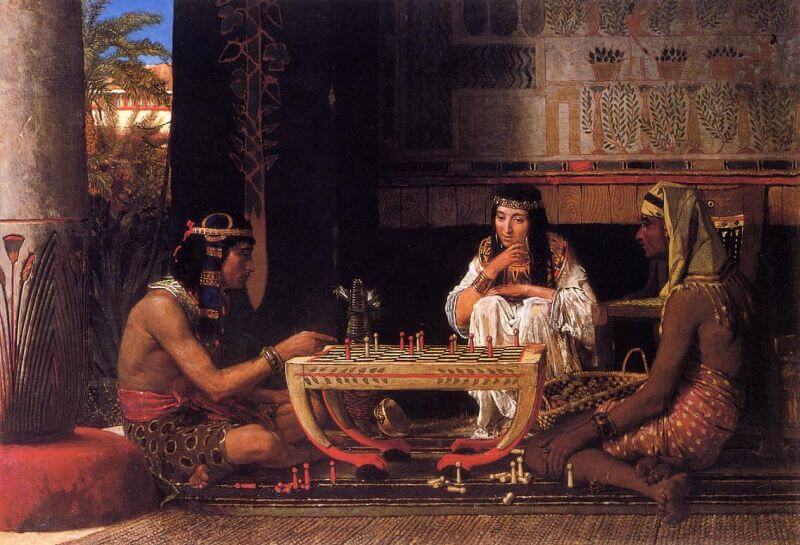
During the summer of 1864, Lawrence met Ernest Gambart, one of the world’s most influential publishers and art dealers. Gambart was very impressed with Lawrence’s works, especially the painting made in the popular Egyptian trend of Egyptian Chess Players (1865). Gambart appreciated the talent of the Dutch painter and arranged for the exhibition of three of Lawrence’s works in London. In 1865, Lawrence travelled temporarily to Brussels, where he was awarded the order of Leopold for special services to the country.
On May 28, 1869, Paulina, the painter’s wife, died unexpectedly in ill health. The death of his wife left him depressed and he ceased his career as a painter for four months. Sister Artje, who lived with Lawrence’s family, helped look after her 5- and 2-year-old daughter and looked after the home. She stayed with her family until 1873 when she got married.
In the summer of 1869, the painter had health problems. Doctors in Brussels were helpless and unable to diagnose the disease. Gambart suggested that Lawrence travel to England to consult with local specialists. In December of the same year, the painter was in London, where he was invited to his home by the painter Ford Madox Brown. There he met his 17-year-old daughter Laura Teresa Epps. He fell in love with her at first sight.
Moving to England
The outbreak of the Franco-Prussian war in 1870 forced the painter to move to England that year. As it turned out, he was to remain there until his death. Laura Epps and Gambart were of great importance in making the decision to move, according to whom it was a big step forward in the artist’s career. As Lawrence Alma-Tadema himself stated, he had always had a special fondness for England, where his paintings were bought and he found his real home. He arrived in London with his daughters and sister in September 1870.
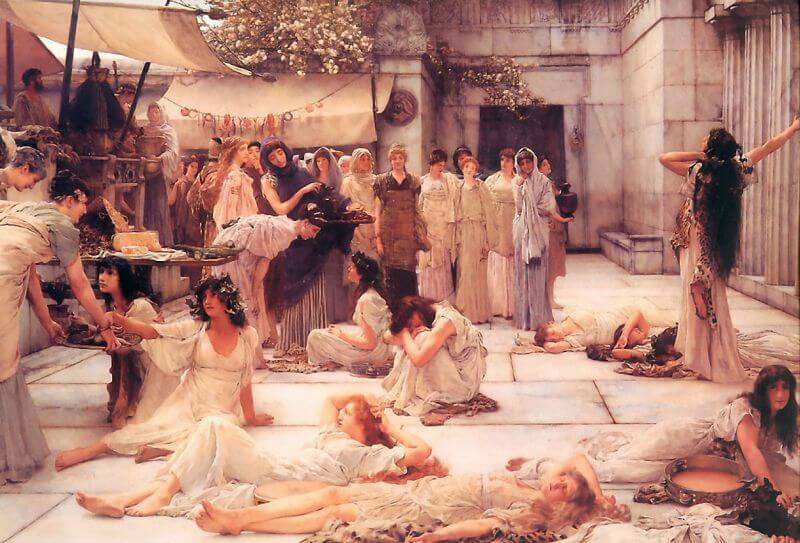
Practically immediately after arriving, he proposed to Laura to learn painting, during which he took up the topic of marriage. As he himself was about 34 years old, and his chosen one was only 18, the girl’s father was against the idea of marriage. Ultimately, however, he agreed, on the condition that they must both get to know each other better. The wedding took place in July 1871. Laura has frequently appeared in Alma-Tademy canvases, such as the Amphissa Women painting. The painter’s second marriage was very successful.
Victorian painter
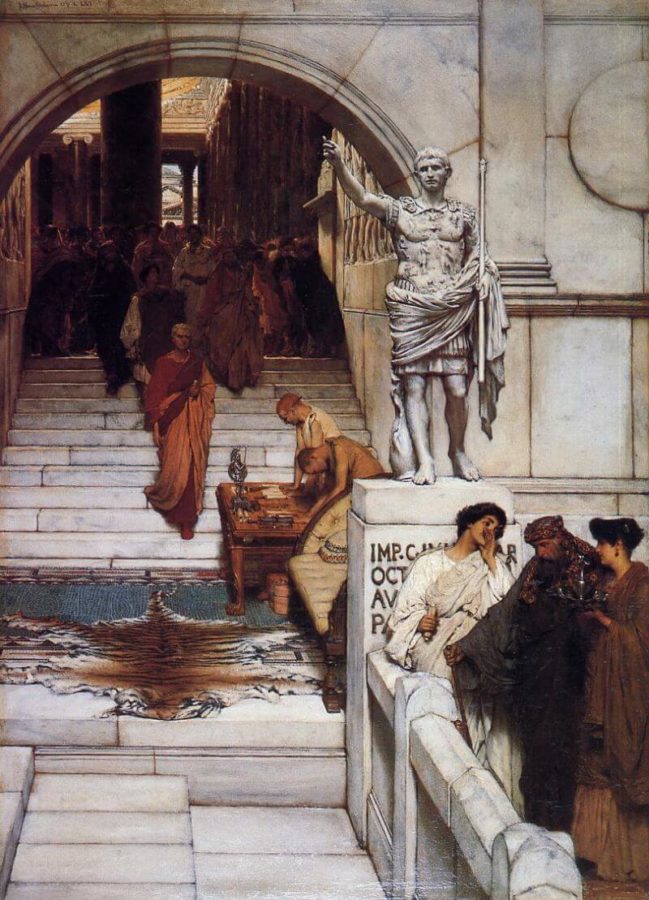
Along with his move to England, the painter’s career gained momentum. He quickly became one of the most famous and best-paid artists of this period. His creations became brighter and more colourful. One of the most important paintings was An Audience at Agrippa’s (1876). Once upon a time, the buyer liked the painting so much that he offered a large amount for a painting on a similar subject. Lawrence then simply turned the emperor over and gave the title After the Audience.
In 1882 the Grosvenor Gallery in London exhibited 185 works by Lawrence. A year later, the artist went to Rome, and then Pompeii, where extremely important excavations were carried out. Every day he looked at and absorbed knowledge from the excavated ruins of the city. The time he spent there allowed him to broaden his knowledge and increase interest in the world of ancient Romans. One of the most interesting paintings on the Roman theme was Roses of Elagabalus (1888). The work shows us an orgy during which Elagabalus suffocates guests with rose petals falling from the top of the room. Other images are: Earthly Paradise (1891), Unaware Rivals (1893) Spring (1894), Colosseum (1896) and Baths of Caracalla (1899).

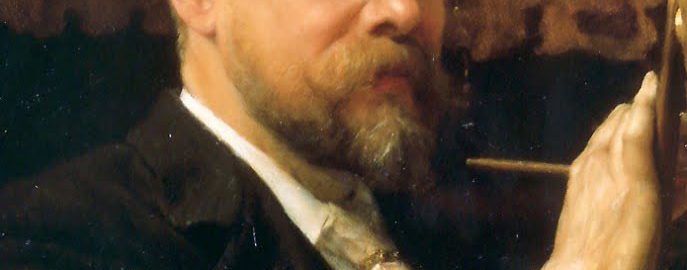
In addition to historical topics, the author also created portraits (eg of Ignacy Jan Paderewski) and landscapes; he also painted a self-portrait.
Late years and death

On August 15, 1909, at the age of 57, Lawrence’s second wife died; thus the painter outlived his two spouses. His last great work was the painting Preparation in the Coliseum (1912).
In the summer of 1912, Alma-Tadema and his daughter Anna went to Spa in Wiesbaden, Germany, to undergo treatment for gastric ulcers.
He died on June 28, 1912 at the age of 76. He was buried in the crypt in the Cathedral of St. Paul in London.
Feedback
Lawrence Alma-Tadema was one of the greatest and richest artists of the 19th century. He was excellent in both painting and business skills. He was distinguished by a warm and extroverted attitude on a daily basis.
Lawrence has received numerous honours and awards for his artistic work. His works were distinguished by the perfectly rendered textures of materials (marble, granite), texture and reflection. In order to reproduce the buildings as realistically as possible, he repeatedly went to the British Museum, where he studied the objects. He also read numerous books where he could learn about the realities of antiquity.
He was a perfectionist in his job. For over 60 years of his painting work, he exhibited numerous paintings that showed beautiful figures in an ancient environment. He distinguished himself especially in Roman matters, to which he devoted a large part of his works. To this day, we can admire the author’s realistic visions and try to find ourselves in the world of the ancient Romans.


