If you have found a spelling error, please, notify us by selecting that text and pressing Ctrl+Enter.

Articles

Roman state existed for nearly thirteen centuries, repeatedly exerting a profound influence on the course of history. I present the history of ancient Rome in the individual articles below, which not always refer solely to the Eternal City itself but encompass the wider world of the Roman Empire.

I encourage you to submit your own articles and to report any corrections or factual inaccuracies.

Roman villa in Eigeltingen

The Roman villa in Eigeltingen, Germany, is one of approximately 3,500 Roman farms in what is today the Land of Baden-Württemberg. The area on which the farm was located is looked after by the Association for the Support of the Roman Farm in Eigeltingen.

Rebuilt farm building in Eigeltingen

Why are ancient monuments so deep underground?

Regularly, from time to time, we receive information about the discovery of ancient monuments, including those that date back to Roman times. We can see photos showing mosaics hidden a few meters below the road, pavement or the present ground level. How is this possible?

In 2020, an exceptionally well-preserved Roman mosaic was discovered under a vineyard near the city of Negrar (northern Italy)

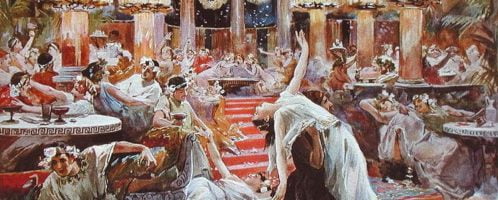
“Trimalchio’s dinner” – work showing richness of Roman feasts

“Trimalchio’s dinner” (Cena Trimalchionis) is a preserved fragment of the Roman novel Satyricon, which in a mocking and realistic way depicts Roman society from the middle of the 1st century CE. The work itself it has been preserved only fragmentarily, and to this day there are disputes about its authorship.

Ulpiano Checa y Sanz, Banquet in Nero's Palace

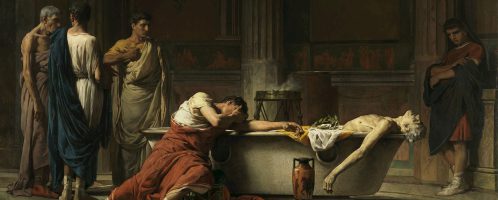
Senatus consultum Silanianum – resolution authorizing torture of slaves whose owner was murdered

During the existence of the Republic, the Senate had mainly an advisory function. However, after Octavian Augustus took power in 27 BCE, the role of the Senate changed. Since then, this institution had a legislative function, and the adopted resolutions had the force of binding law and often rewarding the upper classes. The resolution of the Senate was called Senatus consultum. In 10 CE, one of the most brutal resolutions was adopted – Senatus consultum Silanianum.

Manuel Domínguez Sánchez, Suicide of Seneca

Embankment on Hadrian’s Wall

Hadrian’s Wall, Vallum Hadriani, is perhaps the most famous of the Roman limes. It was built in the years 121-129 CE and stretched 117 kilometres in the present-day village of Bowness on the Solway Firth to the Segedunum fortress (today it is Wallsend on Tyne).

Hadrian's Wall

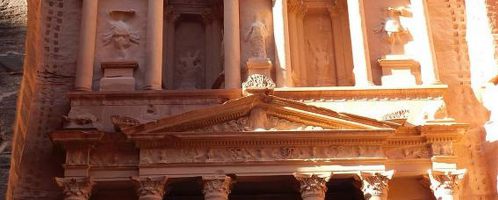
One more secret of Petra

One of the most interesting – and possibly the most beautiful – cities of the Roman Empire was the former capital of the Nabataean Kingdom: Rakmu, better known as Petra. Incorporated into the empire during the reign of Trajan in 106 CE, it became the capital of the Arabia province and began to develop dynamically.

Tomb in Petra

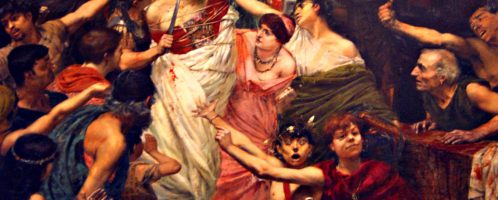
Conspiracy of barbarians – barbarian invasion of Britain in 4th century CE

According to the Roman historian Ammianus Marcellinus, an event called barbarica conspiratio (“barbarian conspiracy”) took place in the second half of the 4th century CE, which involved a simultaneous attack on Roman Britain by various barbarian tribes. It is not clear whether this was an organized action; however, it certainly severely damaged the province, which was abandoned by the Romans half a century later.

Conspiracy of barbarians

Edict of Milan

Edict of Milan (Edictum Mediolanense) was jointly issued by the emperor of the Western Roman Empire Constantine the Great and emperor of the eastern part of Licinius in 313 CE in Milan. It introduced the freedom of confession of faith in the Roman Empire.

Constantine I the Great

Spelling error report

The following text will be sent to our editors: